AUGUSTA, ME — As Maine faces widespread workforce shortages, the Maine Community College System is convening a statewide workforce attraction and development summit on November 17th for employers and other workforce experts to share ideas and come away with specific strategies and tools for Maine businesses to use right away to boost hiring and retention.
“This Summit is a powerful reflection of what’s possible when Maine’s employers, educators, and workforce and economic partners commit to solving problems together. No single organization can build the workforce Maine needs on its own,” said MCCS Chief Workforce Development Officer Dan Belyea. “It takes this kind of collaboration, and Maine’s businesses pulling in the same direction, to create real, lasting opportunity for Maine people and the future of our economy.”
The Maine Talent Summit is presented by the Harold Alfond Center for the Advancement of Maine’s Workforce, which coordinates all short-term workforce training at Maine’s community colleges, and co-hosted by the Maine State Chamber of Commerce, the state Department of Economic and Community Development, Live and Work in Maine, and the University of Maine System.
The Talent Summit will feature national speakers, a training and vendor expo, regional roundtables, and breakout sessions, all focused on the shared goal of strengthening Maine’s talent pipeline. With an eye toward the future, the day will spotlight job outlook and data, regional and statewide workforce solutions and best practices, alongside focused tracks covering attracting workers, retaining employees, upskilling an existing workforce, AI tools and tips, how employers can stand out in a competitive market, and connecting with Maine’s future workforce.
Business owners and leaders, human resources leaders and workforce and economic development professionals are encouraged to attend.
The Talent Summit will be held at the Augusta Civic Center on November 17, from 8 a.m. to 5 p.m. Tickets are $150. Frontline workers are eligible for a 50% reimbursement through the Maine Workforce Development Compact. For more information, to reserve your spot, or to learn how your company can be part of the day, go to http://mainetalentsummit.org/2026-talent-summit.
AUGUSTA, ME — The Maine Community College System (MCCS) Board of Trustees will meet on Tuesday, August 18, 2026, via Zoom.
For additional information and instructions on how to participate in the meeting, please contact Director of Communications and Public Affairs Noel Gallagher at (207) 629-4028 or at ngallagher@mainecc.edu.
For additional information and to view the agenda (subject to change prior to meeting date) click here.
AUGUSTA, ME — Maine’s community colleges received a $5 million federal grant on Wednesday to provide specialized short-term training that prepares students for work at Maine’s small- and mid-sized manufacturers.
The grant is part of a $50 million U.S. Small Business Administration grant to technical schools and community colleges across the nation. In Maine, the funds will expand access to eight existing classes in fabrication, machining, welding, blueprint reading, quality assurance, manufacturing, and advanced manufacturing technologies at Central Maine Community College, Southern Maine Community College, and York County Community College.
More than 600 students will get the no-cost training, which is offered on a rolling basis approximately every four to eight weeks.
“This grant allows us to take training that’s already proven itself with Maine’s largest defense manufacturers and put it directly into the hands of the small shops and suppliers that keep that supply chain running,” said Maine Community College System Chief Workforce Development Officer Dan Belyea. “These are the employers who often don’t have the time or capacity to build their own training pipeline, and this project meets them where they are.”
The short-term workforce training classes covered by the SBA grant were developed by MCCS’ Harold Alfond Center for the Advancement of Maine’s Workforce in collaboration with the Maine Defense Industry Alliance to increase the number of skilled workers for high-demand defense industry jobs in Maine. The classes offered are: Technician Training (MTT), Advanced Manufacturing Technician Training (AMTT), Computer Numerical Control (CNC) Precision Machining, MIG and TIG Welding, Foundations of Machining, Maritime Pipefitting and Marine Machine Mechanic, Industrial Welding, and Introduction to Quality Assurance (QA).
Maine’s smaller manufacturing firms are a critical part of the supply chain that sustains the industry’s major employers, such as General Dynamics-Bath Iron Works (BIW), Portsmouth Naval Shipyard, and Pratt & Whitney.
AUGUSTA, ME — A new partnership among Maine’s healthcare industry leaders, Maine’s community colleges, and education and workforce organizations is expanding short-term healthcare training opportunities in Maine and helping fill chronic frontline staffing shortages in healthcare settings across the state.
“Maine’s healthcare system is strained. Rural hospitals are closing units, our population is aging faster than almost any other state, and the workforce caring for our most vulnerable Mainers is stretched thin,” said Maine Community College System (MCCS) Chief Workforce Development Officer Dan Belyea. “Long-term solutions are only possible if we work together.”
Belyea leads the system’s Harold Alfond Center for the Advancement of Maine’s Workforce, which coordinates all short-term workforce training programs for Maine’s community colleges. The Alfond Center is launching a series of sector-based partnerships as part of a bold five-year plan to train 100,000 Mainers by 2030. The first partnership was in the construction sector, and manufacturing is next.
The Healthcare Industry Workforce Partnership has 50 members. Like the other partnerships, it has steering committees and action teams that co-create short-term, skills-focused training aligned to real hiring needs.
“Sector-based partnerships like these are key to solving Maine’s workforce challenges,” said Liz Love, director of sector partnerships at the Alfond Center. “Together we’re designing industry-led training solutions that provide relevant skills, fill in-demand roles, and offer pathways to meaningful careers.”
Maine’s community colleges have been training the state’s healthcare workers for decades, offering two-year associate degrees and one-year certificate programs in dozens of fields, from nursing and emergency medical services to surgical technicians, radiology technicians, and other licensed clinicians. In recent years, the system has vastly expanded short-term programs that take only a matter of weeks or months to complete, and can move a newly skilled worker into an entry-level healthcare role even faster.
Among the new short-term training programs available in 2026-27 under this partnership are enhanced medial assisting; language and work readiness pathways; pre-apprenticeships; and more advanced emergency medical technician (EMT) opportunities.
Short-term programs are typically offered at no cost to students, with some including stipends, and are designed for people entering the workforce, people changing their careers, and incumbent workers looking to add new skills and advance in their field.
Healthcare is the system’s most popular academic program area, with the trades a close second. Last fall, 3,563 students were enrolled in degree and certificate healthcare programs, a 78% increase since 2019. Over the same time frame, MCCS vastly expanded short-term offerings, and more than 8,000 students have taken short-term healthcare training programs since 2021.
The partnership includes healthcare systems; hospitals; healthcare associations; Maine’s seven community colleges; and statewide education and workforce partners. A full list of partners is here.
“I feel incredibly fortunate to collaborate with colleagues across the healthcare and education sectors through Maine,” said Melissa McManus, director of workforce development at MaineHealth. Participating has “enabled MaineHealth to help influence the development of critical training programs. By supporting initiatives like this, we are creating pathways for career growth while advancing our visions of building the healthiest communities in America.”
The finance and facilities committee of the Maine Community College System Board of Trustees will meet on Tuesday, July 28, 2026, via Zoom.
For additional information and instructions on how to participate in the meeting, please contact Director of Communications and Public Affairs Noel Gallagher at (207) 629-4028 or at ngallagher@mainecc.edu.
For additional information and to view the agenda (subject to change prior to meeting date) click here.
Employers in Maine’s construction industry, grappling with labor shortages for more than a decade, are getting a batch of job-ready trainees this month.
A fast-track construction training program that launched this year recently graduated 25 participants across three community colleges.
Northern Maine Community College graduates gained experience in construction fundamentals, job site safety and skilled trade career pathways. PHOTO / COURTESY AGC MAINE
Maine Construction Academy’s Immersion Program is a workforce development initiative of Associated General Contractors of Maine in partnership with the Maine Community College System and the Harold Alfond Center for the Advancement of Maine’s Workforce.
The four-week program debuted this year as the latest of several workforce initiatives offered through partnerships between AGC Maine, Maine’s community colleges and industry employers, all designed to introduce individuals to careers in construction while helping employers connect with job-ready talent.
Direct employer connection
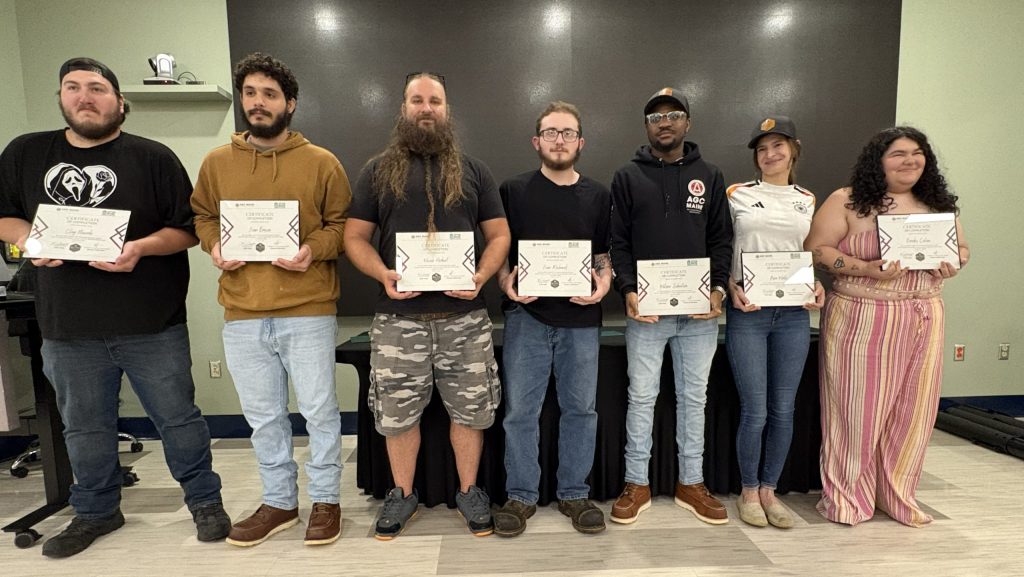
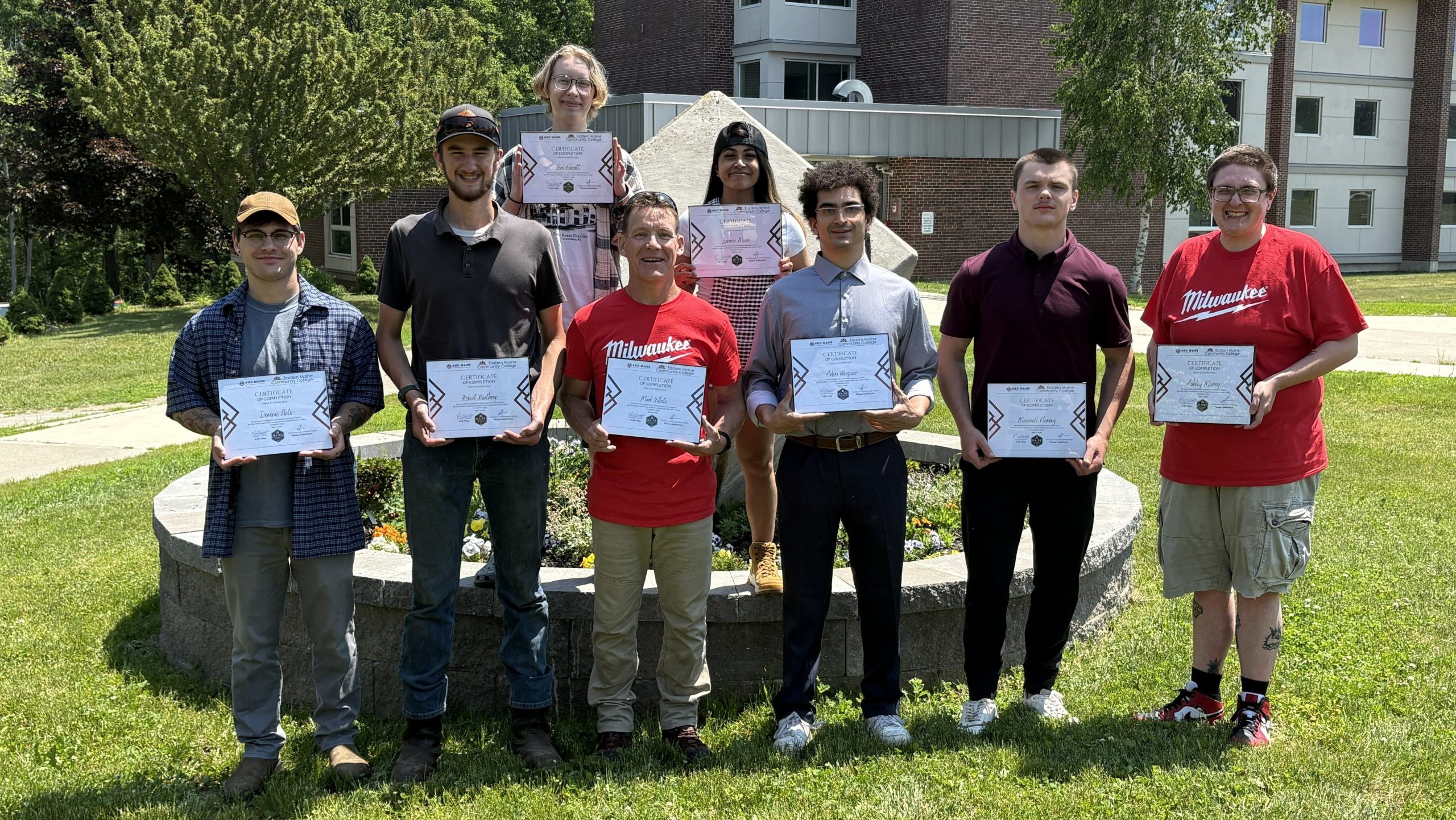
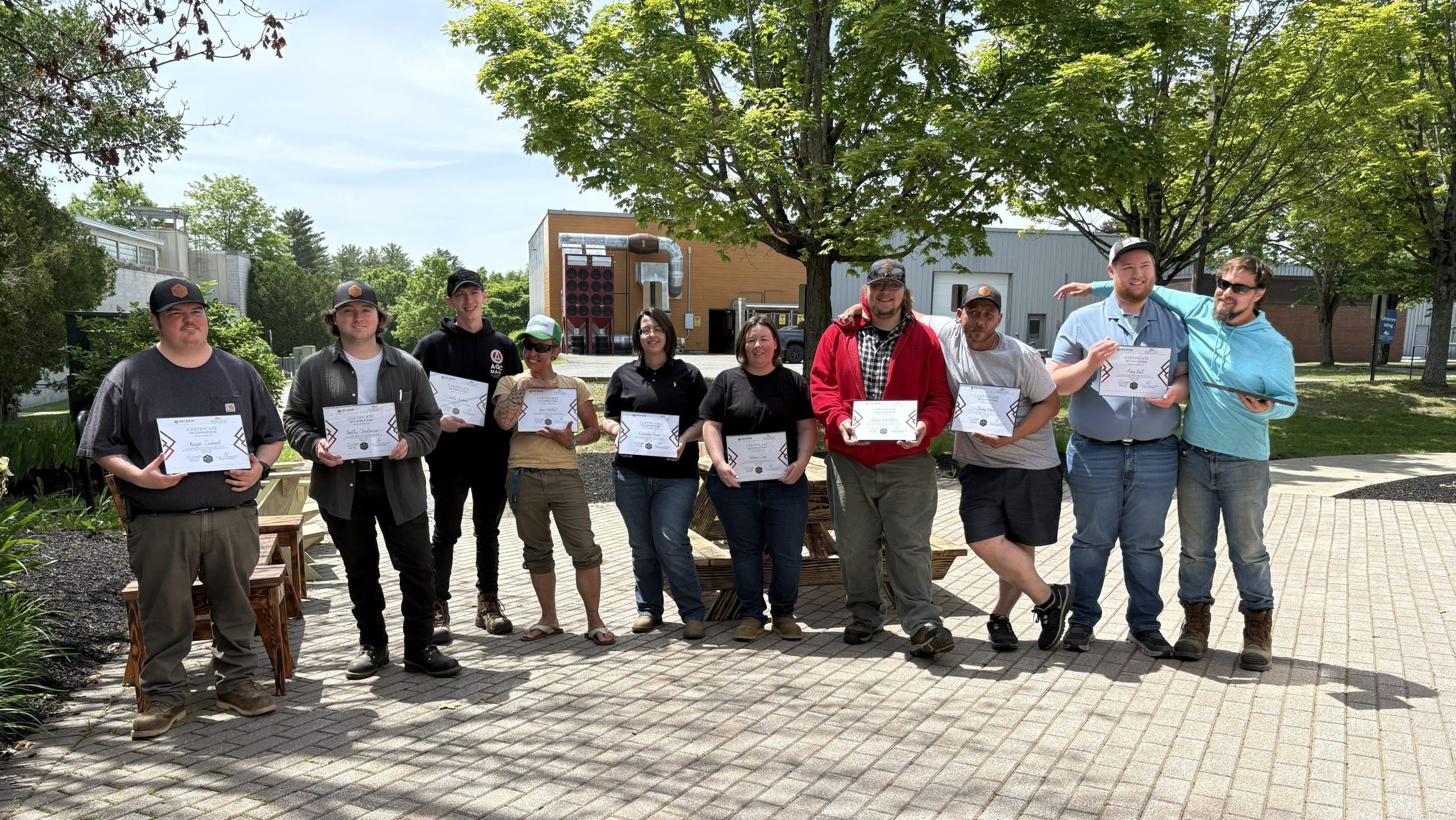
Graduates trained at Northern Maine Community College in Presque Isle, Eastern Maine Community College in Bangor and Kennebec Valley Community College in Fairfield. Training five days a week, they gained experience in construction fundamentals, job site safety and skilled trade career pathways. Graduates earned nationally recognized certifications.
Eastern Maine Community College in Bangor was one of three community colleges to graduate construction academy participants this month. PHOTO / COURTESY AGC MAINE
On graduation day, participants met with employers in structured interviews, providing opportunities to pursue employment, apprenticeships and continued training immediately upon graduation.
Graduates received a Milwaukee Tool kit, a certificate of completion, nationally accredited certifications and four college credits that can be applied toward future educational opportunities for career advancement in construction and skilled trades.
The program, managed by AGC Maine and funded by MCCS’s Harold Alfond Center for the Advancement of Maine’s Workforce, is a result of a statewide construction industry workforce partnership launched in March by the Alfond Center that included over 50 stakeholders from the construction industry, trade associations, union, education and workforce development systems.
Graduates of the immersion program at Kennebec Valley Community College in Fairfield. PHOTO / COURTESY AGC MAINE
AGC Maine represents commercial construction firms across the state. The Harold Alfond Center for the Advancement of Maine’s Workforce coordinates short-term workforce training programs for Maine’s community colleges, working with business leaders and workforce specialists statewide. The Maine Community College System has seven community colleges with the lowest tuition and fees in New England, serving more than 33,000 people per year.
Earlier this month, the Maine Community College System board announced that Susan Rogers would be the next president of Central Maine Community College in Auburn.
Rogers, a Long Island, New York, native is a chief of staff and vice president of institutional effectiveness for Dutchess Community College in Poughkeepsie, New York. She has her doctorate in educational psychology and methodology.
She will begin at Central Maine Community College on Aug. 10, succeeding Betsy Libby, who is vice president and chief academic officer for the Maine Community College System.
Can you tell me about you and your background?
I’m currently chief of staff and vice president of institutional effectiveness for Dutchess Community College, which is part of the State University of New York (SUNY) System. I’ve been in this role at Dutchess for four years, then before that, as an associate dean of academic affairs. I was a psychology professor for eight years. I loved it. I loved being a professor and working with my students so much. They inspired me every day.
What inspired you to apply for the job?
Central Maine Community College is doing amazing work, No. 1. They’ve connected academic programs to the needs of the community for years, very successfully. When I visited the campus, the sense of pride that the faculty have in the work they do to serve students was palpable. I met with students and they had so much pride in their academic and athletic programs and they felt so supported in getting exactly the kind of education they needed. When I did my research, that’s exactly what I expected to find, but when you visit in real life, you can feel it.
What can you bring from Dutchess to Central Maine?
I’ve been the person leading efforts toward more hands-on programming. In 2023, I spearheaded the opening of a mechatronic lab that trains students in electrical technology that offers both credit and training opportunities. A lot of the experiences I had there were directly relevant to the things that are very strong in Central Maine and I think that’s part of why it was a very good fit and why I was drawn to the campus and why it was drawn to me.
What made Central Maine Community College stand out to you?
I think all of the programs at Central Maine are very strong. I’m going to call out the career and technical programs. Some of those are workforce programs and not college credit earning, but some are tied directly to jobs and others to associate’s degrees that move into jobs. I toured those labs and spaces when I was on campus and the teams have done an amazing job doing hands-on learning and working with real equipment and teaching them exactly what they need to know to enter the workforce. The jobs they are getting have thriving wages and the program really gives foundational skills. I was very impressed.
What makes you such a strong advocate for technical education?
Even when I was a psychology professor, my main motivation was helping students build better lives for themselves. Sometimes, some people need a little push, while others need a lot. It doesn’t matter — faculty and staff are all about helping students. When I moved into administration and I could be more involved in developing the impact that can help with employment, I was all in. I understood how much of an impact it has to enter the workforce as a professional, or someone changing careers for real skills and dollars.
It doesn’t sound like it’s related to psychology, but it’s about support and well-being. I understand the relationship between the kind of life you want and choices you want and having the education and wage earning ability to do that. For me, that’s a big part of the motivation. Another part is that people have different talents and skill sets. The idea that everyone should be academically minded and pursue a particular kind of college education, that doesn’t fit who we are.
Do you have any plans when you arrive at the college in August?
Because Central Maine is so strong, I’m not coming in to make sweeping changes. They don’t need me to change things. What I need to learn more about and understand is the amazing enrollment boom in the Maine Community College System and the free college program. I want to make sure we are building the systems we need to be successful. I know it’s already underway, but I want to bring my expertise and background to it.
What about yourself living in Maine?
I’ve always said I wanted to live in Maine. I’ve lived in New York State my whole life, but I’ve visited Maine several times and have always loved it. My husband and I are big outdoorsy people. We love to hike, kayak, bicycle, go to up to Acadia National Park. I am very excited about exploring the outside area, the hikes in particular. Being in Auburn, I can get to the coast, to the mountains and there are rivers and lakes close by. I know I will be putting a lot into my job and balancing it with my adventures.
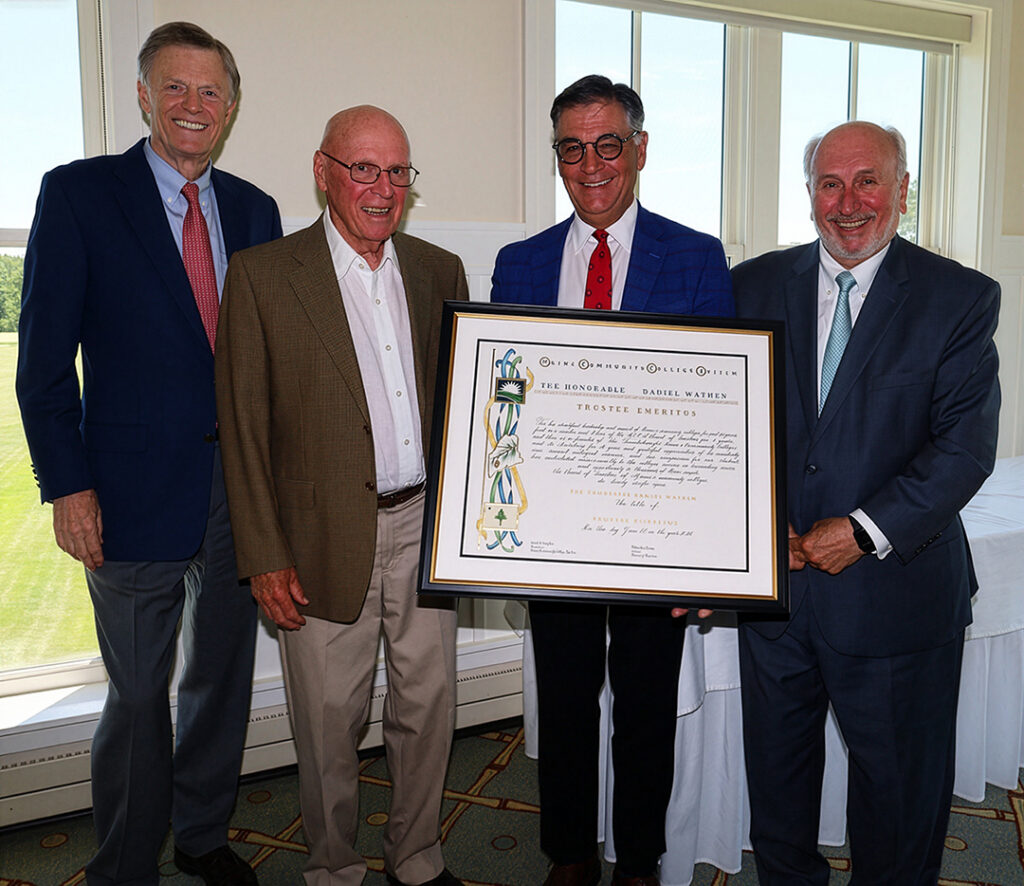
AUGUSTA, ME — The Maine Community College System (MCCS) Board of Trustees honored former Chief Justice of the Maine Supreme Judicial Court Dan Wathen on Wednesday with trustee emeritus standing for his many contributions and dedication to the students of Maine’s community colleges.
“We are very grateful to Dan for his outstanding work supporting Maine’s community colleges during a period of tremendous growth,” MCCS President David Daigler said. “His guidance strengthened Maine’s community colleges and made the state a better place through his dedication to expanding opportunities to Maine’s community college students.”
Wathen, of Easton, was appointed to the MCCS Board of Trustees in 2006 and served for eight years, two of them as chairman. During his tenure, Wathen helped establish the Foundation for Maine’s Community Colleges, serving on the foundation’s board since its founding and served as secretary for 16 years. The Foundation, as the fundraising arm of the colleges, has since raised nearly $150 million in support of student scholarships, program expansion, and new facilities and equipment.
In his remarks after receiving the citation on Wednesday, Wathen said that the Latin root for education – “educere,” which means “to lead out” – meant education is there “to lead you out of poverty, to lead you out of ignorance …. Education is an important thing.”
“I’m firmly convinced that education is the way to lead you out,” Wathen said, noting that he was the only person in his 16-person graduating class in Easton to go on to a traditional college. “If you stick with education, your past is not your future.”
“I’m very proud to have been involved” with the colleges and foundation, particularly for their focus on cultivating and supporting workforce development, he said.
Wathen is the ninth person to be named trustee emeritus in the 35 years since the title was created.
“One of the most satisfying aspects of being Governor and chairing the Foundation for Maine’s Community Colleges has been working with incredibly talented people who are driven to find effective solutions to tough challenges, who care about making life better for others. There are a number of those people here today, and Maine is an infinitely better place because of them,” said former Governor and Foundation for Maine’s Community Colleges Chairman John McKernan. “But no one in Maine has contributed more, over a longer period of time, than Dan.”
Wathen was first appointed to the Maine Superior Court by Governor James B. Longley in 1977, served four years before being appointed to Maine’s highest court by Governor Joseph E. Brennan in 1981. In 1992, he was elevated to Chief Justice by Governor John R. McKernan and he retired in 2001. Since then, Wathen has served in a variety of public service roles in Maine, recently serving as chair of the independent commission to investigate the facts of the Lewiston shooting.
Photo: Former Chief Justice of the Maine Supreme Judicial Court Dan Wathen was honored with trustee emeritus standing on Wednesday by the Maine Community College System. (l to r: Former Governor and Foundation for Maine’s Community Colleges Chairman John McKernan; Wathen; MCCS President David Daigler, and Foundation President John Fitzsimmons.)
#
The Foundation for Maine’s Community Colleges is dedicated to ensuring that the state’s seven community colleges have the resources they need to provide a high quality and affordable education for Maine people. More information about the foundation is available at: www.maineccfoundation.org.
Daigler has led the system since 2019, championing college affordability and expanded workforce training
MCCS President David Daigler
BANGOR, ME —Maine Community College System (MCCS) President David Daigler plans to step down as system president by the end of the 2026-27 academic year, he told employees Thursday.
“It’s the right time for the system, the state, and me personally,” said Daigler, who has been president since 2019 and joined the system in 2003. Daigler notified the MCCS Board of Trustees on Wednesday at their regular meeting at Eastern Maine Community College (EMCC).
Notifying the board now gives them time for a thorough search and smooth transition, Daigler said in his closing remarks at Dirigo, an annual two-day retreat for MCCS employees held at EMCC.
“We have new state leadership coming in, we have successfully made the Maine Free College scholarship permanent, our workforce programming is incredibly robust, and our leadership team is strong,” he said. “Together we have ensured that Maine’s community colleges are delivering on their promise to be affordable, accessible, and the single best way for Mainers to get the skills they need for good jobs in today’s economy.”
As president, Daigler guided the seven-college system through the pandemic without layoffs or permanent program cuts, oversaw multiple years of record high enrollments, signed historic new transfer agreements with public and private colleges and universities in Maine, and successfully collaborated with Governor Janet Mills to ensure her Maine Free College scholarship proposal became permanent, making Maine’s community colleges tuition-free for recent high school graduates for the foreseeable future. At the same time, tuition has not increased since fall 2020, MCCS employee wages have increased by 32%, and the system has consistently delivered balanced budgets.
One of Daigler’s signature accomplishments was growing a decades-old, modestly state-funded short-term workforce training program (Maine Quality Centers) into a historic $150 million grant-fueled initiative, dubbed the Harold Alfond Center for the Advancement of Maine’s Workforce, that vastly expanded the colleges’ short-term workforce training programs. Today, the Alfond Center is on track to train more than 100,000 Mainers by 2030. Through this effort, Maine remains on the leading edge of a now-ubiquitous nationwide focus on two- and four-year colleges adding or increasing short-term workforce training programs to their offerings to meet the needs of an ever-changing workplace.
“David has been a tremendous leader in a consequential and difficult period, deftly handling the pressures of the pandemic, political turmoil, and dramatic swings in economic factors in Maine resulting from the pandemic,” said Peter DelGreco, chairman of the MCCS Board of Trustees. “The board could rely on his outstanding stewardship and his ability to advance a bold vision that expanded and grew the system to better serve students and the state, delivered in an authentic, personable way that invited collaboration and enthusiasm. He will be sorely missed.”
The search for a new president will begin immediately.
“It has been my greatest privilege to work alongside the outstanding people at Maine’s community colleges to make these colleges, our communities, and the entire state a more prosperous, kind, and supportive place for all,” Daigler said. “The power of education to transform the lives of those striving to improve and become more informed and engaged citizens cannot be underestimated.”
Maine’s community colleges enroll more than 20,000 degree-seeking students a year and ultimately serve more than 33,000 students annually through two-year associate degrees, one-year certificate programs, short-term workforce training, early college programs, advanced certificates, and other learning opportunities.
BANGOR, ME — The Board of Trustees of the Maine Community College System (MCCS) has confirmed the recommendation of MCCS President David Daigler and appointed Dr. Susan Rogers, a vice president at Dutchess Community College in Poughkeepsie, N.Y., as the next president of Central Maine Community College in Auburn. She will begin August 10.
“I am honored to join Central Maine Community College and the Maine Community College System at such an exciting time. Community colleges create opportunity by design, and CMCC already has strong programs, strong partnerships, and a deep commitment to students. I look forward to working with faculty, staff, students, employers, and community partners to build on that foundation and expand opportunity for the people and communities we serve,” Rogers said.
Rogers has been chief of staff and vice president for institutional effectiveness at Dutchess Community College since 2022, and previously served as interim vice president of instruction and learning. Dutchess Community College is part of the State University of New York (SUNY) system.
Before joining Dutchess Community College, she was a faculty member and division chair in the division of social sciences, sustainability, & entrepreneurship at SUNY Sullivan, earning the SUNY Chancellor’s Award for Excellence in Faculty Service in 2014. In her time at Sullivan she helped design and implement an innovative first-year-experience program focused on student belonging, engagement, and success, oversaw the expanded community presence of the culinary program, and led institutional strategic planning processes for campus and community members.
At Dutchess, Rogers led strategic initiatives focused on student success, workforce development, and institutional effectiveness. She oversaw the development and opening of the college’s Mechatronics Lab, launched its professional microcredential program, and helped create a new Office of Workforce Development and Continuing Education to strengthen pathways into credit programs. She also led the cross-campus effort that resulted in successful institution-wide reaccreditation while strengthening the college’s culture of assessment, planning, and continuous improvement.
“It’s invaluable to have a college president with first-hand experience from the classroom to the leadership team,” Daigler said. “Her focus on student success, academic excellence, employer-focused workforce training programs, her coaching skills and collaborative approach, and her experience leading major strategic initiatives will all be tremendous assets to the CMCC community.”
“The Board of Trustees warmly welcomes Dr. Rogers. Her experience, success, and enthusiasm for many of our key priorities at Maine’s community colleges make her an outstanding choice to lead Central Maine Community College,” said MCCS Board Chairman Peter DelGreco. “The Board of Trustees is very excited to see what new heights a great campus like CMCC will reach under Dr. Rogers’ leadership and vision.”
Rogers has a doctorate and master’s in educational psychology and methodology from the University of Albany, N.Y., and a bachelor’s degree in psychology from SUNY New Paltz. She also holds a graduate certificate in education research and multiple professional development certifications. She was part of the first New York State Student Success Coaching Academy cohort in 2019, which was based on a national training program by Jobs for the Future and Achieving the Dream.
Rogers succeeds MCCS Vice President and Chief Academic Affairs and Enrollment Management Officer Betsy Libby, who led CMCC as president for more than five years and first joined the college in 2006.
Central Maine Community College serves more than 5,500 students and is located in Auburn, with an off-campus center in Damariscotta. The college offers more than 50 degrees, certificates, and advanced certificates; a range of short-term workforce training programs; on- and off-campus housing options, and a robust athletic program.