AUGUSTA, ME – Twenty-six Maine community college students have been named to the All-Maine Academic Team in recognition of their outstanding academic achievement, leadership, and service.
The students receiving the award and a $500 scholarship from the MCCS Board of Trustees are:
Emma Dionne, Auburn, Central Maine Community College in Auburn
Ivy Hutchinson, New Vineyard, Central Maine Community College
Logan Levesque, Greene, Central Maine Community College
Zulma Lizarazo, South Portland, Central Maine Community College
Georgiana Baker, Frankfort, Eastern Maine Community College in Bangor
Emma Brezovsky, Bucksport, Eastern Maine Community College
Samuel Meyers,Corinth, Eastern Maine Community College
Stephanie Wright, Oakland, Eastern Maine Community College
Skye Havey, Somerville, Kennebec Valley Community College in Fairfield/Hinckley
Andrea King, Unity, Kennebec Valley Community College
Jaikari Rada-Gonzalez, Palermo, Kennebec Valley Community College
Jasmine Sanders, Augusta, Kennebec Valley Community College
Logan Bernier, New Canada, Northern Maine Community College in Presque Isle
Grace Flewelling, Easton, Northern Maine Community College
Robert Giles, Bangor, Northern Maine Community College
Ethan Thibeault,Mapleton, Northern Maine Community College
Emily Berry,New Gloucester, Southern Maine Community College in South Portland/Brunswick
Callie Chambers, Portland, Southern Maine Community College
Tyler LaFontaine, Bridgton, Southern Maine Community College
Anne Martucci,Bath, Southern Maine Community College
Jordyn Bray, Springfield, Washington County Community College in Calais
Chelsey Megquier, Calais, Washington County Community College
Nataleigh Blackman, Sanford, York County Community College in Wells
Pamela Meads, Kennebunk, York County Community College
Andrew Melendez, Berwick, York County Community College
Christos Stathoplos, Moody, York County Community College
Emma Dionne (CMCC) and Samuel Meyers (EMCC) were named Maine New Century Scholars for earning the highest scores in the state on their All-USA Academic Team applications.
Dionne was named the 2025 Maine New Century Transfer Pathway Scholar and will receive a $2,250 scholarship. Meyers was named the 2025 Maine New Century Workforce Pathway Scholar and will receive a $1,500 scholarship.
Dionne was also one of only twenty college students nationwide chosen for the prestigious 2025 All-USA Academic Team by Phi Theta Kappa. Selected from nearly 2,100 nominees, Dionne will receive a $5,000 scholarship.
Dionne was recognized for her academic achievements, campus and community engagement, and overall leadership. Dionne will be recognized during the American Association of Community Colleges’ (AACC) annual convention in Nashville in April.
The New Century Pathway Scholarship program is sponsored by The Coca-Cola Foundation, The Coca-Cola Scholars Foundation, the American Association of Community Colleges, and Phi Theta Kappa. Only one New Century Transfer and Workforce Scholar is selected from each state.
The All-Maine Academic Team is a program of Phi Theta Kappa, an international honor society for two-year colleges. Students are nominated and selected for the team by their college.
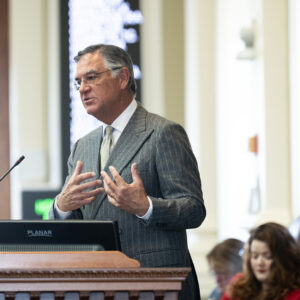
AUGUSTA Maine —Maine lawmakers have good reasons to support extending Maine’s Free College program to future high school graduates, Maine Community College System (MCCS) President David Daigler told Maine legislators on Tuesday.
“The Free College promise we have collectively made is changing lives,” he told a joint convention of the 132nd Maine Legislature. “(It) is widening the pipeline for more skilled graduates entering the workforce and increasing transfers to our four-year college partners.”
The leaders of the state’s three public higher education institutions (MCCS, the University of Maine System, and Maine Maritime Academy) all addressed the lawmakers on Tuesday. It was the first in-person “State of Higher Education” event at the statehouse since 2019, before the pandemic.
The Maine Free College program covers 100% of tuition and fees for qualifying high school graduates from the graduating classes of 2020-2025. Students must live in Maine while enrolled, pursue a degree or certificate, complete the FAFSA, and accept all state and federal aid before the Free College funds are applied. It is a last-dollar scholarship.
State funding to continue the program beyond this year’s high school graduates is in the governor’s proposed biennial budget. MCCS has also requested an increase to its base funding to compensate employees and funding to meet financial obligations under the state’s new paid medical leave law.
“Free College is an investment in our future,” Daigler said. “And for those of you in the legislature, there are real financial returns on your investment. With more college graduates, incomes rise and balancing future budgets will be just a bit easier.”
Daigler also highlighted the system’s success in diversifying revenue to support expanded short-term workforce training programs; the doubling of the system’s nursing programs; new transfer agreements; increased transfer rates; and expanded construction and manufacturing programs.
Daigler recognized several community college graduates in the audience, including:
Marilou Ranta, a 2016 Eastern Maine Community College (EMCC) culinary program graduate who won a coveted James Beard award for outstanding hospitality at her restaurant, The Quarry, in Monson.
Marilou’s son, Gunnar, a 2021 EMCC graduate who is a firefighter at Bangor International Airport.
Kristen Crowley, who enrolled while still incarcerated through a limited “Second Chance” Pell program, eventually graduating with a 4.0 GPA and being named the Washington County Community College Student of the Year.
You can read the full text of the 2025 State of the Maine Community College System here.
AUGUSTA, ME — The Maine Community College System (MCCS) welcomes construction executive Stacey Harris as its newest trustee.
Harris, of Windham, was nominated by Governor Janet Mills and confirmed by the Maine Senate. Her first Board of Trustees meeting was February 12.
Harris is a general superintendent in Consigli Construction Co., Inc.’s Portland, Maine office, where she leads field operations for the firm and manages large-scale commercial projects across market sectors throughout the region.
“I am very pleased Stacey Harris has joined the MCCS Board of Trustees, particularly now, when training students to work in construction is so critical for the state. Her experience, perspective, and guidance on how to grow and strengthen our trade programs will help us tremendously,” system President David Daigler said. “The trades, and electrical programs in particular, are hugely popular with today’s students and we’re seeing incredible demand. Working closely with employers will ensure those students are ready to step into good jobs right away.”
“Having grown up in Maine and a proud graduate of its public university system, I am honored to join the MCCS Board of Trustees and help support efforts to expand educational opportunities for learners of all ages and build the future of Maine’s trades workforce,” said Stacey Harris. “Maine is filled with talented, hardworking individuals who are ready to develop hands-on skills and explore career paths like construction, and industry leadership and partnership is critical to ensuring that students have the tools they need to succeed in the classroom, on the jobsite and beyond.”
Harris has been deeply involved in higher education professionally and personally. Since 2016, she has managed notable Consigli projects including the Ferland Engineering and Design Center at the University of Maine, the Gordon Center for Creative and Performing Arts at Colby College, and Bowdoin College’s Center for Arctic Studies and Barry Mills Hall. Prior to Consigli, Harris worked as superintendent at Turner Construction in Boston.
She has served on the board of directors for the University of Maine Alumni Association and for MedRhythms. An advocate for young women considering a career in STEM industries, Harris is a frequent collaborator with local high schools and workforce development organizations, including her local ACE Mentor Program Chapter, which connects local high school students with architecture, construction, and engineering employers. She is a member of the National Association of Women in Construction (NAWIC) and the Society of Women Engineers (SWE).
Harris has an MBA in global enterprise management from Rensselaer Polytechnic Institute in New York, and a bachelor’s degree in civil and environmental engineering from the University of Maine.
AUGUSTA Maine — The Board of Trustees of the Maine Community College System (MCCS) has confirmed the recommendation of MCCS President David Daigler and appointed Dr. Doug Binsfeld as the next president of Northern Maine Community College located in Presque Isle. He will begin in April.
Binsfeld currently serves as the vice president for academic and student affairs at Upper Iowa University, where he has worked since 2020.
“Dr. Binsfeld is an outstanding leader with a deep understanding of critical issues facing higher education today,” Daigler said. “His commitment to academic excellence and expanding access to underserved communities aligns with our strategic vision, and his experience in workforce development and strategic enrollment initiatives make him an excellent choice to lead the college through the upcoming years.”
Prior to joining Upper Iowa University in 2020, Binsfeld served as associate vice president of academic affairs at Northeast Iowa Community College, leading accreditation and assessment efforts there.
Throughout his career, Binsfeld has advocated for initiatives to foster community engagement, support underrepresented groups such as women in STEM, and expand student and faculty communities. In several roles he spearheaded strategic plans to achieve financial sustainability while enhancing student success.
“I am honored to be selected as president and I’m looking forward to working with the faculty and staff at NMCC to continue the excellent work taking place on campus and in the broader community,” Binsfeld said.
“I am very pleased to welcome Dr. Binsfeld as the new president of Northern Maine Community College,” Board Chairman Peter DelGreco said. “I’m looking forward to seeing him apply his experience and expertise as he leads the NMCC community to a bright future.”
Binsfeld also served as a member of the executive board of directors of the National Alliance of Concurrent Enrollment Partnerships, the accrediting body for concurrent enrollment partnerships. He was also elected to the Council on Accreditation for Two-Year Colleges.
Binsfeld earned a doctorate in adult and higher education from the University of South Dakota, a master’s degree in communication studies from South Dakota State University, and a bachelor’s degree in speech communication and Spanish from St. Cloud State University, in Minnesota. Binsfeld was selected from an initial field of more than 50 candidates following a national search. He succeeds Tim Crowley, who retired in August 2024. NMCC Academic Dean Angela Buck has served as interim president.
Northern Maine County Community College is located in Presque Isle and has an off-campus learning center in Houlton. The college has more than 770 students and offers 30-plus programs of study. The college also offers student housing, Early College, and short-term workforce training programs. It is one of seven colleges in the Maine Community College System.
AUGUSTA, ME — Leaders of the University of Maine System (UMS), the Maine Community College System (MCCS) and Maine Maritime Academy (MMA) are praising the commitment to public higher education in the biennial budget proposal released by Gov. Janet Mills today.
Together, UMS, MCCS and MMA enroll 46,695 students and educate tens of thousands more Mainers each year through short-term training, early college and extension programs. Thanks to past investment supported by Gov. Mills and the Legislature, region-leading affordability and innovation, all are experiencing enrollment growth that is outpacing that in the Northeast and the nation.
The Governor’s Fiscal Year 2026-2027 biennial budget proposal includes 4% annual increases for operations at Maine’s public universities, community colleges and maritime academy, and makes permanent up to two years of free tuition at Maine’s community colleges. The Governor’s budget also proposes funding to cover the costs related to implementing Maine’s new Paid Family Medical Leave program at public institutions of higher education, which collectively employ more than 12,200 dedicated faculty, staff and student workers in the state.
“The University of Maine System is delivering, with demographic-defying enrollment, record student retention, and unprecedented workforce and research impact,” UMS Chancellor Dannel Malloy said. ” We thank Governor Mills for recognizing the significance to the state of our public universities’ progress and putting forth a biennial budget proposal that will enable us to maintain our momentum for Maine. We look forward to working with the Legislature to make the case for the necessity of this level of investment, as well as much-needed infrastructure improvement bonding, to our ability to continue our region-leading affordability and drive even greater educational attainment and economic growth for the state.”
“We are incredibly grateful to Governor Mills for her ongoing support, particularly in recommending Free College be made permanent. This is a powerful statement to Maine students and families that the state is investing in them to build stronger families, a stronger workforce, and a better future for all Mainers,” MCCS President David Daigler said. “This funding is critical to continue the good work happening at Maine’s community colleges, supporting our faculty, adjuncts, staff, and students.”
Since Fall 2022, there have been 17,151 Free College-eligible students who have enrolled in MCCS degree and certificate programs 100% tuition free. MCCS tuition and fees are the lowest in New England at $4,156 per year. “I join my colleagues in thanking Governor Mills and her staff for recognizing the need for an ongoing commitment to higher education in Maine. Maine Maritime Academy is uniquely positioned to offer an academic experience and workforce training that propels our students into successful post-graduate careers all over the world and in Maine,” Maine Maritime Academy Interim President Craig Johnson said. “We fully recognize the financial challenges facing our state and applaud the support for both our ongoing programs and the mission-critical capital projects underway to support our students.”
Consistent with their commitment to enhanced collaboration that includes a new Transfer ME guaranteed MCCS-to-UMS admissions agreement, in September, Chancellor Malloy and President Daigler sent a coordinated budget request to the Mills Administration, conveying unified support for State appropriations increases that promote college access and affordability like free MCCS tuition and that help address rising operating expenses, which are largely driven by contractually obligated compensation costs.
“During your Administration and with your strong support, we have achieved a level of collaboration that we believe is unmatched by similarly independent two- and four-year public postsecondary systems in any other state in the nation,” the two leaders wrote to the Governor. “Your Administration has taken significant steps to reverse decades of underfunding of public higher education and Mainers are benefiting with increased educational attainment, employment, and earnings. Your final biennial budget offers an opportunity to make lasting investments that position our public systems and Maine’s families, workforce, and economy for long-term success.”
In that letter, the two public systems also noted the importance of public higher education infrastructure investment, as together, UMS, MCCS and MMA are burdened by at least $2 billion in deferred maintenance according to an independent third-party analysis.
FAIRFIELD, MAINE – Kennebec Valley Community College (KVCC) is excited to announce that for the first time in its 55-year history, lodging will be available for 50 first-time, full-time students beginning in fall 2025.
“We are pleased to offer an option for room and board close to campus. More and more students have been asking for local housing and are seeking to increase their community engagement,” KVCC President Karen Normandin said. “The Kennebec Valley is a great place to live, and local lodging will provide students with the complete college experience they are seeking. I expect this will be a highly desirable option for many of our students.”
With KVCC’s announcement, all seven community colleges in Maine now offer on-campus residential housing or nearby lodging options. Systemwide, the colleges currently provide housing and lodging for more than 1,600 students, out of a total enrollment of 21,385 students.
The KVCC student lodging will be located at the Best Western Plus Waterville Grand Hotel, a two-mile, five-minute drive from the main campus, located in Fairfield. In addition to lodging, a meal plan and shuttle bus service will be available to lodging students, and a resident director will be available, living alongside students.
Student rooms will have two queen-size beds, cable TV, mini-fridge, microwave, and a full bathroom. Lodging students will have access to the hotel’s indoor pool, fitness center, and lounge areas. Additional information is available online on the college’s website at kvcc.me.edu/life-at-kvcc/kvcc-lodging.
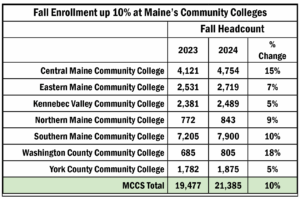
AUGUSTA, ME — Fall enrollment is up 10% at Maine’s community colleges, breaking 20,000 students for the first time and marking another historic high enrollment for the seven colleges.
“This is what happens when you intentionally and strategically make college affordable, relevant, and accessible,” said David Daigler, president of the Maine Community College System (MCCS). “This last year has been a period of tremendous growth for us, made possible by the dedication and excellence of our incredible employees and partners. Together, we’re expanding opportunities for Mainers through Free College, early college, job skills training in a breadth of industries, and excellent transfer pathways to four-year colleges.”
“We’re grateful to see this surge of interest in pursuing an education at Maine’s community colleges,” Daigler said.
Fall enrollment was 21,385 students, compared to 19,477 students last year.
Enrollment has been boosted by the Free College program, which was proposed by Governor Janet Mills in early 2022 and enacted by the Legislature a few months later. It covers 100% of community college tuition and fees for recent high school graduates.
“We’re hopeful that Governor Mills and the legislature will support the continuation of Free College, but the clock is ticking,” Daigler said. “This year’s seniors are the last to qualify for this groundbreaking program. We strongly urge all high school seniors and their families to make plans now to start their college journey tuition-free.”
Fall enrollment has also been boosted by an increase in high school students taking early college courses, increased capacity in popular academic programs, and expanded hours with more night and weekend classes. There’s also an increase in returning students from last year’s record-breaking fall enrollment of 19,477 students.
The increase in community college students is having a ripple effect, with the University of Maine System (UMS) reporting a 39% increase in undergraduate transfer students.
That MCCS-to-UMS transfer pipeline is expected to increase significantly in the coming years due to the historic Transfer ME agreement reached between the two systems this summer. The agreement guarantees automatic admission – and eliminates UMS application paperwork or fees – for MCCS graduates in transfer programs to seamlessly continue their education at one or more of Maine’s public universities.
Official fall enrollment figures do not include short-term workforce training students. More than 26,000 students have taken short-term workforce training classes since January 2022. Some of those students use short-term workforce training as an on-ramp to pursue a certificate or degree program, which in turn boosts official enrollment figures.
This fall begins the third academic year with the Free College Scholarship. Since it launched in Fall 2022, 17,132 Free College-eligible students have enrolled.
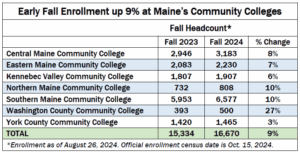
AUGUSTA, ME — Early fall enrollment is up 9% at Maine’s community colleges, putting the seven colleges on track for another historic high enrollment this year.
Enrollment has been boosted by a Free College Scholarship that covers 100% of tuition and mandatory fees for recent high school graduates, an increase in the number of high school students taking early college courses, expanded hours with more nights and weekend classes, and increased capacity in popular academic programs that traditionally had waiting lists. The colleges are also seeing more returning and continuing students from last year’s record-breaking historic fall enrollment of 19,477 students.
As of Tuesday, early fall enrollment was 16,670 students, compared to 15,334 students on the same date last year.
“All of these factors are playing a role in ongoing strong enrollment at the colleges, and we couldn’t be more pleased that we’re able to offer more low- or no-cost educational opportunities to more students,” said David Daigler, president of the Maine Community College System (MCCS). “It’s also a reminder that the clock is ticking on the Free College Scholarship: The high school class of 2025 is the last graduating class that qualifies for the free college scholarship, so we strongly urge all high school seniors to plan for a tuition-free college experience at Maine’s community colleges.”
The Free College Scholarship, which started in Fall 2022, was intended to re-engage people whose high school and early college experience was disrupted by COVID, particularly since most community colleges serve higher percentages of first-generation and lower-income students. Since it launched, MCCS has enrolled a total of 12,625 Free College-eligible students.
New this fall are seamless transfer agreements with both public and private Maine colleges. Under these new agreements, Maine’s community college graduates are guaranteed admission to 13 four-year colleges in Maine. Over the summer, MCCS signed new transfer agreements, one with the University of Maine System guaranteeing direct admission – without having to fill out application forms, write essays, or pay application fees – to all seven universities in the University of Maine System, and individual agreements with six independent colleges guaranteeing admission to certain programs.
As more students complete their associate degrees at Maine’s community colleges, the number of transfer students going to four-year colleges is expected to increase. Already this fall, the University of Maine System is reporting a 39% increase in undergraduate transfer students.
Early fall enrollment figures do not include short-term workforce training students at Maine’s community colleges. More than 26,000 students have taken short-term workforce training classes since January 2022. Some of the students from those programs continue in certificate and degree programs, adding to the fall enrollment numbers.
Official fall enrollment figures are calculated on October 15.
This is the third academic year with the Free College Scholarship, which was proposed by Governor Janet Mills in early 2022 and enacted by the Legislature a few months later. In July 2023, the scholarship was extended to the Classes of 2024-25. Graduates in the Class of 2022 must enroll at a community college in the 2024-25 academic year, graduates in the Class of 2023 must enroll no later than the 2025-26 academic year, the Class of 2024 must enroll no later than the 2026-27 academic year, and this year’s high school seniors – the Class of 2025 – must enroll no later than the 2027-28 academic year.
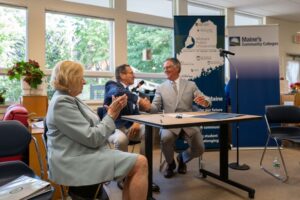
MCCS President David Daigler and UMS Chancellor Dannel Malloy shake hands after signing the Transfer ME agreement, while Governor Janet Mills applauds.
Under a new agreement, Maine community colleges will also proactively notify their students about direct transfer pathways to Maine’s public universities and provide coordinated advising
SOUTH PORTLAND, Maine — Maine’s public universities will guarantee admission to graduates of the state’s community colleges starting this fall.
Under the terms of a historic Transfer ME agreement signed today by Maine Community College System (MCCS) President David Daigler and University of Maine System (UMS) Chancellor Dannel Malloy, Maine’s community colleges will proactively notify their students about the opportunities to continue their postsecondary education through UMS.
Interested students will receive coordinated advising from the two systems and be directly admitted to UMS universities that offer an aligned program. After completing their associate degree, MCCS graduates can seamlessly transfer to a Maine public university of their choice without filling out an application, paying application fees, or providing essays, recommendation letters and transcripts.
“This partnership will make it easier than ever for Maine community college graduates to continue pursuing their education at one of Maine’s public universities, building upon my Free Community College initiative, which has enabled thousands of students to attend community college at little or no cost to them,” said Gov. Janet Mills, who participated in the announcement. “I thank the Maine Community College System and University of Maine System for heeding my calls to make it even easier for Maine students to get a great education at an affordable price with a good-paying job waiting for them in the end.”
Transfer ME builds on more than 180 existing articulation agreements that allow MCCS graduates to transfer to Maine’s public universities and have all their Maine community college credits count, with further pathways being formalized.
Notification will begin this fall to qualifying students who have earned at least 30 community college credits and are enrolled in eligible degree programs, including behavioral health, biotechnology, business, education, hospitality, human services, psychology and pre-engineering. A complete list of programs and additional information is available at www.maine.edu/students/transferME.
“Transfer ME removes barriers to opportunity. We want all Mainers to know how successful they can be at the University of Maine System and in their careers. While we have long welcomed transfers from the Maine Community College System, instead of waiting for their students to come to us, we will now reach out to them together and provide a well-paved pathway to our public universities. We think this will be a real game-changer in raising awareness, aspirations and access to affordable, door-opening bachelor’s degree programs and upward mobility,” said Chancellor Malloy.
“What students want and need is a clear-cut, simple route to a four-year degree, without a lot of paperwork and barriers. This agreement does just that,” President Daigler said. “We expect this to be an enormously popular program that increases the number of Maine community college graduates continuing their education.”
Under the leadership of President Daigler and Chancellor Malloy and in response to state workforce needs, there is a growing commitment to collaboration between Maine’s two public postsecondary systems, which together enrolled 46,942 degree-seeking students in the 2023-24 academic year as well as tens of thousands of Mainers in free early college courses, short-term training and non-credit bearing educational programs.
To ensure more Mainers can benefit from the transformative power of public postsecondary education and further strengthen the size and skill of the state’s workforce, MCCS and UMS have partnered with the Mills Administration and the Maine Legislature to advance postsecondary education access and affordability.
For example, in 2022, MCCS and Gov. Mills launched a free tuition program to encourage more recent high school graduates to go to college, including those who may not have believed they could afford higher education. Since the launch of the program, which is currently funded for graduates or the equivalent in the high school classes of 2020-25, MCCS annual enrollment has increased by 20%. It has also led to the first year-over-year increase in the number of MCCS students transferring to Maine’s public universities since before the pandemic.
Maine’s community colleges are the largest source of transfer students to UMS. In 2023-24, 737 students from MCCS transferred to UMS compared to 681 the previous year.
While Transfer ME is the first system-to-system agreement of its kind in the state, there is a history of working together that Transfer ME leverages. For example, Southern Maine Community College (SMCC) and the University of Southern Maine (USM) have long partnered to make it easier for students to transition between the two institutions. More than 125 SMCCstudents who plan to transfer to USM now live in that university’s new Portland residence hall and can participate in student life offerings there. Additionally this spring, the University of Maine and its regional campus, the University of Maine at Machias, and MCCS formalized Black BearAdvantage, a co-enrollment program.
“Maine employers need more workers with postsecondary credentials and this seamless transfer will help to ensure that more Mainers will benefit from postsecondary education and also increase the size and skills of Maine’s workforce,” said Finance Authority of Maine CEO Carlos Mello.
“I applaud the Maine Community College System and the University of Maine System for continuing to reduce barriers for students by developing seamless pathways between the two systems,” said Educate Maine Executive Director Jason Judd, a UMS graduate. “Transfer ME will lead to more students in degree programs and more graduates ready to thrive in Maine’s workforce.”
Today’s Transfer ME signing ceremony took place at the Spring Point Children’s Center at SMCC. Through a partnership with SMCC, the University of Maine at Farmington has deliveredits early childhood education bachelor’s degree program there since 2007, making it more accessible to recent community college graduates and other place-bound working adults in southern Maine.
As a result of legislation enacted in 2015 to foster greater collaboration, MCCS and UMS report annually to the Governor and Maine Legislature on their ongoing shared efforts to promote efficiency, cooperation and strategic planning. The 2024 joint report is here.
Five-year Grant Will Fund 70,500 Short-Term Workforce Students
SOUTH PORTLAND, Maine – The Harold Alfond Foundation (HAF) is investing $75.5 million into short-term, workforce training programs at Maine’s community colleges over the next five years in what is the largest grant ever for the Maine Community College System.
“This is truly a transformational investment that will directly benefit Mainers and Maine businesses across the state,” said David Daigler, president of the Maine Community College System (MCCS). “Maine faces persistent workforce shortages across all industries and age groups, and employers are desperate for skilled workers, fast. These programs, developed side-by-side with Maine employers large and small, give Maine workers free access to the skills they need to enter and progress in today’s workforce.”
The grant was announced Thursday at Southern Maine Community College. This is the third HAF grant awarded to The Foundation for Maine’s Community Colleges for short-term workforce training programs. The first, in 2018, was for $3.6 million, and the second, in 2021, was for $15.5 million. All together the three HAF grants total almost $100 million, supporting short-term workforce training for 100,000 people.
“We are very grateful to the Alfond Foundation board for their long-term vision and commitment in fueling the spectacular growth of short-term workforce training at Maine’s community colleges, particularly at a time when it is so critically needed,” Daigler said, referring to the economic disruption of the pandemic.
It was the second HAF grant, combined with $35 million in one-time, pandemic relief funds from the state through the Maine Jobs and Recovery Plan, that launched the community colleges’ robust roster of short-term workforce training programs, overseen by the system’s new Harold Alfond Center for the Advancement of Maine’s Workforce. Since 2022, more than 26,000 students have taken short-term workforce training classes through the Alfond Center.
The training has three distinct components: basic occupational skills training for people looking to enter a field or career; upgraded skills training for current workers so they keep up with evolving industry standards; and scholarships for workers looking to pursue an associate degree or certificate.
“These programs are critical to building Maine’s skilled workforce, and we’ve seen outstanding results at Maine’s community colleges in recent years. We’re proud our grantmaking will lead to so many people getting the relevant, responsive job skills so needed by our economy,” said Greg Powell, chairman of the Harold Alfond Foundation.
Short-term workforce training programs generally just take days, weeks, or months to complete, and are free or discounted for the students. They are offered on a rolling basis throughout the year, onsite at the colleges, at workplaces, online, and through third-party, industry-approved instruction.
The short-term programs are in addition to the community colleges’ traditional offerings of two-year associate degree programs and one-year certificate programs, which are largely workforce training as well. More than 80 percent of degree-seeking students at Maine’s community colleges are enrolled in career and occupational programs.
“We want to give anyone who is looking for training, at any point in their working life, the opportunity to learn new skills,” said Dan Belyea, chief workforce development officer for MCCS and the director of the Alfond Center.
One of the longest-running short-term programs is in welding, which comes with a guaranteed interview at Bath Iron Works, a $500/week “earn while you learn” incentive, and campus housing for some students. Dozens of short-term healthcare programs are also available, including four weeks-long phlebotomy classes, six months Advanced EMT classes, and nine-months long medical assistant programs.