October 18, 2023
 AUGUSTA, ME — Enrollment at Maine’s community colleges hit a historic high of 19,477 students this fall, surpassing the record set in 2011 and up 16 percent from last year.
Enrollment was boosted by a new tuition-free scholarship for recent high school graduates, expanded nursing programs statewide, more than 700 short-term workforce students moving into degree programs, and an easing of pandemic-related restrictions that expanded on-campus housing capacity.
“At a time when Maine desperately needs more skilled workers and Mainers need good jobs to support themselves and their families, we’re extremely pleased to see enrollment increase so significantly,” said David Daigler, president of the Maine Community College System (MCCS).
“These numbers show the strength of our offerings, the hard work and drive of our students, and the promise of a stronger economy for Maine as these students enter the workforce or continue on to four-year degrees and beyond,” Daigler said. “I am humbled by how hard the people at the colleges and system have worked to make the dream of a college education come to fruition for so many Mainers who want the opportunity to improve their lives through education.”
Total headcount this fall is 19,477 students, up from 16,792 students last year, according to the official tally on October 15. The previous high point was 17,911 students in 2011.
Sixty-one percent, or 8,186 students, qualified for free tuition under the Free College Scholarship because they graduated from high school or earned a Hi-SET diploma in 2020, 2021, 2022, or 2023. The scholarship covers 100 percent of a student’s tuition and mandatory fees, which is $3,750 a year for the average full-time student. That’s the lowest college tuition in New England.
Of the 8,186 Free College Scholarship-eligible students this fall, 3,668 are new students enrolling for the first time, and 4,518 are continuing community college students who were previously enrolled.
Since the Free College Scholarship program was proposed by Governor Janet Mills and enacted by the Legislature in early 2022, 11,543 Free College Scholarship-eligible students have enrolled, surpassing the administration’s target of enrolling 8,000 students by the end of the 2023-24 academic year.
“The impact of the Free College Scholarship is impressive,” Daigler said. “In its first year, it attracted a higher-than-expected number of young men and lower-income students to college. As a group they had a higher fall-to-spring retention rate than the rest of the student body. All of that is particularly noteworthy since these students had a high school experience significantly disrupted by the pandemic. We’re looking forward to welcoming the graduating classes of 2024 and 2025 to this transformative scholarship.”
In addition to offering a tuition-free scholarship, 2022-23 was also the year Maine’s community colleges added 200 seats to the nursing program; had more than 700 short-term workforce graduates enroll in degree programs; and expanded on-campus housing as pandemic-related restrictions eased.
Official fall enrollment figures do not include the thousands of students enrolled in rolling short-term workforce programs that take less than a year to complete. Last year, 12,000 students enrolled in short-term workforce programs over the course of the year. Those courses focus on tailored job skills training that prepares students for their first job or helps them advance in their career in the trades, health care, hospitality, business, and many other Maine industries. Last year, more than 700 short-term training graduates earned scholarships to enroll in a degree or certificate program.
Altogether, MCCS serves more than 30,000 students a year through early college courses, two-year degree programs, one-year certificate programs, short-term workforce training, advanced certificates, and continuing education.
September 29, 2023
Maine’s motto, Dirigo, means to lead. But two decades ago, Maine lagged the nation in one critical area: access to low-cost community college. In fact, until Maine’s technical colleges transitioned to community colleges in 2003, Maine was one of only three states in the nation that lacked a system of public, two-year community colleges.
At the same time that the state’s economy was undergoing dramatic change, shedding manufacturing and natural resource-based jobs at an alarming rate, too few Mainers had access to the education they needed to compete for the emerging jobs. In the early 2000s, only a third of Maine adults had a college degree. And only 50 percent of high school graduates were going to college.
The case for community colleges was strong.
For many Mainers — especially those place-bound by geography, work or family commitments — local, affordable access to higher education could provide them with the opportunity to begin a degree and acquire the education essential for building a more prosperous life. For Maine’s employers, community colleges across the state could mean a more highly skilled and competitive workforce.
When Gov. John Baldacci proposed legislation in the spring of 2003 to create comprehensive community colleges, 117 members of the 121st Legislature, Democrats and Republicans, signed on as co-sponsors of the bill.
By 2010, enrollment in the new Maine Community College System had increased 76 percent, making it one of the fastest growing systems of higher education in the nation. That year, convinced of the enormous potential of the colleges and their need for greater private sector support, Leon and Lisa Gorman led the effort to create a statewide foundation, one that has been chaired by Gov. John McKernan since its inception. To date, The Foundation for Maine’s Community Colleges has raised over $63 million in support of the colleges’ programs, infrastructure and scholarships.
In just 20 years, Maine’s community colleges have grown into the powerhouse its backers imagined.
The colleges have awarded more than 45,000 credentials, the vast majority of them in occupational programs tied directly to the workforce needs of Maine employers.
The percentage of Mainers with a college degree has increased from 33 percent to 48 percent.
The seven colleges have opened the door to higher education to tens of thousands of Mainers by maintaining the lowest tuition in New England.
With the University of Maine System, the community college system has developed seamless pathways that enable students to transfer easily between the two systems as they pursue four-year degrees. Today, more community college students (about 600 each year) transfer into the university system than from any other type of post-secondary institution.
The colleges have proved remarkably adept at responding to the state’s changing needs:
New offerings in wind power technology, e-car repair, water treatment and other areas are providing skilled workers to critical areas of the economy.
With an investment of $60 million from the Harold Alfond Foundation, state and federal recovery funds, and the private sector, the Maine Community College System has established the Alfond Center for the Advancement of Maine’s Workforce which over four years will upgrade the skills of 24,000 front-line Maine workers.
Under Gov. Janet Mills’ leadership and with the support of the Legislature, the Maine Community College System is providing free tuition to recent high school graduates affected by the pandemic and in the process is attracting many students who would have otherwise believed college to be out of reach.
The system’s Remote Work for ME initiative is providing occupational training to rural Mainers to deliver the skills needed in high-demand fields that increasingly rely on remote workers.
Twenty years ago, the case was made for community colleges. Today, we are proud to celebrate the powerful engines of growth and opportunity they have become, for Mainers and their families, for Maine businesses in need of skilled workers, and for a stronger state economy.
John Baldacci served as Maine’s governor from 2003 to 2011. He led the effort to establish Maine’s community college system in 2003. John McKernan served as Maine’s governor from 1987 to 1995. He served as chair of The Foundation for Maine’s Community Colleges since its inception in 2010.
September 29, 2023
Meeting with high school sophomores recently, I had to equivocate about the availability of free college; nobody is sure they’ll have the option. That’s a problem.
Over the summer, we got the amazing news that Maine’s groundbreaking initiative providing Maine high school graduates access to a tuition-free associate degree was extended to the classes of 2024 and 2025. For those of you playing along at home, that means grads from 2020-2025 are eligible. It is truly a transformational program that has attracted national attention from the Chronicle of Higher Education.
Those of us in the trenches are pushing hard for this to become a permanent fixture in Maine statute, so that parents can send their kiddo off to pre-K assured that their education is covered through grade 14.
The program simply will not meet its potential if it is subject to gubernatorial shifts or legislative reprioritization.
My high school counseling colleagues and I have talked about community colleges more in the past year and a half than perhaps the previous (sometimes considerable) years in the field combined.
Kids who never saw themselves as “college material” are legitimately going to college. Undecided students have a viable way forward: “I don’t know what I want to do, but I am going to community college to figure it out.” First-generation kids/families are finally able to consider being the first to pursue education after high school because they know it won’t be a money pit that leads to financial ruin. “Four-year college kids” who genuinely have no interest in a four-year college program now have cover to make the decision that is best for them without undue outside influence. And financially savvy kids are taking advantage of 2+2 transfer programs to cut costs, therefore amassing less student loan debt.
Maine has seven community colleges, which run literally the length of Maine, starting at York County Community College in Wells and continuing up to Northern Maine Community College in Presque Isle. The many and varied programs of study are simply mind-boggling; there truly is something for everyone. Students can even begin taking college courses – for free! – during high school.
One of the best hacks in higher education is the 2+2 model, allowing students to earn an associate degree and then transfer seamlessly to a program at a four-year college to continue on to a bachelor’s degree. Each Maine Community College System college has transfer agreements with four-year colleges that make transferring simple and straightforward.
There is also a rapidly expanding workforce development initiative at the colleges, courtesy of Maine’s favorite philanthropist, Harold Alfond. These programs take less than a year to train participants in a specific skill set to do a specific job. Cost is typically covered by a grant; in other words, also free.
All of which make it possible for Maine kids to stay in Maine for education after high school and, often, to choose to remain in Maine once educated. It is a win-win for the long-term viability of Maine and the Mainers who call it home. And you might just be able to get a skilled tradesperson to your house without a months-long wait.
We need to write this program into statute permanently. I met with some sophomores recently and had to equivocate about the availability of free college; they’re starting to think about post-high school plans and – as of right now – there is no assurance that the scholarship program will be an option for them. That is a problem.
The present transient nature of the program is an aspiration killer. Hardscrabble Maine families don’t willingly take on debt. Period. Full stop. If this program may or may not be available, would-be first generation students may or may not have their family’s support to go to college. Often, this decision is made during middle school or even earlier. Once abandoned, these hopes and dreams are rarely revisited; the die has been cast.
Maine families need to be able to count on this program all the way through their kids’ education.
Piet Lammert is a long-time (25-plus years) Maine public high school counselor and relatively new (two-plus years) independent educational consultant. His college consulting business, DiriGo! College Consulting, serves Maine students and families exclusively.
August 31, 2023
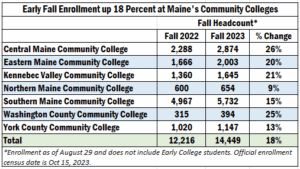 AUGUSTA, ME — Early fall enrollment is up 18 percent at Maine’s community colleges, boosted by a new scholarship for recent high school graduates, expanded programs, and an easing of pandemic-related restrictions.
“The Free College Scholarship is unleashing a new generation of skilled college graduates who are fast-tracked to join the workforce — which Maine businesses desperately need right now — or transfer seamlessly to a four-year college,” said David Daigler, president of the Maine Community College System (MCCS). “People want to learn new skills and pursue their dreams, but money can hold them back. This shows what investing in people hungry for an education can do.”
Community college enrollment nationwide dipped dramatically during the pandemic, with a 17 percent decline in 2020, according to National Student Clearinghouse data. The Free College Scholarship, which started last fall, was intended to re-engage people whose high school and early college experience was disrupted by COVID, particularly since most community colleges serve higher percentages of first generation and lower income students.
The increase in community college students is expected to result in more transfer students going to four-year colleges. MCCS, which has a long-standing block transfer agreement with the University of Maine System (UMS), is actively expanding program-level transfer agreements with individual UMS colleges and other colleges in Maine to capitalize on the influx of students and provide clear academic pathways so students can seamlessly transfer to a four-year college.
Another factor boosting enrollment is a surge of interest in short-term workforce programs that take less than a year to complete and have invigorated overall campus activity at Maine’s community colleges. Some students enrolled in either short-term or degree programs are cross-enrolling to expand the breadth and depth of their education. At Washington County Community College, residential and commercial electricity student Brandon Vinal decided to enroll in a short-term workforce program in fiber optics.
“I saw an opportunity to push myself,” said Vinal, who completed his electrical degree program this spring and is enrolled this fall in the electromechanical instrumentation technology program. Vinal wants to eventually be a licensed master electrician.
Maine’s community colleges have vastly expanded short-term workforce training in recent years due to major investments from the Maine Jobs and Recovery Plan and the Harold Alfond Foundation. In the last year, over 12,000 people enrolled in short-term workforce training programs, up from nearly 3,000 in the previous year. More than 24,000 Mainers are expected to complete short-term training through Maine’s community colleges between 2022 and 2025.
Fall enrollment was also boosted by adding more than 200 seats to the colleges’ nursing programs statewide. The colleges also lifted pandemic-related restrictions, including the student COVID-19 vaccination requirement and limiting residence halls to one student per room.
The early enrollment figures do not include high school students enrolled in Early College programs or students in short-term workforce training programs. Official fall enrollment figures are calculated on October 15. Final fall enrollment is likely to greatly increase after Early College students are added and because, unlike four-year colleges, community college students traditionally continue to enroll right up to the first day or in the first few weeks of classes.
This is only the second academic year with the Free College Scholarship, which was proposed by Governor Janet Mills in early 2022 and enacted by the Legislature a few months later. In July, the scholarship was extended to the Classes of 2024-25 under the budget passed by the legislature and signed by Governor Mills. Details about the scholarship are here.
“The scholarship has been very successful in attracting people who didn’t go right off to college in 2020 and 2021. We’ve also seen a big increase in adult learners who earned their Hi-SET during the qualifying years,” said Dr. Janet Sortor, vice president and chief academic officer for the system. “Across the state, we hear from high school counselors, parents, and the students themselves that many of these Free College students simply wouldn’t have gone to college otherwise. It finally put a great education within financial reach.”
August 30, 2023
Complete College America will work with 80+ colleges across 11 states to eliminate barriers to student success and higher education attainment
INDIANAPOLIS (AUG. 29, 2023) – Complete College America (CCA), a national non-profit organization on a mission to raise postsecondary attainment in the United States, announced today the selection of eleven state partners to join the Complete College Accelerator, an ambitious nationwide initiative to improve student success and close gaps in college access and completion. With funding from the Bill & Melinda Gates Foundation’s Intermediaries for Scale (IFS) initiative, CCA will work with eleven state agencies over the next four years to implement research-based practices designed to dramatically increase college completion on a statewide scale. The initial cohort of Complete College Accelerator states includes:
- Kentucky Council on Postsecondary Education
- Louisiana Board of Regents
- Maine Community College System
- Minnesota Private Colleges Council
- Missouri Commission of Higher Education and Workforce Development
- New Mexico Higher Education Department
- Ohio Association of Community Colleges
- Ohio Department of Higher Education
- South Carolina Commission on Higher Education
- Vermont State University
- Washington Student Achievement Council
- University of Wisconsin System
“While persistence and retention are finally returning to pre-pandemic levels at both two-year and four-year institutions, there are troubling gaps in access, completion, and career outcomes that continue to persist for students from underserved communities,” said Yolanda Watson Spiva, Ph.D., president of CCA. “As institutions and economies continue to shift following the pandemic, taking action now is critical to long-term success. Through the Complete College Accelerator, these eleven states and more than eighty participating institutions will build their capacity to scale, implement, and sustain evidence-based practices that improve college completion rates for all students.”
Utilizing funding from the national grant program, CCA will engage with higher education agencies from each Complete College Accelerator partner state to build a network of more than 80 institutions who will conduct assessments of institutional performance, build data capacity, and develop and implement strategies to improve student outcomes.
Nationally, about 90% of students from under-resourced families do not graduate within six years–let alone four. According to NASPA’s Center for First-generation Student Success, 56% of first-generation college students had not attained a postsecondary credential after six years. Research from the U.S. Department of Education’s National Center for Education Statistics shows that 6-year graduation rates for Black and Latinx students stand at 51.5%, lower than graduation rates for White students.
The Complete College Accelerator builds upon CCA’s long track record of developing the capacity of states, higher education systems and campuses to create and implement data-informed transformative policies and practices. The selection of state partners is the result of a competitive RFP process, which launched in February. Participating states were selected from members of the Complete College America Alliance — which includes senior leadership from states, systems, institutional consortia, and partner organizations — and, in turn, selected the participating institutions.
Originally launched in January 2020, the Bill & Melinda Gates Foundation’s Intermediaries for Scale Initiative is designed to help build the capacity of colleges and universities across the country to implement proven strategies for improving student success at scale. CCA is among six selected entities that will now work over a 5-year period to increase student success through institutional transformation. The members of the IFS Cohort include UNCF, American Association of State Colleges & Universities (AASCU), American Indian Higher Education Consortium (AIHEC), Excelencia in Education, and Growing Inland Achievement (GIA).
To learn more, visit completecollege.org/intermediaries-for-scale.
August 16, 2023
I’m Goldie Blumenstyk, a senior writer at The Chronicle covering innovation in and around higher ed. This week I report from Maine on the community-college system’s efforts to jump start work-force training programs for incumbent workers and those looking to begin or switch careers.
Maine bets its push on skills training can become a pathway to lifelong learning
Maine bets its push on skills training can become a pathway to lifelong learning
Yes, Maine is a great place to visit in August, but (I swear!) that’s not the only reason I ventured northeast from hot-and-muggy D.C. last week to spend time with community-college leaders, instructors, and students in South Portland and Brunswick. I went because the economic challenges Maine is now confronting offer a preview of circumstances that could be coming soon to many other parts of the country. I wanted to see firsthand how Maine has responded — and how replicable this approach might be.
Maine has an aging population coupled with a decline in young people continuing their education beyond high school. But it also has an economy still in need of skilled workers in health care, energy, defense, and other fast-growing fields (with fewer and fewer low-skilled jobs available). The state has a sizable population of other adults who’ve become disengaged from work — an “under-skilled and untapped labor pool” in the words of David Daigler, president of the Maine Community College System — that could easily move up the economic ladder with even a little additional education and training.
None of that lends itself to a casual approach. “We need to be more efficient in getting students to jobs,” Daigler told me.
Two big infusions of money in 2021 have helped finance Maine’s new emphasis on what Daigler calls a “real skills for real jobs” approach: $35 million from the state (a portion of its federal American Rescue Plan dollars) and $15.5 million from the Harold Alfond Foundation. Maine also created a new partnership program to engage with employers — the “Workforce Development Compact” — which encourages them to provide training to their incumbent workers by covering half the cost, up to $1,200 per employee.
While job training is the focus for the programs supported by these and other work-force funds, the system is also hoping the approach will eventually translate into something even more holistic. The programs are creating “another pathway to college,” Daigler said. “This is literally a stage for lifelong learning.”
It’s too early to say whether the strategy will play out that way, but from the looks of things, the first act is paying off.
Already more than 1,200 employers have signed onto the compact, and more than half of them have spent a total of $8.5 million (some of it later reimbursed) to provide training for nearly 9,800 employees. Maine’s two big health systems and the shipbuilder Bath Iron Works are among the biggest partners. Notably, the community-college system has provided only about one-quarter of the training; the rest has come from other providers. But the system still expects to benefit, as I explain below.
The system has also enrolled another 3,000 students in dozens of “pre-hire” programs, like the nine-month medical-assistant program I visited at Southern Maine Community College, in South Portland, where students were practicing injections on a dummy patient, and the three-week Marine Design course I popped into at the college’s Brunswick campus, where students using CAD software were learning some of the basics of ship design. Students who complete the course are guaranteed an interview at Bath Iron Works. (While there, I also took a turn at the campus’s welding simulator, complete with a VR headset. That was cool, but let’s just say it’s a good thing I’m not the one building ships.)
Maine has so many job-training programs running right now that are free or at a low cost to students — some with stipends to students covered by the community-college system, some paid apprenticeships funded by employers, some considered pre-apprenticeships — I honestly started to lose track.
But what I saw and heard left a big impression. Here are four thoughts:
The programs are opening doors to economic opportunity, thanks in no small part to the stipends and salaries that often are attached. At all the classes I visited, I met students eager to improve their career prospects. Among them: a young mother who never attended college and left her job at a cellphone company to train for six weeks and become a phlebotomist; a 12-year restaurant cook in the Marine Design course hoping for a “more family friendly” job; and a former document-scanner in a medical office now training to be a medical assistant after seeing one of the system’s “Earn While You Learn!” flyers in the kitchen where he worked.
The programs are reaching students who aren’t traditional college age: 62 percent are over the age of 35. More than half have a high-school diploma but no college degree.
The compact and other efforts are fostering deeper partnerships between the college system and employers. Yeah, college leaders often make such boasts, but the Maine folks insist that their partnerships are more than talk. Jim Whitten, dean of work-force development at Southern Maine Community College, said he now meets quarterly with MaineHealth officials to ensure he understands their coming staffing needs, like plans to offer certified nursing assistants courses that could prepare them for more advanced roles, and meets weekly with leaders at Bath Iron Works. The defense contractor, a subsidiary of General Dynamics, has even begun to share confidential information with the college about its production plans (it has contracts to build destroyers for the U.S. Navy) so the two can better coordinate on training.
Thomas Stevens, director of training at BIW, told me the relationship was akin to “a very functional family,” where the system can provide training for almost everything he needs. The ship builder now employs 6,500 people and expects to hire 1,000 people a year for the next five years in response to growth and retirements. The college system, he said, “really wants to understand what our challenges are.”
As I was speaking with Stevens in the lobby of Southern Maine’s Brunswick campus, I glimpsed another angle of that partnership as a visitor swung by to say hi. It was Charles Krugh, president of BIW, heading to speak at a Southern Maine leadership class for new BIW managers. The class is one of the training programs for incumbent workers funded by the compact.
The Workforce Development Compact is creating opportunities for more-lasting connections with students. Although community colleges aren’t offering most of the incumbent-worker training, the system is still hoping to benefit as it provides overall coordination for those programs. One way it does that is by withholding 20 percent of the reimbursements it owes to employers until they provide some basic demographic data on each employee trained. With that information, the system can follow up with the employees about enrolling in credit-bearing courses. Those employees are also eligible for 50-percent discounts on tuition.
The replicability of this program — and even its long-term sustainability — is still a big question mark. The federal money funding many of the pre-hire programs was a one-time infusion of cash, and the Alfond Foundation money is also due to run out by the end of 2025. Then what? The system isn’t sure. The foundation had previously given the system $3.5 million, so college leaders are hoping that the training program’s successes will encourage further Alfond support. College and state officials have also begun talks with their representatives in Congress, with an eye on attracting some U.S. Department of Defense funding, given the strategic importance of training future employees at BIW and at the nearby Portsmouth Naval Shipyard, which is responsible for modernizing some of the Navy’s nuclear-powered submarine fleet.
Apart from these efforts, Daigler said he thinks the relationships the colleges are developing now with employers and broader trends in the economy — especially, in this region, the shortage of workers — will encourage more employers to step up.
Nationally right now, for every 100 jobs, there are about 75 available job seekers, according to the U.S. Chamber of Commerce. In Maine, it’s only 50 job seekers per 100 jobs. I’ve never been all that convinced that there are enough enlightened employers out there to make a big dent in the system, but Daigler said demographic and economic shifts are changing those dynamics. “Our relative work-force shortage,” he said, “is changing that mindset.”
If he’s right, Maine could be a model for other states where the populations are aging but the needs aren’t going away.
August 3, 2023
Short-term workforce training programs at Maine’s community colleges are the centerpiece of a series of articles published by The EvoLLLution, part of the Modern Campus portfolio. The articles offer an in-depth discussion on various aspects of our short-term workforce programs and how to connect those students to degree and certificate programs for lifelong learning that is relevant, accessible, and affordable for everyone.
WORKFORCE DEVELOPMENT: Serving 1000 Employers Through Short-term Programming
The workforce is looking for employees with the right skills to fill their talent gaps, which opens up a key opportunity for higher ed. But to deliver the right employees, it’s critical to deliver the right programming that will meet workforce needs. In this interview, Maureen O’Brien discusses the need for short-term training offerings, the challenges that come with delivering them and how Maine Community College System is serving over 1000 employers in their communities. With Maureen O’Brien, Workforce Development Coordinator, Maine Community College System.
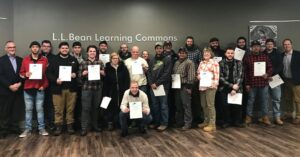
Recent graduates of the Manufacturing Technician course offered at SMCC in partnership with General Dynamics Bath Iron Works.
WORKFORCE DEVELOPMENT: What It Takes to Create Short-Term Workforce Programming
As the talent gap continues to grow, higher ed and industry need to work closer together to meet both employer and learner needs. Today’s learners need high-quality short-term programming to stay relevant and competitive in the job market. In this interview, Michelle Hawley discusses what makes a program high quality, administrative obstacles that can arise in short-term programming and how Maine Community College System is delivering on its promise to students. With Michelle Hawley, Director of Statewide Workforce Advancement and Initiatives, Maine Community College System.
EXTENDING LIFELONG LEARNING: Opening Community College Doors to a 60-year Curriculum
A traditional curriculum isn’t going to cut it anymore for today’s modern learners. Instead, by providing lifelong learning, students will be able to come to an institution and take the programming they need in the moment, no matter what stage of life they are in. In this interview, Charles Collins discusses the importance of a 60-year curriculum, how community colleges play a role in implementing it and the impact it can have on the community. With Charlie Collins, Deputy Executive for Workforce Training, Maine Community College System.
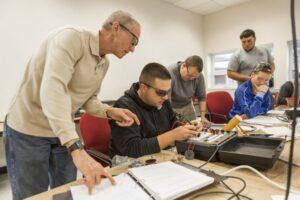
A nine-month electrician’s tech program is one of the short-term workforce programs available.
PROGRAM PLANNING AND DESIGN: What Goes Into a High-Quality Short-Term Program
As microcredentials continue to gain popularity in higher ed, institutions need to understand that they can’t be produced in a day. Strategy and careful planning are required to deliver something modern learners will be able to use. In this interview, Joseph L’Africain discusses the need for high-quality programming, what goes into it and associated challenges that higher ed leaders can encounter. With Joseph L’Africain, Director of Instructional Design and Assessment, Maine Community College System.
MARKETING AND BRANDING: The Evolution of Marketing in Response to Short-Term Offerings
Marketing today isn’t what it was ten years ago—especially with the increasing demand of short-term offerings. Simply marketing to a traditional-aged demographic won’t cut it anymore, and students know what they’re looking for from an institution. It’s critical for higher ed leader to be tuned into what’s being asked of them. In this interview, Heather Douglass discusses the evolution of marketing in higher ed, the challenges marketers still face and how Maine Community College System is able to market their offerings to serve 1000 employers in the state. With Heather Douglass, Director of Workforce Communications, Maine Community College System
July 26, 2023
The Maine Department of Education has placed advisers on community college campuses to help students bridge the gap between adult education programs and colleges.
Carolyn Haskell, college and career success coordinator at Kennebec Valley Community College in Maine, heard from a concerned academic adviser at the college earlier this year that a student might be underprepared for an upcoming English 101 course.
College and career success coordinators working at Maine community colleges gather for a summer retreat.
Maine Department of Education
Haskell reached out to the struggling student and connected her with virtual tutoring through an adult education program. When the student decided she wasn’t ready for college-level work and needed to withdraw from the course, Haskell went with her to the adult education center nearest to her home so she could enroll in college preparatory classes. The student now plans to re-enroll in the English class in January, and Haskell and staff members at two different adult education programs are providing her with academic support.
“I think it’s much less likely that we’ll lose her completely,” Haskell said of the student.
Haskell is one of seven college and career success coordinators across the state, one on each campus of the Maine Community College System. They were hired as part of an initiative begun last summer by the Maine Department of Education and the community college system to bridge the gap between adult education centers and community colleges in the state.
Coordinators at the adult education centers offer academic and career advising to any current or prospective student in need of their services, but they specialize in helping students and graduates of adult education programs to transition to and persist in college. They also help underprepared college students take advantage of adult education resources, such as free or low-cost college preparatory and English language courses. Over the last year, coordinators have worked with 1,950 students and counting.
The coordinators are paid for through the Maine Jobs and Recovery Plan, an effort by Governor Janet Mills, and approved by the state Legislature in 2021, to invest $1 billion federal COVID-19 relief dollars to boost the local economy. The initiative is budgeted to receive $2 million over two and a half years, and state education officials are currently working on plans to keep the roles going into the future.
Lana Sawyer, state education representative at the Maine Department of Education, noted that the majority of students in adult education programs who pursue higher education go on to community colleges.
“So, adult education and the community college working together is a way that we can more holistically support learners, she said.
Southern Maine Community College introduced the first coordinator position in 2019, and the success of that role led to the larger statewide effort that began last year.
Paul Charpentier, vice president and academic dean at Southern Maine, said the state’s adult education programs are typically located at high schools, unlike some other states that base these programs on college campuses.
“We’ve always had a problem when we refer students to adult ed—the referral doesn’t work very well because they’re not here,” he said. “You can’t walk [students] over to somebody.” But now students have a direct connection to adult education programs through the coordinators, “and they provide different supports than we do.”
He said the timing of the statewide coordinator program is opportune. The state launched a temporary free community college program last year for prospective students with either a high school degree or equivalent who graduated in 2020, 2021, 2022 or 2023. These students can attend Maine community colleges for two years with all tuition and fees covered after state and federal financial aid. The program went into effect last summer and was recently extended for another two years for high school graduates in 2024 and 2025.
The adult education graduates taking advantage of free college will now have additional support through the coordinators—and so will their younger peers. Charpentier noted that free college has led to “an influx of students who aren’t all perfectly ready for college” at Southern Maine, so having extra supports available to them via adult education experts helps.
Bethany Huoppi, college and career success coordinator at Northern Maine Community College, said she’s worked with 18 students who transitioned to college from adult education programs and 11 prospective and current college students referred to adult education services so far, in addition to the other students she advises. She’s guided some college students into free adult education courses this summer, including a new adult education chemistry course, developed to fulfill a requirement for the college’s nursing program.
“It’s just nice to be able to be there and have those conversations … to be able to say, ‘Hey, where can we work together to be able to help these students be able to do what they want to do?’” Huoppi said.
Benefits of Building Bridges
More than a million adults were in state-administered adult basic education, adult secondary education and English as a second language programs in 2018, according to the National Center for Education Statistics. A report by the Urban Institute cites a 2013 U.S. Department of Education estimate that only 3 to 6 percent of adult education students transition to higher education and earn any kind of postsecondary credential.
Maine adult education programs awarded at least 1,000 high school credentials to adult learners last year alone, according to a press release from the Maine Department of Education. Yet these learners are often overlooked as a potential recruitment pool by higher ed leaders, even as colleges are struggling to recover from enrollment declines related to the pandemic, said Rachel Pleasants McDonnell, a director at Jobs for the Future, an organization focused on helping college and workforce leaders create equitable economic outcomes for students. Jobs for the Future launched an initiative in 2011 to work with a handful of states to improve their pipelines from adult education programs to community and technical colleges.
“These are students that have already made a commitment to education,” she said. “They often are very motivated students with a strong desire to learn.”
She noted that college systems and states have used various strategies to smooth the transition from adult education programs to college, including enrolling students in credit-bearing college courses while in adult education programs, allowing adult education coursework to replace remedial coursework, training college instructors to better serve these students and offering targeted financial supports. Having coordinators on college campuses, as Maine does, isn’t unheard-of, but it isn’t widespread, either, she said.
“We know through a lot of research that having a dedicated person can just make a huge difference in helping people navigate between systems,” she said.
Students in adult education programs face heightened barriers to enrolling and persisting in college. Sawyer said they have diverse needs because adult education programs are so varied. Some people attend these programs to prepare for high school equivalency exams because they dropped out of high school or graduated from high school, and sometimes college, in another country. Others are taking workforce training classes or courses to bolster their English language proficiency or study skills.
Sawyer noted that some students come to adult education programs with “not great experiences” from high school.
“Maybe that was the reason that they dropped out,” she said. “So, then continuing on with their education might be quite scary for people, and they might not feel ready for it.”
She added that many of these learners are first-generation students, or immigrants wanting to earn American degrees in professional fields they’ve already practiced in their home countries, and they need help navigating the community college system.
Adult education students are also often older than traditional-age college students and are more likely to have family or work responsibilities competing with college, Huoppi noted. She said part of her job is talking with students to figure out, “how can we make this work?” Sometimes the answer is taking classes part-time or online, or it can mean connecting students with resources, such as free laptops or scholarships. Huoppi tries to be a “one-stop shop,” whatever the need.
Sawyer emphasized that college students from any educational background can benefit from coordinators’ ties to nearby adult ed hubs. She noted that because so much of Maine is rural, some college students live far away from their campuses and might have long commutes or take courses online. For some, it’s easier to go to local adult education programs for tutoring help or other services. Coordinators can help make those connections.
“I don’t think a lot of people know that you can have that dual support,” Sawyer said. “It doesn’t have to be one or the other.”
Haskell has found the skills she acquired working with adult education students more useful serving other kinds of college students than she expected. She’s familiar with working with students with social anxiety who “suffered from experiences in traditional school that they never quite got over,” and she believes traditional-age students today whose high school years were disrupted by the pandemic and the abrupt shift to online learning are now facing some similar struggles.
“I like having my feet in both worlds,” she said.
July 26, 2023
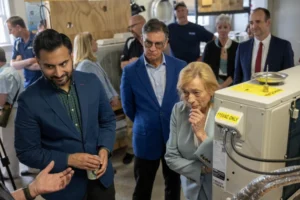
Maine Gov. Janet Mills, far right, Maine Community College System President David Daigler, center, and White House national climate advisor Ali Zaidi listen to an explanation of how a heat pump operates during a tour of Kennebec Valley Community College’s heat pump workforce training lab in Fairfield on Friday. Michael Seamans/Morning Sentinel
Maine met its goal to install 100,000 heat pumps two years ahead of schedule. So Gov. Janet Mills is raising the bar, hoping that general state and federal incentives will help Maine lower heating bills and meet its climate goals.
Maine is doubling down on heat pumps to help lower home heating bills and achieve its climate goals.
On Friday, Gov. Janet Mills announced Maine had met one of its key climate action plan goals two years early. In 2019, Mills committed to the installation of 100,000 new heat pumps in Maine by 2025. As of June, Maine had provided rebates for the installation of 104,000 pumps.
Mills said Maine is now a national leader in heat pump installation, and she wants to sustain the momentum. With White House officials looking on in approval, Mills told a small crowd gathered in Fairfield about Maine’s new goal: 175,000 more heat pumps installed by 2027.
“We are setting an example for the nation,” Mills said. “With our new and ambitious goal, we will continue to lead the way when it comes to embracing efficient, climate-friendly technologies that strengthen our economy, protect our environment, and save people money.”
Mills announced the milestone and the new target inside Kennebec Valley Community College’s heat pump service training center to underscore the job creation benefits of meeting the state’s climate goals. The community college system has trained 558 new heat pump techs to date.
Josh Breault, 25, of South China graduated from the program this year. He said he likes working in a green field. He likes helping people, too: Heat pumps help Mainers lower their runaway heating and electricity bills. And at $25 to $30 an hour, even the starting pay is good.
“It’s a good job where I get to do good,” a soft-spoken Breault told a state official Friday. “I feel lucky.”
Installers at the event were thrilled about the new goal, but say they’ll need more workers to reach it.
White House Climate Adviser Ali Zaidi attended the event, saying Maine is leading the way in greening its old buildings and is setting an example that he will be urging other states to use their federal weatherization and energy efficiency incentives to duplicate.
It can be hard to put a specific number on the emissions reductions that Maine’s 104,000 heat pumps have achieved, state officials say. It depends on what kind of heat the pump is replacing (oil, gas or electric) and what is powering the regional energy grid (fossil fuels, wind or solar).
Efficiency Maine put it like this: A typical heat pump user, who uses one pump to offset a third of the heating load of their oil-heated home, is reducing carbon dioxide emissions by 2,400 pounds a year because of that pump. That’s the pollution equivalent of three months of average driving.
Heat pumps, which usually run on electricity, essentially move heat in or out of a house, depending on the season. They can be used to heat or cool a home, something that could prove essential in years to come as temperatures climb and the frequency of heat waves increases.
Heat pumps are embraced in other parts of the world, like Japan, but their high upfront costs make them a tough sell. But the International Energy Agency warns that the number of heat pumps worldwide must more than triple by 2030 to meet global net-zero emissions by 2050.
That is starting to change in the United States thanks to $500 million in heat pump funding included in the Inflation Reduction Act. The federal government plans to use this money to subsidize heat pump manufacturing, which should lower prices, and install heat pumps in public buildings.
States are taking notice. Last year, California announced a goal of installing 6 million pumps by 2030.
Now Maine is about to get $36 million in new federal funds to bolster its heat pump plan. That funding will help Maine continue to offer rebates of $1,200, to $2,400 on two units (the federal government offers tax credits of up to $2,600), which Mills said will be essential if Maine wants to hit its new target.
Hannah Pingree, the head of Mills’ Office of Policy, Innovation, and the Future and co-chair of the Maine Climate Council, said the heat pump success story is a definite bright spot in Maine’s effort to achieve its climate goals.
“This is one of the most exciting bright spots of climate action in Maine,” Pingree said. “In part, because it was an ambitious goal and we met it, but also because it is a great example of how climate action can save people money, create jobs and strengthen our economy.”
Families that transition from home heating oil to heat pumps – the average home needs three – would save about $437 a year, based on the cost of oil and electricity in May, according to Efficiency Maine, which oversees heat pump rebates and other state energy efficiency programs.
The average payback period is a little more than six years for a typical middle-income family that uses heat pumps to heat and cool their whole home, according to Efficiency Maine. The pumps will pay for themselves even faster, in about four years, for low-income families.
This success gives Pingree hope that Maine can achieve its other ambitious goals, including those that are not coming as easily, or as quickly, as heat pump installation. Maine is lagging on electric vehicle sales, for example, although that may be due to supply chain problems.
But there are ways to do better even with heat pumps, Pingree said. She would like to see as many of the next 175,000 heat pumps as possible be installed in the homes of low-income Mainers, who often struggle the most with high energy bills, as well as towns, schools, and small businesses.
Maine’s love of heat pumps began with Republican Gov. Paul LePage, who saw them as key to reducing home heating bills. He went so far as to install 22 in the Blaine House in 2014. He used rebates to spur the installation of about 45,000 heat pumps during his tenure.
But it was the Mills administration that identified heat pumps as integral to its efforts to meet its climate goals, including the governor’s pledge to reduce greenhouse gas emissions in Maine by 45 percent by 2030 and 80 percent by 2050.
Another key difference is how they wanted to power the heat pumps, which run on electricity. LePage wanted to import power from Hydro Quebec to reduce the state’s reliance on fossil fuels. Mills wants to add renewables to the mix, such as solar and land and sea-based wind power.
In 2019, Mills signed into law the state’s heat pump target of 100,000, enhanced heat pump rebates through Efficiency Maine, and established a low-income heat pump program at MaineHousing. The plan became a centerpiece of Maine’s climate plan, Maine Won’t Wait.
Since the law was passed, at least 104,000 heat pumps have been installed in Maine. The number is most likely higher, as this number is based on MaineHousing data and the number of Efficiency Maine rebates processed. Households are only compensated for the first two pumps they buy.
Efficiency Maine estimates it is now helping about 25,000 Mainers install heat pumps every year.
July 14, 2023
College and Career Success Coordinators Provide Academic and Career Supports and Help Students Transition to College
The Maine Department of Education (DOE) and the Maine Community College System announced that current and prospective community college students across the state now have access to College and Career Success Coordinators to provide them with academic and career supports and assist them with the transition to college. Through Maine Jobs and Recovery Plan (MJRP) funding, the Success Coordinators have already served more than 1,000 students and helped nearly 400 students develop career and academic plans. More»
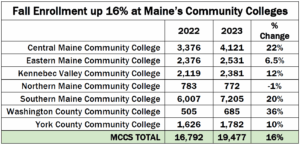 AUGUSTA, ME — Enrollment at Maine’s community colleges hit a historic high of 19,477 students this fall, surpassing the record set in 2011 and up 16 percent from last year.