The proposed budget, which would continue free community college tuition and public school investments, is being formally unveiled in a news conference this afternoon before facing public hearings and possible changes by the Legislature.
AUGUSTA — Gov. Janet Mills on Wednesday proposed a $900 million increase in state spending over the next two years to maintain the state funding for public education, expand pre-kindergarten programs, continue to offer two years of free community college tuition and increase investments in behavioral health, child welfare and services for older Mainers and people with disabilities.
The 9.6% increase is based on projected increases in state revenues and would not require any tax increases or use of the state’s reserves, or rainy day fund, according to the Mills administration.
The budget proposal also maintains revenue-sharing with municipalities, provides $46 million in funding for a senior property tax relief program enacted last year and $17 million in addition funding to increase the state’s reimbursements to municipalities for the Homestead Exemption by 3% each year until the state reaches 100%.
Additional funding is also being proposed for people who cannot afford an attorney. Mills proposes an additional $17 million in funding for the Maine Commission on Indigent Legal Services, including $3.6 million to hire 10 new public defenders, adding to the five defenders included in the previous state budget. Another $13.5 million would be used to increase hourly reimbursement rates to assigned attorneys handling more complex cases for indigent defendants.
The $10.3 billion spending package unveiled Wednesday represents as 9.6% increase over the current $9.4 billion state budget.
The spending is based on revenue forecasts that predict Maine will take in $10.5 billion in revenue during the next two fiscal years and $11.5 billion in the following two years.
Mills is formally unveiling the budget in a news conference this afternoon and will submit it to the Legislature’s budget-writing committee for hearings and possible changes.
In a written statement, she described her proposal as an investment in the state’s “greatest asset: the Maine people.”
“Every budget I have offered has sought to give Maine people the tools and resources they need in a fiscally responsible manner, and this budget is no exception,” Mills said.
The budget does not use any of the state’s Rainy Day Fund, which currently stands at $901 million — close to the statutory limit of $970 million, which is 18% of the current general fund revenue.
Mills is also expected to introduce a supplemental budget for the current year that includes a payment of $25 million to long-term care facilities, including nursing homes, and an additional $25 million in federal and state funds ($6 million) for hospitals to help recover from the pandemic.
The supplemental budget also includes $6.6 million for a one-time cost of living payment for 37,6000 retired state workers, who would receive an average benefit of $175.
Senate Minority Leader Trey Stewart, R-Presque Isle, said Tuesday that his caucus would ensure that Mills does not raise taxes, while also funding nursing homes and addressing wait lists for services for people with disabilities.
To that end, the budget proposal includes $27 million in state spending for supporting people with disabilities, bringing the total state and federal investment to $84 million. Of that, $34 million would aim to eliminate wait times for MaineCare Section 29 services, $3 million in emergency funding for Section 21 services and $42 million for cost-of-living increases for providers.
Another $78 million state funding will be spent on services for aging Mainers, bringing the total state and federal investment to $169 million. About two-thirds of that — $116 million — will be used to help long-term care facilities, including Maine veteran’s homes, recover from the pandemic.
Mills is also proposing $94 million in state funding in behavioral health, bringing the total state and federals investment in mental health and substance use disorder to $237 million.
Democrats could pass a budget without Republican support because they control a majority of seats in both chambers. But a so-called majority budget would not take effect for 90 days, which means it would need to be approved by April to prevent a government shutdown on July 1.
Getting enough Republican buy-in to adopt a budget with the support of two-thirds of the Legislature would allow the budget to take effect immediately. But Republicans in the Senate showed during the debate of Mills’ $473 million emergency heating relief proposal that they’re ready to play hardball on budgetary matters.
Democrats passed a status quo budget during the 2021 pandemic without Republican support, but later debated and passed a supplemental budget to spend additional revenue. The move angered Republicans and became fodder to attack Democrats during the last gubernatorial election.
A strong revenue forecast could prompt calls for increased spending and expanded programs, but Mills has expressed concerns about a potential recession and has called for a fiscally cautious budget.
In late November, revenue forecasters predicted a $283 million surplus in the current fiscal year. That revenue was used to help pay for the $473 million emergency winter relief plan that was approved by lawmakers on Jan. 4.
Forecasters also increased their revenue projection by another $489 million over the next biennium, projecting revenues of $10.5 billion in revenue next fiscal year and $11.5 billion the following year.
The budget includes $101 million to maintain the state’s commitment to paying 55% of public education costs and $58 million to continue providing free lunch to school students. Another $10.5 million is proposed to expand universal prekindergarten.
The budget also invests in higher education, including $15 million to continue offering up to two years of free community college for high school graduates over the next two years and an $41 million increase in funding for the University of Maine System, Maine Community College System and Maine Maritime Academy.
Additional budget highlights include:
$400 million for transportation projects that could unlock $1 billion in federal infrastructure dollars
$15 million for in child welfare investments for foster care and adoption assistance, including increases in reimbursement rates.
$26.8 million in liquor operation revenue to pay off outstand hospital debt, transitioning future revenues to the highway fund
$4 million to continue providing student loan repayment assistance for health care professions in medicine, dentistry, behavioral health and nursing.
Grow-your-own community college programs in rural communities reach nursing students who might struggle with a commute to campus
Emily Thompson was working in a convenience store in rural Maine two years ago when she met someone who changed her life.
Thompson, then 47, had recently reentered the workforce as a cashier after raising her child. A woman came into the store, worried about getting gas into her car because she had forgotten her wallet. As she helped the woman with the electronic payment app on her smartphone, she noticed her name tag: Pilar Burmeister, director of the nursing program at Eastern Maine Community College.
“Can you really get an R.N. from a community college?” Thompson recalls asking her.
Yes, she could. Not only that, she wouldn’t need to travel into the city to do it.
The nursing program at the Eastern Maine Community College in Bangor, Maine, partners with rural hospitals to provide nursing education close to home for students who would rather not come into the city. Now in its sixth year, the program is helping the community college increase enrollment in a job that’s in great demand. And it is reaching students who might otherwise struggle with transportation costs (especially during a period of epically high gas prices), family responsibilities or just a preference for staying close to home.
“It is a need in this community, and I want to work in the community where I live.” Katie Eastman, nursing student at Northern Light Maine Coast Hospital, Ellsworth, Maine
“It’s a win-win for everybody,” Burmeister said. “We get to increase our rolls. Hospitals win because they get nurses. Students win on saving time and money.”
Nationwide, hospitals are grappling with major staffing shortages. To get enough nurses to care for patients, hospitals have been shelling out extraordinary sums to travel nurses. The situation is dire in rural hospitals, which have a smaller local population to draw from and have historically struggled to recruit people to work in the more remote regions.
Eastern Maine Community College currently enrolls students who do their clinical rotations, lab work and remote coursework in three rural hospitals, and work is underway to bring the program to additional communities. The Eastern Maine staff is also helping Washington County Community College. That college, in a remote region near the Canada border, does not have a nursing program, but the model Eastern Maine developed to partner with rural hospitals will help Washington County bring nursing education to the most northern reaches of the state.
This rural focus helps community colleges train more people who are likely to stick around in the rural hospital after they graduate.
So far, most of the nurses being trained by Eastern Maine are staying in the rural hospitals that they are paired with for clinicals. It’s already saving money for hospitals. For instance, Northern Light Mayo Hospital in Dover-Foxcroft, Maine, graduated six students in the class in 2020 and five are now working there, Burmeister said. In the first nine months after their graduation, she said, that saved the hospital $360,000 in travel nursing costs.
The locally recruited nurses also get a benefit. The hot job market means they likely will have a job offer in hand as soon as they graduate, for a job that pays a good wage and benefits. And it’s a chance for local people to serve their family and friends.
“It is a need in this community,” said Katie Eastman, a student who is paired with the Northern Light Maine Coast Hospital in Ellsworth, Maine, “and I want to work in the community where I live.”
“It’s a win-win for everybody. We get to increase our rolls. Hospitals win because they get nurses. Students win on saving time and money.” Pilar Burmeister, director, nursing program, Eastern Maine Community College
The students do their clinical work and labs in the local hospital they are paired with for the duration of the two-year program. A nurse in the local hospital works for the community college to oversee the clinical work. Students take their classes online, meeting together as a local cohort in their community and Zooming in, so to speak, to watch a live class together that is happening in Bangor. The local nurse paired with the cohort is also at the Zoom class, so she can help answer questions and better connect the classwork to the hands-on training.
Dyana Gallant, an adjunct nursing instructor for Eastern Maine and a staff nurse at Millinocket Hospital, said that of the four graduates of the program’s first year, three started working at the hospital. The local training also gives the students what amounts to a two-year job interview, allowing both employer and employee to get to know each other well. And when nurses go on to the job after graduation, the transition is smooth. They already know their co-workers and where to find supplies.
“It is a huge confidence booster,” Gallant said.
The rural students must occasionally travel to Bangor for a few experiences that the community collage can’t facilitate locally, such as clinicals in in-patient psychiatric wards and obstetrics. But making that trip only a handful of times, as opposed to several times a week, makes a big difference for people who live in rural communities.
Transportation to nursing programs, which require affiliation with a hospital, can be a challenge for these students, who don’t get financial aid to pay for the kind of beating a car would take doing a long commute. Nearly 44 percent of Maine’s community colleges are located in places without access to public transportation, according to a study by the Seldin/Haring-Smith Foundation.
Finding a community college close to home was a game-changer for Thompson, who went to the city for a bachelor’s degree in English right after high school. She didn’t do much with that degree when she moved home to rural Maine. Now, she’s looking forward to May when she plans to graduate as an R.N. and leave her cashier days behind.
“It is going to be a bit of a new lease on life for me,” Thompson said. “I wasn’t making a bunch of money at the store. I liked working there. But this is a real career for me.”
‘Given the current climate, their prospects (of getting a job) are near 100%.’
AUBURN — It’s no secret that Maine needs skilled tradespeople desperately, and the pay is better than it’s ever been.
According to Classet, a company that connects industry and students to new job opportunities and paid apprenticeships in the skilled trades, a person could end up getting paid more than the average college graduate.
To acquire those skills there are essentially two paths — learning as you go in the field, slowly working your way up, or taking a two-year course in one of many fields at a community college at little or no cost. There are area companies that may pay for training or certifications on top of the already generous packages of benefits, paid time off and retirement plan contributions.
Elmet Technologies in Lewiston has a tuition reimbursement program for current employees and has about 10 who graduated from Central Maine Community College on staff.
Maine’s unemployment rate remains at just over 3% with a majority of economists saying they don’t expect the situation to change much in the next year or more. That’s because there are still more jobs open than there are applicants to fill them, which means those whose skills employers are looking for are in high demand and can command a higher wage or salary.
Construction, hospitality, health care and precision machining are some of the segments in the local economy where skilled workers are in demand. For those looking to capitalize on the demand and change the course of their career in any of those fields or others, the answer could be at Central Maine Community College.
Curry Caputo, who chairs the Building Construction Technology Program, said enrollment in the program doubled this year. That’s despite the reality that the school competes against businesses desperate to fill jobs from the same pool of students, who he said, have dollar signs in their eyes. “They want to make a profession, they want to make money out there in the field — that’s one thing that’s driving them here.”
Another motivator for students is the state’s free tuition scholarship for high school graduates from the classes of 2020 through 2023.
Students can choose from two degrees in the program, an in-house track and a job-site track. Caputo said the in-house students spend their two years in the classroom shop working on projects and in the outdoor classroom where there are five full-sized foundations on which they build full-sized houses.
Caputo said the job-site track teams students with an employer, either a large residential contractor or a commercial contractor. They work 40 hours a week, are on payroll and covered by insurance.
“The big difference is I tell them I can’t control what they teach you on the job,” he said. “They’re going to teach you what you need to know to be a successful part of their crew.”
At the end of four semesters, Caputo estimated 80% of students are getting out in the field and working for residential or commercial construction. Some go on to four-year schools, where he said one former student pursued a degree in civil engineering, while others seek out sales, design or even estimating jobs in the industry.
Others come to develop the skills so they can work with confidence on their own homes and projects, while still others use the program as part of a career change.
What are the prospects for getting a job after the course?
“Right now,” Caputo said, “given the current climate, their prospects are near 100%.”
Jacob Dwelley is a second-year student from Lincoln enrolled in the Precision Machine Technology Program. He said he likes working with his hands and wasn’t interested in a more traditional academic track.
A welding class in high school sparked his interest. At CMCC, he said he’s learned to make things out of metal. “The easiest way to describe it,” he said, “is taking a raw piece of material and cutting it down into something that can actually be used.”
What will he do upon graduation?
Go into the industry and find out what area interests him the most. He’s considering the aerospace field, because, he explains, they work with tighter tolerances, and he is considering more school after working for a few years.
Outside of school, Dwelley works at a machine shop in Bangor where the owner has a job for him if he wants it. Having choices is one of the benefits of learning a skill in high demand.
CMCC is working on a partnership with Lewiston Regional Technical Center to bring high school students to the community college campus to take precision machine technology courses. There’s also some overlap in the culinary programs.
Yes, the hospitality industry is severely understaffed, which is where CMCC’s Culinary Arts Program comes in. On a recent day, students resembled a quartet of violinists — carefully sliding knives across sharpening stones in unison. It is part of a knife skills lesson.
“We are going to be (learning) what you need to go out and work in the industry,” said Austin Perreault, chairman of the program. “Given any recipe, any technique, you should be able to know how to do it walking into any kitchen.”
Perreault said that without any training or degree, anyone can go straight into the workforce and get the technical aspect of working in a kitchen, but they won’t understand why. That’s what formal schooling gives students, he said.
What students can expect from the culinary program is basic skills, chicken fabrication, methodologies of cooking, like the five mother sauces of traditional French cooking, and some a la carte cooking experience in a kitchen. Students must also do an “externship,” usually with a restaurant of their choosing anywhere in the state.
Kaitlyn Baker is a second-year culinary student from Skowhegan. She has a very clear vision of what she wants from the program. She is part of a changing landscape in commercial kitchens and the hospitality industry in general, which Perreault agrees is opening up more and more to women in key positions.
Baker said she originally wanted to pursue criminal justice, but got a taste for culinary arts in a high school course and decided it was in her blood. “I’ve always loved baking,” she said. “Baking is my specialty. My mom always taught me growing up.”
She started a little baking business on the side and managed to bake more than 40 dozen macarons over the summer, with plans to do even more. “I’m going to Thomas (College) next year. I want to get a couple of business classes in and start my own bakery.”
Not all skilled trades require people to work with their hands. Computer aided design students, for example, work primarily with software to design plans for buildings and machinery.
“I’ve always really been fascinated with how houses look different from one another,” Peighton Theriault of Sabattus said. “I’m a really big interior design person — matching patterns and colors and everything, so I just thought it would be a good head start into the engineering world.”
Advertisement
She’s a second-year student in the Architectural and Engineering Technology Program at CMCC. Department Chairman Timothy Braun said they have a studio class that is essentially a problem-solving exercise. Students are given an assignment to design either a residence or a commercial building.
“So, the idea here is they are taking a problem, working through the problem and coming up with a solution at the end of the problem,” Braun said. “And each student has a different solution, each student has a different view.”
That doesn’t mean graduates will sit behind a computer all the time. There is land surveying, interior design and a host of job possibilities. Some students move on to four-year programs in engineering or other subjects. That’s what Theriault plans to do next year, even though her father owns a construction and landscaping business. She hopes to go to the University of Maine at Augusta and see where it takes her.
All the two-year degree programs result in an associate degree and require some basic liberal arts courses such as math and writing. Maine students will most certainly graduate with plenty of job or career options in front of them and starting pay at or above $20 an hour, plus benefits.
Hello, this is Governor Janet Mills and thank you for listening.
Well this week, I joined graduates from Eastern Maine Community College to celebrate an important milestone in their lives and careers.
Each of them graduated with an important new set of skills — skills that Maine employers are looking for. These people worked hard and earned a credential proving that they are prepared to take on an in-demand job in our economy, a job that Maine people rely on.
Some of these individuals will be collecting blood, phlebotomists, providing support to doctors and nurses and patients. Some of them will be doing the technical work that keeps our health system running smoothly. Every day, their work will help keep Maine people healthy.
Some students will work in energy, inspecting, maintaining and operating propane delivery trucks, filling propane storage containers, and making customer deliveries. Every day, their work will help keep Maine families warm.
Some of them will work as Learning Facilitators. Now that’s a program our Department of Education created with Eastern Maine Community College during the pandemic. It’s a program that supports teachers in classrooms all across the state. Every day, their work will help provide a quality education to our children.
It takes courage to be willing to learn a new skill. Some of these individuals are young single moms. Some are older workers looking to increase their skills and increase their opportunities and their pay. Look, I am proud of each of those graduates, and I know that their friends, family, and faculty are proud of them too.
I am also proud that the State of Maine was able to help. We invested $35 million in the Maine Community College System, through my Maine Jobs & Recovery Plan as approved by the Legislature, to provide free or low-cost trainings like these that the graduates at Eastern Maine Community College have just finished.
Combined with a $15.5 million grant from the Harold Alfond Foundation, over the next few years, the Maine Community College System will train 24,000 skilled workers, ready to work. That will go a long way toward helping us build the workforce that Maine needs in the decades ahead.
Separately, through my supplemental budget, we have also invested in free community college for recent high school grads to further build out Maine’s workforce. Earlier this week, we learned that enrollment in the community colleges in Maine is up 12 percent this year!
I want all Maine people to be able to experience a graduation ceremony like the one I just attended – a celebration of a new skill they someone has that will provide a better life for themselves and their family. A milestone that marks a more skilled workforce and a stronger economy in the State of Maine.
In partnership with our community college system, the state legislature, and others, my Administration will continue to push to make that goal a reality.
This is Governor Janet Mills and thank you for listening.
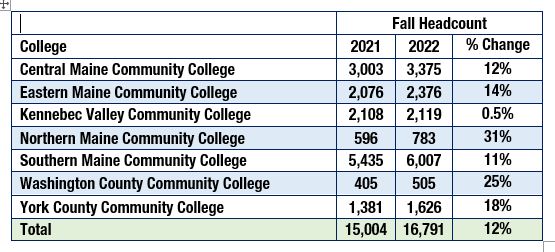
AUGUSTA, ME — Fall enrollment is up 12 percent at Maine’s community colleges, boosted by a new Free College Scholarship aimed at re-engaging people whose high school experience was severely disrupted by COVID.
“This is great news because Maine needs people with skills and education that our community colleges deliver. Free College has really opened the door for so many people who may not have otherwise pursued their interests and dreams,” said David Daigler, president of the Maine Community College System (MCCS).
Total headcount this fall is 16,791 students, up from 15,004 students last year, according to the official tally on October 15. First-time student enrollment is up 28 percent from last year.
Slightly more than a third of this year’s fall class (5,574 students) are eligible for the Free College Scholarship because they graduated from high school or earned a Hi-SET diploma in 2020, 2021 and 2022.
“The large number of high school graduates from the Classes of 2020 and 2021 really shows how the Free College Scholarship accomplished what it set out to do – draw in students who paused their education or maybe decided they weren’t going to pursue college in the midst of the pandemic,” Daigler said.
Of the Free College-eligible students, 2,481 are from the Class of 2022; 1,821 are from 2021; and 1,272 are from 2020.
“A deeper look at those Free College students reveals that 1,232 students graduated in 2020 and 2021 but had never enrolled in college before. That’s huge,” Daigler continued.
High school graduates from the Classes of 2020, 2021, 2022 and 2023 all qualify for a Free College Scholarship that pays 100% of tuition and mandatory fees after grant aid has been applied. The Free College Scholarship was proposed by Governor Janet Mills and enacted by the Legislature in the state’s most recent supplemental budget.
Current high school seniors are the last graduating class to qualify for Free College scholarships, unless the program is extended in the next legislative session. Students must pursue a two-year degree or one-year certificate full-time, live in Maine while enrolled, and stay on track for graduating on time.
“This is outstanding news for the state of Maine and for our future. I am thrilled that thousands of recent high school graduates are taking advantage of the opportunity to receive a free college education,” Governor Janet Mills said. “These students will enter Maine’s workforce with a good-paying and in-demand job that will not only help address our state’s workforce challenge, but also put them on a path to a meaningful career so they can live and raise a family here in Maine. My Administration will continue to work with our community college system to make college more affordable for every student in the State of Maine.”
Other factors that contributed to higher enrollment this fall include: expanding high-demand nursing programs; adding new, high-demand, one-year certificate and two-year degree programs; increasing outreach to high schools and adult learning centers; adding staff in admissions and advising; boosting marketing; and participating in more community and business events. The colleges also launched a new “Return, Resume, Reward” program forgiving up to $2,000 in past debt to returning students.
“We don’t want to be the best-kept secret in Maine,” Daigler said. “We’ve been doing everything we can to get the word out about the terrific programs and opportunities we offer. It’s relevant, it’s a bargain, we bring education to rural and remote corners of the state, and we are truly committed to our students’ success.”
In addition to a double-digit increase in headcount and new students, the system has a 17 percent increase in credit hours, meaning more students are taking more classes. Four community colleges have more than 20 percent increase in credit hours.
“That’s good news for students,” said Janet Sortor, MCCS vice president and chief academic officer. “Studies show that students have a much higher success rate if they enroll full-time.”
Daigler noted that there’s a major financial component to be considered as well. “We know our students come from lower income households. A scholarship covering $3,700 in tuition and mandatory fees may not sound like a lot of money, but it represents an incredible opportunity for our students,” Daigler said. “Removing that financial barrier, paired with our commitment to helping them succeed, is a huge step towards helping more Mainers get the education they need for better paying jobs that are in high demand in the current economy.”
The gender breakdown of this fall’s Free College-eligible students also points to the scholarship attracting entirely new populations who would not otherwise have gone to college. Among the Free College-eligible students this fall, men and women are about equally split 50-50. For years, before the pandemic, the gender balance was roughly 60-40, with more women than men enrolled at Maine’s community colleges, a trend seen nationwide. Re-engaging men in post-secondary education is a major educational policy goal that is needed to build our economy.
Fall enrollment figures do not include students enrolled in non-credit courses, including short-term job training programs offered at all seven colleges as part of the MCCS’ Alfond Center for the Advancement of Maine’s Workforce. Short-term workforce training has also been growing exponentially in recent years.
In total, MCCS serves more than 29,000 people a year through a broad range of two-year degree programs, one-year certificate programs, advanced certificates, continuing education, and short-term workforce training courses that take between a few weeks and less than a year to complete.
The Free College Scholarship is funded with a one-time $20 million state allocation. The expansion of short-term training programs is funded through the Maine Jobs and Recovery Plan and a grant from the Harold Alfond Foundation.
The average cost of tuition and mandatory fees at Maine’s community colleges is $3,700 a year, the lowest in New England.
At Central Maine Community College in Auburn, a high-tech mannequin named Victoria is pregnant with her baby, Tory.
Also referred to as a simulator, Victoria can go into labor and deliver the baby. Both mannequins have realistic blood pressure, pulses, bowel sounds and eyes that blink. They can be made to seem like they’re speaking.
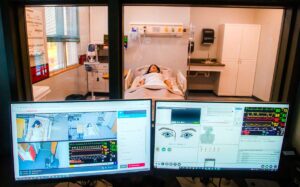
“We control the rate of labor, we have the contractions on one screen and we’ll have the fetal heart rate on another screen,” says Kathy McManus, chair of the college’s nursing program. “Students can look at how mom is doing, how baby is doing in utero – and the advantage is that we can stop and start. Those are teachable moments.”
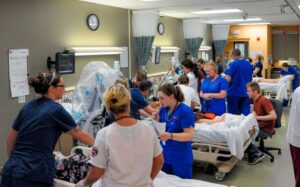
Simulators and other high-tech equipment used to train students in the health care professions are getting more sophisticated all the time.
And simulation capacity is expanding. For example, new simulation technology and simulation coordinator positions are among key elements as Maine’s community college system looks to double its nursing program to 480 students per year, thanks to a $2.5 million allocation included in Maine’s supplemental budget earlier this year and matched by MaineHealth and Northern Light Health.
The expansion is part of an ongoing effort to use simulated environments to provide near-real-world experiences to students in supervised training settings, says Jessica Dreves, chair of the nursing department at Southern Maine Community College in South Portland.
Leading institutions use advanced simulation technology to improve graduates’ competence, especially in clinically high-risk, low-occurrence situations, Dreves says.
“The technology used in a simulation lab combines real clinical gear, robotic, full-body simulators, simulation-specific monitoring, wireless controllers, communication equipment and audiovisual recording apparatus,” says Todd Dadaleares, Southern Maine Community College’s healthcare simulation operations specialist. “At times, clinical actors or standardized patients will be trained to play specific roles as a patient, family member or embedded participant to guide the simulation and/or the learners through the scenario.”
He adds, “A well-run simulation should have all the elements of a well-rehearsed one-act play.”
Debrief
Simulation has numerous benefits. Unlike real life, instructors can stop and restart scenarios, giving students time to ask questions and practice maneuvers.
The quality and ease of use of today’s simulators has improved vastly, requiring hand-held computer tablets and monitors.
“There used to be a massive computer,” says McManus. “Our first simulator had a room that ran the compressor. All the wires and the compression hoses came through the wall and hooked to the mannequin.”
Also useful is the ability to record simulations, allowing for playback and constructive critique.
Dreves says simulation is used across the Southern Maine Community College nursing curriculum in various ways.
“In our beginning semesters, simulation is a great way to safely demonstrate assessments, medication administration, interventions such as intramuscular injections and urinary catheter insertions,” Dreves says.
In later semesters, high-fidelity mannequins can simulate scenarios such as childbirth and life-threatening scenarios across the lifespan, from infant to adult, to assess how students use the nursing process and clinical judgment to intervene.
The focus on simulation picked up during the pandemic, when certain clinical areas were no longer able to accommodate clinical experiences such as pediatrics, maternity and mental health areas, Dreves notes.
New equipment costs for high-tech full-body simulators can be $60,000 to $70,000, says Dadaleares. But there remains another barrier – not enough space to expand simulation capacity and, in turn, workforce development capacity.
Building confidence
Dreves says studies show adult learners absorb and remember more information if it’s presented with an appropriate amount of stress and realism.
“Perhaps the student makes a mistake or the scenario was designed to progress to a decision that forces a difficult conversation or action,” she says.
Students who simulate learn more from their mistakes than from their successes. The lab provides a safe space to do so, building confidence.
“It gives students an opportunity to attain some level of comfort with more complicated intervention and assessment skills, so when they’re with a live patient in a real-world scenario, they have skills and the confidence that they know how to intervene appropriately,” says Erin Soucy, dean of undergraduate nursing at the University of Maine at Fort Kent.
The Fort Kent campus recently acquired a holographic obstetrics simulator, allowing students and instructor to don headsets to study fetal development.
Another benefit to simulation, Soucy says, is that people are able to practice “low-frequency but high-risk patient care situations.” For example, particularly in rural areas, a nurse might go years without seeing an obstetrical complication – but if one occurs, they need to know how to intervene immediately.
Realistic scenarios
In Wells, York County Community College partnered with Southern Maine Community College to implement new high-fidelity simulators for the York County campus’s Advanced Emergency Medical Technician program, funded through the Maine Jobs & Recovery plan and a Harold Alfond Foundation grant. (The training, including books and supplies, is free for Maine residents who meet the grant requirements.)
The money allowed the program to buy adult, child, and birthing mother and baby simulators, says Donald Sheets, co-chair of Southern Maine’s Emergency Medical Services Department. “We’re using those in our lab settings to create as realistic scenarios as we can,” Sheets says.
For example, students can check pulses, listen to lung sounds, and monitor cardiac rhythms. “We’re creating different scenarios where students can assess things on the simulator that we’d want them to check on a live patient,” he says.
Leah Mitchell, a former simulation instructor and currently the department’s co-chair, says simulators help provide students with experience to fulfill training requirements. “For our EMT students to graduate, they have to do 10 patient encounters,” Mitchell says.
Due to the pandemic and EMT workforce shortages, that number couldn’t be guaranteed through fieldwork in recent years. The simulators fill the gap. Sheets credits state funding for advancing education and workforce development.
“These simulators are very hard for us to ever budget for,” he says. “When grant funds come around, it gives us the opportunity to purchase new simulators that we wouldn’t otherwise be able to.”
There’s a world of difference between today’s simulators versus those in the past.
“You’re looking at a more realistic experience for all the senses,” says Mitchell. “Twenty years ago, you could do some airway management and some baseline cardiac monitoring. Now you can do surgical procedures.”
Virtual anatomy
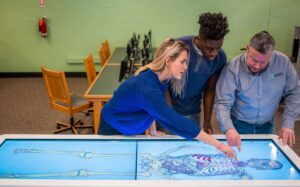
Another educational tool is the virtual anatomy table. “Using this technology, we’re able to visualize complete anatomical systems in 3D and show how they work as a unit,” Northern Maine Community College biology instructor Trena Soucy has said. “The table brings anatomy to life and off the pages of a text book, increasing the students’ understanding of how the body works in parts and as a whole.”
The technology should never replace real-life clinical work, says McManus.
“But there are things students aren’t allowed to do in clinical real-life situations that they can do here,” McManus says. “For example, students aren’t allowed to give blood in the hospital. As a nurse, the first time you give blood is the first time you’ve done that procedure. But students can get that experience in our simulation lab. It allows us to teach skills that students can’t get as a student. It better prepares graduates for what they’ll face in the real world.”
She adds, “It’s a very exciting to be a student or a teacher in the health care professions.”
Specialized training
In 2021, Northern Maine Community College in Presque Isle secured a $1 million grant to develop a 5,000-square-foot emergency medical service simulation lab to allow year-round indoor training with the program’s ambulance, purchased in 2020, along with interactive mannequins and audio-visual technology to allow instructors to view and record scenarios.
The expansion reflects Aroostook County’s increasing need for paramedics and the resulting increased enrollment in the EMS technician and paramedic programs.
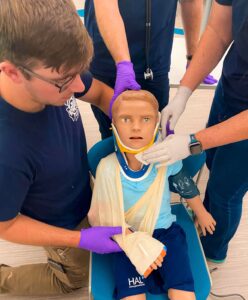
Since 2018, NMCC EMS students have had access to Trauma Hal, a lifelike training mannequin housed in the Nursing Simulation Center. The new space provides access to additional specialized simulators and training equipment.
ORONO, Maine — Chris Richards took in the scene around him and breathed a sigh of relief.
It was the first day of freshman orientation at the University of Maine, and students were arriving in droves.
For Richards, who as vice president of enrollment management is in charge of recruiting each new class, “this is kind of a celebration of the hard work we do.”
It’s been much harder work here than in many other places. With the highest median age of any state, Maine has experienced an estimated 10 percent decline over the last 10 years in its number of new high school graduates — precisely the people Richards needs. The other campuses of the UMaine system have seen a steady hemorrhaging of enrollment.
Yet buried in those figures is a little-reported surprise: The state’s flagship university has managed to steadily increase its undergraduate and graduate enrollment over the last decade, even as the number of students at not only other public institutions in Maine but at colleges and universities in the rest of the country was going in the opposite direction.
Although it now projects a slight drop in the number of entering freshmen, citing additional challenges caused by the pandemic, the university has managed to increase enrollment during the last decade overall.
It fended off the relentless demographic decline until now by luring out-of-staters with in-state tuition prices and by breaking with long-standing attitudes through which higher education sometimes alienates rather than embraces prospective applicants.
Meanwhile, the state’s community colleges, which depend on the same dwindling supply of learners, are reporting record numbers of new applications for the fall — up more than 12 percent as of Friday, the system says — thanks in part to temporary free tuition for recent high school graduates.
They’re also attracting career-changers to which they offer training that’s comparatively cheap or free, faster paced than typical credential programs and at places and times convenient for Mainers who have families and jobs.
Now that the enrollment crisis with which Maine has been contending for a decade has caught up with much of the rest of the country, universities and colleges in other states are being forced to consider similar changes or risk empty classrooms and the financial repercussions that come with unfilled seats.
“I do think there are lessons to be learned from what’s going on in Maine right now,” said Jerome Lucido, executive director of the Center for Enrollment Research, Policy and Practice at the University of Southern California’s Rossier School of Education. “They’re taking care of their reality. The question is whether everybody else will do that.”
Maine’s reality hit home about a decade ago, when the supply of new high school graduates began to fall, even as it was continuing to rise in the rest of the country.
So stark has been this drop-off, especially in rural areas, said Richards, that “I can go to a high school and have nine people come to see me, and that’s the whole senior class and half the juniors.”
Since UMaine once got only 20 percent of its students from out of state, according to university officials, that was a big problem. But it seemed a challenge to lure more of them to this leafy campus of red brick with white trim, so far north that a good-natured chant at hockey games includes the verse, “It might be 10 below under four feet of snow but no matter where we go, we love Orono.”
So the university reworked its financial aid to charge many applicants from out of state, at most, the equivalent of the same tuition they would pay to attend the least expensive programs of their home-state flagship universities.
Billboards advertising the deal sprang up around New England. “Go to the University of Maine for the in-state cost of UMass,” said the ones in Massachusetts, for example. The proportion of students from out of state doubled, according to the university, boosting overall enrollment and bringing in revenue that helped keep tuition comparatively low.
“This is so much cheaper. Even the deposit was cheaper,” said Cinnamon Adams, who works as a public university administrator in Connecticut, and came to the freshman orientation with her newly enrolled daughter, Carissa.
The proportion of students at Orono who are from out of state is now 40 percent of the total of just under 10,000 undergraduates. (The university also has a little more than 2,500 graduate students.)
Another change appeared to be equally important: enlisting everyone on campus, and not just admissions officers, in the job of recruiting students.
Since Orono, for many, is so hard to get to from where they live, the athletics department hosts prospective students at away games. The alumni association produced a report showing the much higher incomes graduates earn compared to people without degrees, and invites high school seniors to tour the campus during the spirited homecoming weekend — which, not coincidentally, usually occurs amid colorful peak fall foliage — rather than at other, quieter times. Dining hall workers are even instructed to overlook the instances when visiting applicants misplace their meal vouchers.
“So many institutions have relied on their admissions office. That model isn’t going to work any more,” said Richards.
“It doesn’t mean that [faculty and staff] have to go down to the admissions house and read a bunch of applications,” he said. “It could be a researcher who goes to the local high school to give a presentation. It happens when you see a person walking on the campus and ask them if they need help finding something. People want that.”
And they notice when it happens.
At other universities she visited, said Em Jeffrey, an incoming UMaine freshman from New Hampshire, she “felt like a number. Their reputations have inflated their own opinions of themselves. It’s not about, ‘We want to have you.’ It’s, ‘You would be lucky to get to come here.’”
By comparison, said Jeffrey, who plans to major in civil engineering, at the University of Maine the dean of engineering personally gave her a tour. It included a new engineering building nearing completion that is part of an ambitious plan to double the number of engineering graduates from all Maine public universities and help fill a looming shortage in the state.
“I definitely felt more welcomed,” Jeffrey said. “None of it felt forced.”
That’s not a heavy lift in a state where strangers wave at passing cars and at a university where traditions include the omnipresent “warm and friendly” “Maine hello” with which students and alumni greet each other, and where students, faculty and staff volunteer each spring for a campus cleanup.
Those who work here get how important it is to their own jobs that students keep coming, Richards said — especially in a part of the country where that’s been so much of a challenge for so long. “A lot of this is about making people understand that enrollment is why universities exist.” But there’s also no denying the effectiveness of it, he said. “If you’re an accepted student and the dean of engineering shows up to speak to you himself, that’s a big deal.”
Making the admissions process seem welcoming instead of intimidating and confusing is a surprisingly big culture shift in higher education.
“They’ve flipped the script on college admission,” said Lucido. At many other universities and colleges, he said, “the public understands college admission as something at which they probably won’t be successful,” persuaded by universities and colleges to think the odds are against them. Many never roll the dice.
There are also some less enviable ways that UMaine has continued to attract students. It’s gotten less selective, for example, accepting 92 percent of applicants. That’s up from 83 percent in 2014, the earliest year for which the figure is available from the U.S. Department of Education.
Despite this, the proportion of students who drop out — another problem that affects enrollment — is lower than the national average.
“Some students are going to come in not as prepared, and you have to be willing to spend the time to give them a high level of success,” said John Volin, executive vice president for academic affairs and provost.
Just as with recruiting them, keeping students from leaving involves everybody on the campus, Volin said. “It’s everyone’s job,” he said. “If they get that sense of belonging, it’s very likely that students will remain enrolled.”
A few miles away, at Eastern Maine Community College, or EMCC, students were taking an exam to become certified surgical technologists — the people who assist in operating rooms — in a program that can take as little as 16 months. Outside in a parking lot, others were learning how to pilot tractor-trailer trucks.
Facing the same demographic realities as the state’s flagship university, Maine’s community colleges have also changed. And while they serve a different population than the university, they’ve kept their numbers up by doing something similar: giving students what they want.
“There was a period where all we had to do was open our doors and students came. Now the tables have turned and it’s a situation where, ‘Listen, we need you as much as you need us. Let’s figure out how we work this out together,’ ” said David Daigler, president of the Maine Community College System.
The colleges have used $60 million in state and private funding to add noncredit short-term training that students need to get or change jobs, and speeded up some for-credit courses by offering them for more hours per week. That gets people their credentials more quickly in a labor market that wants workers fast, such as Portland’s red-hot restaurant sector.
“Up until the past couple of years higher education felt like we were doing the students a service — that they had to come to us,” said Stacy Green, admissions director at EMCC. “What we’ve learned is they don’t have to come to us. They’ll go elsewhere or nowhere at all.”
The schools have also forged agreements with 230 employers around the state to fast-track training for specific jobs that are open and available when students finish, a system spokeswoman said. They’ve offered in-person classes far from their campuses, in remote rural communities where students live and where there is a huge demand for graduates with skills including nursing.
For their many students who also work, they’ve added hours for administrative offices, made counseling services available remotely, scheduled “welcome days” on Saturdays as well as weekdays, cross-trained staff so people can get the answers to all of their questions in one call and added classes after hours and on weekends for in-demand nursing programs and people in those short-term training courses.
“These are students who have families and they’re working other jobs,” said Tisha Clark, who runs the surgical technology program at EMCC, as she put away the scrubs and other equipment in the lab where an exam had just taken place. One of Clark’s former students, for example, would come to class right after working the night shift and before going home to see her kids.
In April, the state made two years of community college free for full-time students from the high school classes of 2020 through 2023, which has resulted in a surge of applications, registrations and deposits for the fall — up 171 percent at EMCC, for instance, among students who qualify, according to Green. An estimated 8,000 are eligible statewide.
Free tuition isn’t always such a game changer. In Tennessee, which made community college free in 2014, enrollment stayed more or less flat before falling significantly when the pandemic hit.
In Maine, however, the temporary free-tuition scheme has coincided with high inflation and economic worry, channeling more students into community college as a way to save money by earning some credits at no cost toward eventual bachelor’s degrees, community college officials speculate.
It’s also been accompanied by a marketing blitz and against a backdrop of the “help wanted” signs prospective students can see everywhere for jobs they know require some kind of educational credential beyond a high school diploma.
“A lot of it is just how the country is. Housing costs are getting higher, the prices of everything are rising. So you need a better-paying job,” said Riley White, who is studying digital graphic design at EMCC. Meanwhile, he said, “There’s a lot of technical jobs around here that fit with this college.”
White qualifies for the no-tuition plan, which, he said, exaggerating only slightly, means “I won’t be paying off student loans for the next 40 years.”
The upshot of all of this is that, in spite of the singular demographic challenges of fewer Maine 18-year-olds, enrollment at the state’s community colleges had almost returned to 2011 levels by the time Covid-19 hit and since then has fared better than the national average. When students in noncredit short-term training are added, enrollment is actually up by a respectable 12 percent since the start of the pandemic, according to figures provided by the system.
“Our students have had a tough go during the pandemic, and there’s an empathy for what that student had to endure and an attitude on campus, ‘You stay with us, we’ll stay with you, and we’re all going to be better in the end,’ ” said Daigler.
“We’ve been nimble. We’ve reacted in hours rather than months to changes that we see,” he said. “We’ve been very responsive to people’s needs.”
Now Maine college and university administrators are bracing for what they say will be an even more challenging time: the next 15 years, when the number of new high school graduates in the state is projected to drop by yet another 7 percent.
This time, though, those administrators in Maine are not alone. The number of new high school grads is forecast to fall by 5 percent nationally during that time. Undergraduate enrollment nationwide has already plummeted by more than 9 percent since the start of the pandemic, or by 1.4 million students, according to the National Student Clearinghouse Research Center. Community colleges have been particularly hard hit, with their number of students down by nearly 17 percent.
“Unless you’re an elite college, you’re going to have enrollment problems,” Lucido said. “We’re going to see some intense competition. Already Maine is using price competition. How many institutions will be able to afford that?”
UMaine now has recruiters spending eight to 10 weeks a year in Florida, Texas and other markets with larger numbers of prospective applicants. It’s hired a Spanish-speaking admissions officer.
“I’m more concerned about the next wave, because you’re seeing the decline in our new fishing spots, so to speak,” said Richards as the arriving freshmen prepared to file across the quad and through the open mouth of an inflatable black bear mascot to a picnic lunch. Universities elsewhere, he said, aren’t going “to just lie down and let us keep taking their kids.”
But Daigler isn’t as convinced that universities and colleges in other states have recognized the problem that they’re up against.
“When I go out and talk to colleagues nationally, I don’t see the kinds of changes coming that we’re making,” he said. “I hear people talking about tweaking around the edges. I don’t think this is an environment where tweaking around the edges is going to work.”
That’s one advantage Maine has, after a decade of enrollment challenges, said Richards: understanding, from experience, how serious the problem is.
“The good thing for us,” he said, “is that our leadership hasn’t existed in a vacuum of false reality.”
This story about declining college and university enrollment was produced by The Hechinger Report, a nonprofit, independent news organization focused on inequality and innovation in education. Sign up for its higher education newsletter.
AUGUSTA, ME — Boosted by a new Free College scholarship for recent high school graduates, fall enrollment at Maine’s community colleges is up 12 percent, according to early enrollment figures.
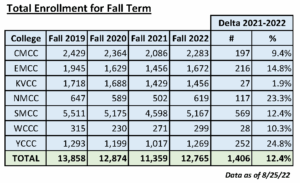
Preliminary fall enrollment was 12,765 students as of August 25, up from 11,359 students last year on the same date. Several thousand more early college students are expected to enroll in the next several weeks. Final fall enrollment figures are tallied on October 15.
Enrollment remains open at all seven colleges and students still have time to enroll for this fall.
Of the total fall enrollment, 42 percent – 5,399 students – qualify for the Free College scholarship.
“This increase in enrollment shows how important the promise of a great education is to Maine residents. Getting the skills needed for jobs in today’s economy is close at hand, affordable, and vitally important to landing a great job with good pay,” said David Daigler, president of the Maine Community College System.
“We deeply appreciate the state’s support in providing the funding for Free College, and we are eager to see these students, who otherwise may not have continued their education, thrive and succeed in pursuing their goals,” Daigler said.
The Free College Scholarship, announced in April, covers all tuition and mandatory fees for full-time students who graduated from high school or passed an equivalency exam in 2020-23. The Free College scholarship was funded with a one-time $20 million state allocation.
The fall semester begins Monday, August 29, at five of the seven colleges (Central Maine Community College in Auburn, Eastern Maine Community College in Bangor, Northern Maine Community College in Presque Isle, Southern Maine Community College in South Portland, and York County Community College in Wells.) Washington County Community College in Calais start August 31, and Kennebec Valley Community College starts September 6.
The average cost of tuition and mandatory fees at Maine’s community colleges is $3,700 a year. The colleges offer a broad range of two-year degree programs, one-year certificate programs, and short-term workforce training courses that take between a few weeks and less than a year to complete.
Since the announcement earlier this year that Maine’s community college system will offer free tuition for recent high school graduates, enrollment and interest among students has surged. We’ll talk with community college leaders and students to find out about the impact of the new policy, and what’s in store for the school year ahead. More»
Panelists: David Daigler, president, Maine Community College System Joe Cassidy, president, Southern Maine Community College
VIP Caller: Stacy Green, director of admissions, Eastern Maine Community College Ruscirene Dinanga, student, Southern Maine Community College
Ruscirene Dinanga had been enrolled at Southern Maine Community College for over a year, taking classes part time – while working one full-time job at cPort Federal Credit Union and another on-call as a Portuguese interpreter for Catholic Charities Maine – when she heard about Maine’s new Free Community College Scholarship program. Holding down multiple jobs in addition to college classes was too much. She could barely manage grocery shopping, let alone sit down to eat. So, she decided to apply.
To be eligible, students must live in Maine while enrolled, have a high school diploma or equivalent earned between 2020 to 2023, and enroll full time in an associate’s degree program or a one-year certificate program at one of Maine’s seven community colleges. They also must accept all federal and state grants and tuition waivers offered to them. The Free College initiative is available thanks to a $20 million allocation for free college in Maine’s supplemental budget signed this April by Gov. Janet Mills. The goal is to give students a debt-free community college education as they begin to work toward a career.
Margarida Celestino, another SMCC student who is studying full time with help from the scholarship, had a similarly easy application experience. She said filling out the application took less than five minutes – “maybe even just one minute” – and required only the most basic information. Celestino is an asylum seeker, and therefore is ineligible for federal aid (FASFA), as well as most scholarship programs.
Previously, Celestino had looked into the TRIO Program, which helps low-income Americans pay for college. However, she found that the program does not benefit those without green cards. She tried to manage classes on her own, but found it was impossible, and had just notified her adviser that she would need to drop out of her classes when she received news of the Free College Scholarship program.
The program came at the exact moment Celestino needed it, she said. She had been in college in New York state, but fell ill and had to give up a full scholarship. She was afraid she would never have access to college again.
When Dinango was granted the free enrollment funds, she felt a heavy weight lifted from her shoulders. “You either have the time, or you have the money. I could afford [college] with the work I had been doing, but I did not have the time for anything else. Now, I am able to have some time for both my coursework and myself,” she said. In addition to full-time college, she is still working as an interpreter and a direct support specialist – but these both have flexible hours, which she finds manageable. Making ends meet remains challenging, but nothing like before, she said.“My grandmother always says, ‘Before life gets easy, it gets a little bit harder.’”
Similarly, Celestino, who also works on the side to pay her bills, said that with access to free college, she does not have to work as many hours outside of school as she did before. This gives her more time to dedicate to school while having more of her own time for daily living and socializing with peers. “This scholarship program ensures I can do school well without overburdening myself trying to pay for it,” she said.
She had expected to take one or two classes at a time, while working to pay for each credit. But now she can be enrolled as a full-time student taking four or five classes at once, without paying for each class individually. This removes a huge financial weight.
Dinango said Free College Scholarship students don’t have to take all classes at the standard, full-time rate each semester. The full-time requirement is yearly, but students can overload credits in one semester, in order to take a lighter schedule during the next semester.
Currently, she is enrolled in an architectural program, and plans to graduate with an associate’s degree. Having access to free college now allows her to work toward becoming financially stable. “This is an opportunity for me to do this degree for free! It makes me more eligible to go to a university to [eventually] get my master’s degree and be financially ready for what is coming next.”
Celestino plans to use her associate’s degree in health science as transfer credits into a four-year bachelor’s degree program toward becoming a physician’s assistant. “Without this Free College Scholarship, it would be a lot harder to go right into a four-year program, since I don’t qualify for FAFSA. This means I can start my education for free, save money for the next step, and go to the four-year school later.”
Dinango hopes others will take advantage of this program, which is slated to end with 2023 graduates. Many of her peers, who are coming of age during the pandemic years, have been considering gap years between high school and college, but she hopes they don’t wait to go to college. Celestino agreed. “There will be more job opportunities with a paper [diploma] in hand,” she said. “Students should take advantage of this free access, work hard for two or three years, and get that paper to start a successful future.”
 AUGUSTA, ME — Fall enrollment is up 12 percent at Maine’s community colleges, boosted by a new Free College Scholarship aimed at re-engaging people whose high school experience was severely disrupted by COVID.