The Maine Community College System Board of Trustees will hold a regularly scheduled meeting at Eastern Maine Community College in Bangor and via Zoom on Wednesday, June 10, 2026.
For Zoom information or any other questions, please contact Director of Communications and Public Affairs Noel Gallagher at (207) 629-4028 or at ngallagher@mainecc.edu.
The agenda for the day’s meeting is posted on the MCCS website and is subject to change prior to the meeting date.
At Hudson County Community College in New Jersey, contentious national topics hit close to home.
Take raids by Immigration and Customs Enforcement.
“It’s hard to see, especially when these people you’re seeing get detained, innocent people as well,” says Emily Martinez, 18, an HCCC student living in Bayonne, New Jersey, majoring in criminal justice, and planning eventually to get a master’s degree and become a homicide detective. “I pray every day,” says Martinez, “that my family is able to return home safely” — all the more so after an HCCC student and her mother were swept up in March by ICE. While the mother was released, the college says, the student is being held at a detention facility in Louisiana.
On social media or at a protest, Martinez, a first-generation Mexican-American college student, will speak her mind on such incidents. “You’ve got to be the voice for the families that can’t speak out,” she says.
On campus, however, she’s hesitant to dive into these matters with her peers. “If you see me in person, I probably won’t say anything.” Face to face, there is too much awkward tension around difficult subjects — and the vibe, says Martinez, is “‘let’s not do this right now.’”
In the last few years, the skills and willingness to have conversations about tough topics have waned, according to students, faculty members, and surveys. Pandemic isolation probably atrophied some of those verbal-engagement muscles, college leaders say, but political violence and ugly, polarized public rhetoric could be bigger factors. Expressing yourself in person, Martinez and other students say, risks hateful and even dangerous reactions.
But ultimately, what’s the alternative? Most people don’t want to go tromping through life starting arguments, but talking through tense, complicated issues is a skill fundamental not just to democracy but to work and to family and community life. Colleges are trying to teach their students civil-dialogue skills so they can approach thorny issues respectfully and tell their stories and express their beliefs without fear.
So far such formal efforts have mostly been at four-year colleges, especially private liberal-arts colleges, even though 39 percent of all undergraduates and 49 percent of Hispanic undergraduates attend community colleges. HCCC and a handful of other community colleges or community-college systems are trying to change that as members of a consortium called College Presidents for Civic Preparedness, which the group abbreviates as CPCP or, in conversation, “CP Squared.”
The coalition of presidents is the brainchild of Rajiv Vinnakota, president of Citizens & Scholars (formerly the Woodrow Wilson National Fellowship Foundation) in Princeton, New Jersey. CPCP started in August 2023 with 14 member institutions and is now at 135 and growing, Vinnakota says.
Every college has pockets of intense civil dialogue occurring in certain classrooms or centers. The key, says Vinnakota, is to make civil dialogue the norm for students. They should practice it regularly from orientation on, throughout curricular and co-curricular life. “We want to make this part of our DNA,” he says. It’s early days, but CPCP has started to measure the civil-dialogue program’s effectiveness through a few select questions in student surveys about campus climate.
Fertile Ground
Community colleges are a promising laboratory for such a project, especially diverse colleges like HCCC, a multi-campus, urban institution with one campus in sight of the Statue of Liberty and another near the site of the duel between Alexander Hamilton and Aaron Burr.
Eighty-seven percent of its students are non-white. On its Journal Square campus in Jersey City, its North Hudson campus in Union City, or its center in Secaucus, you’ll hear students speaking English, Spanish, Arabic, and a slew of other languages, says the college’s president, Christopher M. Reber. A third of HCCC’s 24,000 combined credit and non-credit students were born in other countries, and 1,500 are learning English as a second language.
Community-college students usually don’t live on campus and have fewer opportunities outside the in-person or virtual classroom to absorb an institution’s culture. On the other hand, they often have substantial life and work experience and have had to bridge cultural chasms. Talking through differences and tough situations? Those are the stories of their lives. But they might not know they’ve learned those skills, or that the skills are in demand, and they might not feel comfortable sharing their stories. That’s what HCCC wants to change.
“People’s stories matter. They’re relevant to the content we’re talking about,” says Kade Thurman, the college’s coordinator of sociology and anthropology and an instructor of sociology. Civil discourse isn’t just about being able to speak candidly about Gaza, Ukraine, Iran, ICE raids, and other hot-button issues. It’s about “flattening the hierarchy and really encouraging the students to share.”
“It’s important,” says Christopher Conzen, executive director of HCCC’s Secaucus Center and its dual-enrollment program, “to be able to have that conversation in the classroom rather than tamping it down or avoiding it.”
Community colleges, by their very nature, are good laboratories for civil dialogue, he says. “As an open-access institution, we are a mirror of our community.” And for the nation’s almost 2 million high-school dual-enrollment students at community colleges — more than a fifth of community colleges’ enrollment — civil-dialogue efforts offer early exposure to conversations across differences, says Conzen. Dual-enrollment students are constructively thrust into discussions with older classmates from across the county and, in many cases, international backgrounds. There is a safety in escaping the peer judgment of those younger students’ K-12 classmates. “They feel a little freer to engage in these conversations,” Conzen says, “because it won’t affect their peer standing. … They get to test out some of the beliefs that they have.”
Such conversations are not limited to social-science and humanities classes, says Citizens & Scholars’ Vinnakota. He recalls the director of a nurse-training program who approached him after a CPCP event. Nurses, she said, constantly make tough decisions from complex variables and communicate them to colleagues, patients, and families in intense situations. “Call that collaborative problem solving and civil discourse,” Vinnakota suggests, and call out to faculty and students that employers actively seek those abilities.
How to Open Minds
How, exactly, might an instructor weave civil-dialogue skills into everyday discussions and activities? Instructors from around the country attend CPCP faculty institutes, then follow up with regular online workshops. Back on campus, they share techniques with colleagues in professional-development activities and test them out in their own classes.
“Students here really crave that kind of civil discourse, that kind of expressivist mode,” says DeBlois.
Michael A. DeBlois is a composition and public-speaking instructor at York County Community College, in Maine — part of the seven-college, nine-campus Maine Community College System, which is part of CPCP. DeBlois went to a 2024 CPCP training program in New Jersey for about 50 community-college faculty members and administrators from around the country. Among other activities, they practiced looking for signals that constructive dialogue in a group might be falling apart. The room goes eerily silent, for instance, or students start interrupting each other. That’s when the instructor can switch discussion modes to bring the conversation back into focus and make students feel more comfortable.
DeBlois had always thought of such situations as student interactions he didn’t have much influence over, but he learned that, at least sometimes, an instructor can help steer the conversational ship. For instance, argument and persuasion are fundamental to DeBlois’s syllabi, but instead of having students argue their viewpoints, he might have them map out many possible views on, say, whether AI is, over all, more harmful or helpful. “We end by collaborating, synthesizing, or building upon the different perspectives to create a new idea or a more comprehensive understanding of the issue,” he explains.
Or students might physically line up to represent a spectrum of viewpoints. That shifts their thinking from simple pro-con dichotomies. Part of seeing the viewpoint diversity around them, says DeBlois, is that students don’t worry as much about not being in other people’s ostensible camp. There are no us-versus-them camps, but rather a range of perspectives — and often quickly shifting perspectives at that.
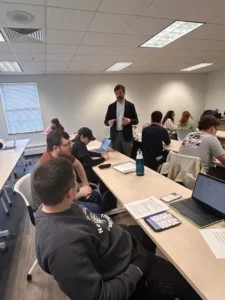
In that kind of discussion, sensitive headline issues come up naturally, says DeBlois, but the instructor needn’t raise them directly at the outset. That risks putting some students on the defensive. Strategies to more gently generate discussion might include reading poetry, says DeBlois, or essays from John Berger’s Ways of Seeing, about how perception is affected by gender, ideology, economics, and other factors.Michael A. DeBlois, a composition and public-speaking instructor at York County Community College, in Maine, went to a 2024 training run by College Presidents for Civic Preparedness. Photo courtesy of York County Community College.
“Students here really crave that kind of civil discourse, that kind of expressivist mode,” says DeBlois.
One class discussion on those Berger readings led students to talk about reporting on the war in Gaza. A student said the conversation was bringing out a lot of anxiety for her, but during the next class, DeBlois said, she thanked her classmates for talking the matter through, which she said helped her cope with that anxiety. Unlike a classic debate format, which DeBlois also teaches and which he says has its place, the goal here is not to win but to seek truths together.
However delicately such discussions are generated, some students will feel awkward staking their claim on a matter. They might remain quiet, at least for a while, says DeBlois, and that’s OK. “Give them space and grace,” he advises.
Overall, says DeBlois, “the students here really crave that kind of civil discourse, that kind of expressivist mode.”
Jason Early, 17, is majoring in architectural and engineering design at York County and plans to transfer to the University of Southern Maine and earn a degree in mechanical engineering. “I try to stay out of politics with friends,” he says. But during discussions in DeBlois’s class and others at York County, he and other students have talked about contentious topics with “no heckling at all,” he says. “No one was being like, What are you doing? Stop talking.” In a history course, “you’re obviously going to go through a lot of touchy topics,” he says, “but there was never a time when people got angry.”
In a discussion of the nuclear attacks on Hiroshima and Nagasaki, students stuck to specifics like how much President Harry Truman knew about what harms the bombs would inflict. A discussion about AI “shifted my viewpoint and made it maybe a bit wider,” Early says, allowing that there could be constructive uses for AI in business even if he still thinks it has no place in education. An online discussion in macroeconomics focused on readings contrasting classical and Keynesian economic models. Early wrote a response to a classmate saying, “I like what you did here,” but adding that he disagreed and was more of a Keynesian himself.
Confronted with opposing viewpoints, Early tries to say, “What makes them feel this way? What makes them tick?” Regarding news he finds outrageous, “I think it can be frustrating sometimes. … ‘Why would anyone be agreeing with this?’” But then he tries to understand what formed those views. He thinks to himself, “‘They had good intentions somewhere, I’m sure,’ and try to find those.”
‘A Better Path’
Those regular opportunities to engage in civil dialogue, says David Daigler, president of the Maine Community College System, “are essential skills for the workplace and they’re essential skills for democracy.”
“It’s not about conquering or winning the day,” he says. “It’s about understanding and being understood.”
Looking at civil communication in his politically polarized state in our politically polarized nation, Daigler says, “In the 1860s we couldn’t do that, and it didn’t end well for us, so let’s find a better path this time.”
Rifaya Dubash Khajamohideen, 20, is wrapping up her associate degree in biology at Hudson County Community College and will transfer to the New Jersey Institute of Technology to study forensic science. In her three years at HCCC, she says, she’s seen a chill come over students’ conversations about current events. “I would definitely say there’s been a bit of cautiousness,” she says — a feeling of “I don’t feel safe having this conversation.” Middle-East warfare, politics, Trump — “we’re scared, Would this person do something to me if I bring that up?”
Khajamohideen is president of the student government association and works two jobs — one on campus in enrollment services and one as a customer-service agent at Newark airport. She says that conversational chill is unfortunate. Knowing when and how to engage across differences, she has learned, is a crucial skill for students and in the workplace. She appreciates the college’s push for civil dialogue across varying viewpoints because “they’re teaching you and you’re teaching them.”
Fearfully swerving to avoid forbidden topics is un-American, she says.
“We live in the U.S.A.,” says Khajamohideen. Choose your moments, sure, but “we should be able to speak our minds without thinking about who’s going to harm us in what way.”
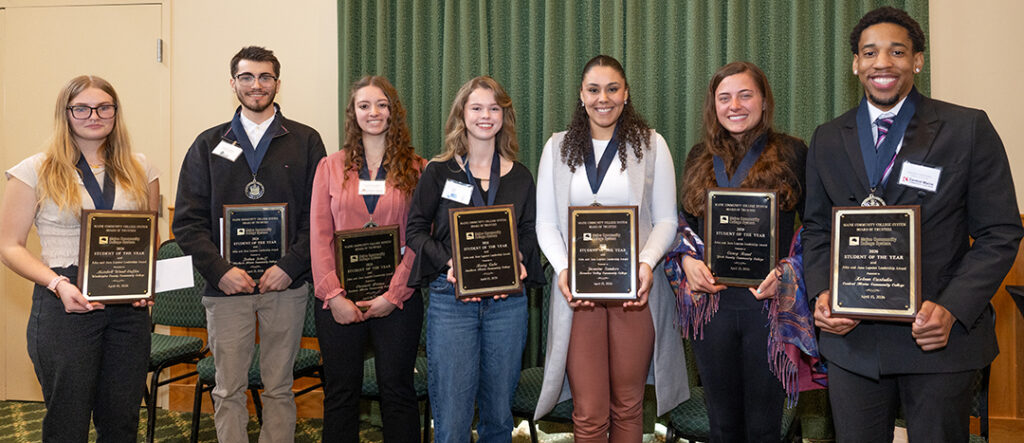
AUGUSTA, ME — Seven Maine community college students were honored for their academic success and campus and community involvement on Wednesday at a ceremony at Maple Hill Farm in Hallowell. The event was hosted by the Maine Community College System (MCCS) Board of Trustees.
The 2026 MCCS Students of the Year are:
Kelson Custodio, Westbrook, Central Maine Community College
Eleanora Haines, Orrington, Eastern Maine Community College
Jasmine Sanders, Augusta, Kennebec Valley Community College
Joshua Scheff, Presque Isle, Northern Maine Community College
Kamryn “Kamy” Dube, Winthrop, Southern Maine Community College
Kendall Wood-Coffin, Machiasport, Washington County Community College
Casey Rand, Wells, York County Community College
The students being honored were selected by faculty and staff at their colleges.
In addition to being recognized as Students of the Year, each received a John and Jana Lapoint Leadership Award in the amount of $1,000.
Mr. Lapoint was president of UF Strainrite in Lewiston and a trustee of the Maine Community College System. After his death in 1995, his widow, Jana Lapoint, served on the Board from 1995 to 2006 and helped establish the fund for the annual awards.
Maine community college leaders and students breathed a sigh of relief after lawmakers narrowly passed a supplemental budget permanently funding the state’s free community college program, albeit with some cost-saving tweaks. Gov. Janet Mills, who proposed and has been a driving force behind the program, signed the legislation Friday.
“This biennial budget should send a clear message to every young person in Maine: if you are willing to work hard and build your future here, Maine is ready to invest in your success,” Mills said in a news release.
The free college program began in 2022 to support high school classes affected by the COVID-19 pandemic, with hopes of making it permanent down the line. It covered tuition and fees at Maine community colleges for those who graduated from 2020 through 2023 and was later extended to the Classes of 2024 and 2025. But last summer, the Maine Legislature’s Appropriations and Financial Affairs Committee threw the program into limbo when lawmakers raised concerns about the program’s long-term sustainability and declined to make it permanent.
The move left Maine on the brink of becoming the first state to establish and then take away free college. But after months of dialogue with the governor, community college leaders and students, and an outpouring of public support for the program, the Legislature ultimately voted in favor of sustaining a less expensive version of the program.
David Daigler, president of the Maine Community College System, said the program’s future felt uncertain to him “right down to the wire. I was taking nothing for granted.” But that anxiety has now been replaced with a “sense of jubilation” on campuses and among high school students who now know for certain they can take advantage of the program.
When Maine’s program hung in the balance, Daigler said he heard from a high school counselor that students “used up a full box of Kleenex because they realized they weren’t going to have enough money to go to college” if the program didn’t continue.
“The free college program gives those very students the opportunity to continue their education,” he said.
To get there, Daigler and other program advocates had to make some concessions. Going forward, the program will cover tuition but not student fees, which amount to roughly $600 per semester. Because it’s a last-dollar program, students who receive the Pell Grant can apply it to their fees and still pay nothing, but Daigler said he does worry for students “just above the Pell line.” The program will also give students three years instead of four to complete their studies. And students must reside in Maine for at least a year before they’re eligible for tuition coverage. The program was originally designed to include out-of-state students in hopes of coaxing young talent to the aging state, where deaths now outpace births and retirements are leaving gaps in the workforce, Daigler said.
Still, he believes these modifications are a small price to pay for the state continuing to cover students’ tuition.
“That’s essentially how legislation is made,” Daigler said. “We’ve got to all sit at the table, roll up our shirtsleeves and try and make sure that we find the formula that meets everybody’s objectives.”
STUDENTS REACT
Student Jason Early, who’s graduating from York County Community College this spring and advocated for the program to state lawmakers, said he was similarly “disappointed” by students having to pay fees from now on. He hopes the Legislature might revisit that provision down the line.
But “if they have to make a compromise somewhere for [the program] to continue, well, it’s better than it ending completely,” said Early, who’s heading to the University of Southern Maine in the fall. “People who weren’t expecting that they’re going to be able to go to college are now able to. I feel like that’s such a great thing, just to have a more educated populace in Maine. I really think it’s great for everybody.”
Victoria Wile, a student at Central Maine Community College who also spoke out on behalf of the bill, said the program partly drove her decision to earn her building construction technology associate degree at the college—the same institution her grandmother, grandfather and mother have attended. She’s now working on the college’s maintenance team while she earns her second degree in facility maintenance and management.
The program “allowed me to focus on the schoolwork rather than trying to pay the bills” and put the money she saved toward other costs, including a study abroad experience and the tools she needed for her courses, she said. “I really didn’t want to go into college just to rack up debt.” Attending CMCC “became an easy decision, and it ended up being a very worthwhile decision.”
Wile said she’s glad to see Maine’s free college program continue so that her brothers and other Maine students can “get the same opportunity and financial freedom” she did.
“I hope other Mainers, other students who wouldn’t otherwise be able to attend college, really take advantage of the opportunity they have,” she said, “because I definitely wouldn’t be the same if I didn’t have the opportunity of free college.”
BROADER IMPLICATIONS
Despite the trade-offs made to keep the program alive, Daigler sees the moment as a good omen for the free community college movement as a whole. Preserving the program during a time of intense political polarization and a lean budget year indicates how popular free college is as a policy, he said.
As fewer federal dollars flow to states, “everybody has to tighten their belt” and take cost-saving measures, Daigler said, but Maine lawmakers made “a very strong legislative commitment, driven by a very strong popular opinion that this program is necessary.” A fall 2025 poll found that 80 percent of Maine voters supported continuing the program. And enrollment has surged at the community colleges since the program began. More than 23,000 students eligible for the program have enrolled.
Morley Winograd, chairman of the board for the Campaign for Free College Tuition, agreed that Maine’s triumph is a win for the movement. He also believes the modifications made to the program were “reasonable” and don’t taint the victory.
More than 30 states now offer some form of tuition-free community college, and none of them have rescinded these programs, despite executive transitions in some of these states, “which is great evidence that they are an essential and important part of the overall U.S. higher education system and also a great benefit in this time of high, high concern over affordability,” he said.
In fact, Winograd expected states to propose cutting back on free community college programs amid heightened uncertainty around federal funding. But so far, that hasn’t happened.
“We have not seen such activity of any consequence,” he said, “which may be simply a lull before the storm, because a lot of state budgets are still operating on assumptions from last year … and a lot of them have midyear deadlines … but at this point, no, this has not been a big issue anywhere that we’re aware of.”
He also pointed out that Gov. Mills is running for Senate and has touted free community college as one of her landmark accomplishments.
“I think it further reflects the popularity of the program,” he said. “It’s a bipartisan idea.”
BANGOR, ME — With a scratch of the pen and surrounded by e-vehicles and cars in an automotive bay at Eastern Maine Community College, Governor Janet Mills made the Maine Free College Scholarship permanent for high school graduates in the Class of 2026 and beyond.
“This is a once-in-a generation moment for Maine’s higher education landscape,” Maine Community College President David Daigler said. “This gives future high school graduates the means and opportunity to pursue a path they may have felt was financially out of reach. And now that it’s a permanent program, a generation of young people can move with confidence and intention toward a brighter future for themselves and Maine.”
The Maine Free College Scholarship covers 100% of tuition for recent high school graduates who are Maine residents and are pursuing a degree or certificate program at a Maine community college. It’s a last-dollar program, after federal and state grant aid is applied. The scholarship, which applies to the Class of 2026 and beyond, is a slightly scaled-back version of a Maine Free College Scholarship program proposed by Mills and launched in fall 2022.
The Maine Free College Scholarship language was included in the supplemental budget signed Friday by Mills. It’s rare to have a bill signing not at the Capitol; Mills office believes this is the first one signed off-site.
“This biennial budget should send a clear message to every young person in Maine: if you are willing to work hard and build your future here, Maine is ready to invest in your success,” Mills said.
To qualify for the Free College Scholarship, students must have a high school diploma or equivalent, enroll no more than two years after graduating , pursue an associate degree program or one-year credential, be a Maine resident and live in Maine while enrolled, and accept federal and state grants before the Maine Free College scholarship is applied.
The Free College Scholarship is offered in addition to multiple other tuition waiver or free college opportunities at Maine’s community colleges, such as free early college classes for Maine high school students and a wide assortment of free short-term workforce training programs that take just weeks or months to complete.
Full-time tuition at Maine’s community colleges is $2,880/year.
AUGUSTA, ME – Twenty-one Maine community college students have been named to the All-Maine Academic Team in recognition of their outstanding academic achievement, leadership, and service.
The All-Maine Academic Team is a program of Phi Theta Kappa, an international honor society for two-year colleges. Students are nominated and selected for the team by their college.
The students receiving the award and a $500 scholarship from the MCCS Board of Trustees are:
Jennifer Bailey, Jefferson, Central Maine Community College in Auburn
Ella Hanson, Durham, Central Maine Community College
Daniel Levis, South Paris, Central Maine Community College
Sophia Nappi, Windham, Central Maine Community College
Nora Caldwell, Corinth, Eastern Maine Community College in Bangor
Alexander Hinkley, Milford, Eastern Maine Community College
Shawn Johnson, East Corinth, Eastern Maine Community College
Patricia Sanchez, Newburgh, Eastern Maine Community College
Desiree Kelley, Kennebec Valley Community College in Fairfield/Hinckley
Selene Metts, Winslow, Kennebec Valley Community College
Bridgett Wooten, North Yarmouth, Kennebec Valley Community College
Sarah DeMerchant, Presque Isle, Northern Maine Community College in Presque Isle
Chance Lilly, Madawaska, Northern Maine Community College
Tonya McLennan, San Fernando, Trinidad & Tobago, Northern Maine Community College
Joshua Scheff, Presque Isle, Northern Maine Community College
Lucia Campillay, Cordoba, Argentina, Southern Maine Community College in South Portland/Brunswick
Bree Michaud, Oakland, Southern Maine Community College
Victoria Muanda, Scarborough, Southern Maine Community College
Wendy Eckert, Baileyville, Washington County Community College in Calais
Brittany Inman, Strong, Washington County Community College
Victoria Fisher, Lebanon, York County Community College in Wells
Daniel Levis (CMCC) and Victoria Muanda (SMCC) were named national New Century Scholars for earning the highest scores in Maine on their All-USA Academic Team applications.
Muanda was named the 2026 New Century Transfer Pathway Scholar and will receive a $2,750 scholarship. Levis was named the 2026 New Century Workforce Pathway Scholar and will receive a $1,500 scholarship. Muanda was also chosen for the prestigious 2026 All-USA Academic Team by Phi Theta Kappa and will receive a $3,000 scholarship.
Muanda was recognized for her academic achievements, campus and community engagement, and overall leadership. Muanda will be recognized during the American Association of Community Colleges’ (AACC) annual convention in Seattle in April.
Bree Michaud was named a Coca-Cola Academic Team Scholar and will receive a $1,300 scholarship.
The New Century Pathway Scholarship program is sponsored by The Coca-Cola Foundation, The Coca-Cola Scholars Foundation, the American Association of Community Colleges, and Phi Theta Kappa. Only one New Century Transfer and Workforce Scholar is selected from each state.
AUGUSTA, ME — Maine Community College System President David Daigler issued the following statement Thursday, following the legislative votes on the supplemental budget, which now goes to Governor Janet Mills:
“We are on the verge of witnessing a once-in-a-generation transformation in Maine’s higher education landscape,” Daigler said.
“Making community college tuition-free a permanent reality gives future high school graduates the confidence of knowing they can attend college. This initiative provides the means and the opportunity for Maine’s high school graduates to pursue college and for the state’s businesses to secure the skilled, educated workforce they need,” Daigler said.
“I am profoundly grateful to the legislature for their support and for sending this bill to Governor Janet Mills for her signature.”
AUGUSTA, ME — A new podcast focused on finding solutions to Maine’s workforce challenges launched today with an interview with Maine Department of Corrections Commissioner Randy Liberty.
“Maine Ideas” will focus on finding practical, actionable solutions to common workforce challenges at Maine companies of all sizes, said host Dan Belyea, the chief workforce development officer at the Maine Community College System (MCCS). Belyea leads MCCS’s Harold Alfond Center for the Development of Maine’s Workforce, which oversees all short-term workforce training programs at Maine’s community colleges.
“Across the country, employers are facing workforce shortages, changing skill demands, and real questions about how to grow in a competitive economy. Here in Maine, we’re not just talking about those challenges—we’re sharing the ideas and partnerships that are helping move the state forward,” Belyea said. “The ‘Maine Ideas’ podcast brings together leaders from business, education, and communities to highlight what’s working and where opportunity is growing.”
The inaugural episode explored how workforce training is contributing to a drastic drop in recidivism.
“Ninety-nine percent of the individuals that are incarcerated today, both in the county jails and in the prison system, will be returning back to our communities,” Liberty said. “The question is, how can we successfully help them transition back? If someone obtains a college degree at the Maine Department of Corrections, they have a .05% return to custody rate.”
The first 16-episode season of “Maine Ideas” will air weekly with new episodes released each Tuesday on Spotify.
Belyea and business leaders will explore innovative workforce strategies, from recruitment and retention to investing in employee growth. Each episode will highlight examples of success and collaboration, with insight into how to tap into career pathways, access existing resources, and learn about emerging workforce organizations and opportunities in Maine. The podcast is ideal for everyone from business owners and human resources professionals looking to implement new ideas to government, industry, and education leaders deeply engaged in workforce development already.
Other guests in the first season of “Maine Ideas” include Katie Shorey, director of engagement for Live & Work in Maine; Kelly Flagg, executive director of Associated General Contractors of Maine; Peter Delgreco, president and chief executive officer of Maine & Co.; and Kate Kinder, executive director of the National Council for Workforce Education.
Legislation working its way through the Maine State Legislature could make a free-community-college program a permanent part of the state budget — but also alter it to limit eligibility and make some students newly responsible for fees. It would be the first time since free-college programs proliferated to around 35 states over the past decade that a state-level program has cut back benefits.
A supplemental budget bill under consideration by the Appropriations and Financial Affairs Committee would permanently add the program to the state’s budget. (It has been funded since 2022 on a year-to-year basis.) It would also change the provisions of the current program in three ways: limiting eligibility to students who have lived in Maine for a year before applying, covering three years of study rather than four, and removing coverage of institutional fees.
The changes were made to ensure the program works exclusively for Mainers and that it remains economically feasible to support, said David Daigler, president of the Maine Community College System. The residency requirement was added because of concerns that out-of-state students were taking advantage of Maine taxpayer dollars: About 4 percent of students who have received free-college benefits each year hailed from out of state before moving to Maine and applying. The other two shifts were prompted by concerns from lawmakers about the costs of making the program permanent, Daigler said: “It’s really all about that future commitment.”
Making free college a permanent part of the state budget was part of an “affordability agenda” advanced by Gov. Janet Mills, a Democrat. John Baldacci and John R. McKernan Jr., former Democratic and Republican governors of the state, respectively, endorsed the move in a newspaper editorial.
Daigler acknowledged that there’s something magic about the words “free college” that opens minds and doors for students who might not otherwise think of attending. In 2022, the first year the program was offered, the system expected about 8,000 applicants and received about 12,000. Community-college enrollments of students coming directly from high school have been about 50 percent higher during the past three years than in the three-year period preceding the start of the program.
It is unclear to what extent asking students to pay hundreds of dollars of fees will be an impediment to participating in the program. Studying at a Maine community college costs about $2,100 per semester in tuition and fees. Maine’s free-college program, like most, works on a “last dollar” basis, which means that it covers costs after all other forms of federal and state aid kick in. Students eligible for the maximum Pell Grant will still have their tuition and fees covered. About 30 percent of students in slightly higher income brackets would have to pay their fees, which amount to about $600 a semester.
Despite the increased costs for some students, the revamped program represents a good thing over all for Maine learners, said Laura Perna, a professor of education and senior vice provost for faculty at the University of Pennsylvania. “They’re trying to figure out a way to have some assurance to people that this actually is going to be available now, and it will continue to be available,” she said. “That’s what people need if they’re trying to make plans about going to college.”
The larger issue is that, even with tuition and fees covered, attending college involves other costs that states and institutions rarely address. Students “still need to buy books, and they have to figure out how to get to campus,” she said. Food, child care, and living expenses are also part of the picture. “Perhaps this can be part of a bigger conversation of how we ensure that people who want to go to college actually can afford to go and then fully engage in the experience.”
Daigler does not see the changes in Maine as the beginning of a tide turning against free-college programs. If anything, he said, it’s the opposite. The proposed changes in Maine will reduce the state’s costs from about $12.5 million a year to about $10 million a year, he said, which will allow the program to be sustainable. “That’s budgeting reality. There are a lot of pressures on the state,” he said. “If there was a clawback, they would have said, ‘We can’t fund this.’ And so I don’t think that you’re seeing a reduction. I think it’s a ratification of the importance of the program.”
The supplemental budget bill still has to be voted on by the state House and Senate — and if passed, signed by Mills — to become law. Daigler says he’s “optimistic” that the new program will go into effect.
John Baldacci, a Democrat, served as Maine’s governor from 2003 to 2011. He led the effort to establish the state’s community college system in 2003. John McKernan, a Republican, was Maine’s 71st governor from 1987 to 1995. He has served as chair of The Foundation for Maine’s Community Colleges since its inception in 2010.
Making the Maine Free College Scholarship permanent for the high school graduates of the Class of 2026 and beyond delivers on a promise the two of us made decades ago — and maintained since — to keep a community college education affordable to as many Mainers as possible.
Now Gov. Janet Mills is working to secure that same promise for future generations, by making permanent the Maine Free College Scholarship. Her plan invests $10 million in state funds annually to guarantee recent high school graduates in Maine a tuition-free community college education. It is a sound and profound decision.
If passed by legislators in Augusta, the investment will pay off for not just for students and their families, but for the state’s coffers in the form of more tax revenue, for local businesses in the form of more skilled labor available, and for communities who will have more vibrant, engaged, and employed residents. Already, more than 23,000 Maine Free College Scholarship-eligible students have participated since the last-dollar scholarship program began in 2022.
The two of us have worked tirelessly, and across party lines, over the past quarter century to evolve the community colleges. As public leaders, we are partners in helping the state’s public two-year colleges find and secure the resources and tools they need to fulfill their state-ordered mandate of creating the educated, skilled, and adaptable workforce Maine needs to fill jobs in Maine’s economy.
That was the vision when Gov. Baldacci led the effort to evolve what were then vocational technical colleges into a true community college system that expanded its academic offerings and offered an affordable pathway to four-year colleges.
At the same time, Gov. McKernan started his tenure as chairman of The Foundation for Maine’s Community Colleges, leading fundraising and making connections to strengthen the colleges. To date the Foundation has raised over $147 million in support of the colleges’ programs, infrastructure, and scholarships. The Maine Free College Scholarship will allow those philanthropic and grant dollars to stretch even farther.
As a state, we committed long ago to making local, affordable access to quality post-secondary education a priority in Maine. Despite having the lowest tuition in New England, affordability remains one of the greatest barriers to higher education for Mainers. Making the Maine Free College Scholarship permanent is the logical, practical, and necessary next step to true affordability.
We now applaud and welcome Gov. Mills into our mutual efforts to keep growing and strengthening Maine’s community colleges and making sure they remain affordable and accessible to the largest number of Mainers possible.
We urge today’s lawmakers to support this economic engine for Maine, giving young people the opportunity to pursue a tuition-free degree, while knowing their state believes in them and their potential.