AUGUSTA, ME — Across Maine’s varied industries and communities, a steady stream of support is emerging for making the Maine Free Community College Scholarship (MFC) a permanent program.
“I can say without a doubt that the MFC program has made a tremendous difference in the lives of many Maine students graduating from high school,” Stan Pelletier, a school counselor of 25 years told Maine legislators in a letter supporting the scholarship. “I have, on repeated occasions, had a conversation with a student that goes something like this: ‘I never thought I could go to college. Where do I sign up?'”
The $10 million proposal to make Maine’s community colleges tuition-free for recent high school graduates in Maine is part of Governor Janet Mills’ supplemental budget currently being debated in the State House.
Dozens of letters of support were sent by a broad coalition that includes business leaders; higher education allies including Educate Maine, FAME, and the Maine School Management Association; economic policy advocates including the Maine Center for Economic Policy; student-facing advisors and faculty at community colleges; parents, grandparents, and – of course – community college students themselves.
“When I found out about this program, college stopped being just a dream and became a real possibility,” wrote student Anna Rose Ross. “This program didn’t just help me pay for tuition – it gave me stability, purpose, and a future. Because of this opportunity, I am not only building a better future for myself, but also honoring my mom’s sacrifices and creating something brighter for both of us.”
One York County high school counselor described using “an entire box of tissues” one recent day in her office because students realized “in real time, that their plans for life after high school were no longer financially possible.”
“This reality stands in stark contrast to what I witnessed when the Maine Free College Scholarship was in place,” Marshwood High School counselor Kyle Lontine wrote in a letter to Maine lawmakers. “I urge you, as you make critical appropriations decisions, to fully fund and reinstate the Maine Free College Scholarship. Because no student should have to sit across from a counselor and grieve a future they worked hard to build, and no state can afford to push away the very people it is depending on to build its future.”
Business owners and advocates describe the scholarship as an economic investment that will strengthen local economies for generations to come.
“Local employers across healthcare, manufacturing, trades, education, hospitality, and public service depend on (Northern Maine Community College) graduates to fill critical workforce needs. Without accessible and affordable pathways to education, many of these students would not have the opportunity to enroll, complete their credentials, or remain in Aroostook County,” wrote LaNiece Sirois, executive director of the Central Aroostook Chamber of Commerce. “The (chamber) strongly supports the approval and continued funding of Maine Free College. Investing in our students is an investment in our workforce, our businesses, and the long-term vitality of our region.”
Critical Insights polling in fall 2025 found that Maine voters strongly support the scholarship: 80% of all Maine voters support continuing the scholarship, and the support is stronger this year than in the past.
Education allies noted the scholarship promotes progress in multiple education initiatives in the state from PreK-12 to Maine’s public universities: improving Maine’s high school graduation rates; increasing transfer rates to the University of Maine System; and increasing the state’s goal of 60% of Mainers holding a degree or credential of value.
“The past investment in this program led to increased enrollment for young men, similar retention rates compared to other programs, and strong outcomes for transfer students,” Educate Maine Executive Director Jason Judd wrote.
The Maine School Management Association’s Robbie Feinberg wrote: “Giving more students access to education after high school will encourage more to finish high school – and help more students stay in Maine.”
Deborah Cormier of Sanford said one of her two grandsons with the scholarship is now transferring to the University of Southern Maine engineering program as a Presidential honors student: “I hope this free community college program can continue, and keep helping to send well educated individuals into our Maine society. Thank you!”
The current scholarship proposal is a lower-cost version of the Maine Free College scholarship already approved for the graduating classes of 2020 through 2025. A proposal to continue the scholarship failed to win legislative support last session. By limiting scholarship access to students who have lived in Maine for at least a year, shortening the amount of time students have access to the scholarship, and limiting scholarship dollars to tuition only, the new proposal will cost $10 million a year, instead of $12.5 million a year.
Lawmakers will decide budget priorities and send their budget to the governor by April 15.
Broad-based Support for Governor Mills’ Proposal to Make Maine Free College Scholarship Permanent
Educators, students, business leaders, workforce advocates, and Maine families across the state are urging passage of the current proposal to make the Maine Free College Scholarship permanent for the high school graduating class of 2026 and beyond.
Here’s what they’re saying:
Broadcasters: This video features students at Eastern Maine Community College talking about the Maine Free College Scholarship. Please credit Eastern Maine Community College.
Educators:
“Allowing this program to lapse for the Class of 2026 has created an immediate and visible impact. I am seeing it firsthand in my office, in the form of students reconsidering their futures, delaying their plans, or abandoning them altogether. This is not a theoretical policy discussion. It is a present and personal reality for the students I serve. Choosing not to sustain (the scholarship) places us in the position of having proven what works, and then walking away from it.” – Kyle Lontine, M.S., Marshwood High School counselor.
“This program is not a hand out, it is a thoughtful investment in the future of our economy and the quality of life of Maine citizens and families to come.” – Stan Pelletier, a school counselor of 25 years.
“This scholarship has been instrumental in providing access to higher education for many students who otherwise would not have had the opportunity. By making this scholarship permanent, we are ensuring that future generations of Mainers will have the chance to pursue their educational and career goals without the burden of overwhelming debt.” – Michelle McNeil-Brown, Business and Accounting Chairperson, York County Community College.
Business Leaders:
“The (chamber) strongly supports the approval and continued funding of Maine Free College. Investing in our students is an investment in our workforce, our businesses, and the long-term vitality of our region.” – LaNiece Sirois, executive director of the Central Aroostook Chamber of Commerce.
“At a time when Maine desperately needs more workers, more young families, and more long-term residents, removing free community college would move us backward. Keeping it moves us forward. It strengthens our workforce. It supports our businesses. It keeps young people here. It gives Maine a fighting chance against the demographic challenges we all acknowledge.” – Jean Ginn Marvin, Nonantum Resort Innkeeper and MCCS Trustee.
Students and families:
“When I found out about this program, college stopped being just a dream and became a real possibility. This program didn’t just help me pay for tuition – it gave me stability, purpose, and a future. Without it, I don’t know how I would afford school, and honestly, I don’t think I would have believed college was an option at all.” – York County Community College student Anna Rose Ross.
“If Free College had not been an option for me, I do not believe I would have attended college at all. The cost of tuition would have been a barrier that I could not overcome. Rather than worrying about how I would pay for school or how many hours I needed to work, I have been able to dedicate my time and energy to my studies. That has made a real difference in my success and in my confidence. Free College has provided me with the first steps toward gaining an education that I once believed was out of reach.” – Washington County Community College automotive student Amelia Drake.
Gov. Janet Mills spent Wednesday morning trying on virtual reality headsets, visiting veterinary technician training labs where stuffed dogs and cats sprawled on operating tables, and examining skulls in a human anatomy classroom at York County Community College.
As she interacted with the students, she emphasized how more than half of those enrolled at the southernmost community college campus are taking advantage of Maine’s free community college program.
“That’s why I’m here,” 18-year-old Elyana Odess told the student sitting next to her.
As lawmakers weigh the scholarship’s future, Mills’ visit was part of a push to make it permanent, describing the pilot program as “vital” to developing a skilled workforce and keeping young people in Maine.
During her last State of the State address in January, Mills emphasized the importance of the program, which was first introduced in 2022. Since then, more than 23,000 students have enrolled in community colleges for free, boosting transfer student enrollment for Maine’s public universities and bolstering the workforce.
The Legislature opted not to include language in last year’s budget that would have made the scholarship permanent, despite the governor’s request, leaving colleges unable to promise free tuition to the high school class of 2026.
This year, the Maine Community College System is more optimistic. After working with Mills, the proposed annual cost of the program has been reduced from $12.5 million to $10 million. The governor’s proposed supplemental budget includes $2.5 million in one-time funding to cover the class of 2025 and adds $10 million annually to the state’s baseline spending for future years.
“When they put it in the baseline, they’re saying, “These are the programs that we’ve committed to fund on an ongoing basis,’” said David Daigler, president of the Maine Community College System.
“Right now, the community colleges can’t make a commitment to the class of 2026 because we don’t know that the funding is there,” Daigler said.
The Legislature’s Appropriations and Financial Affairs Committee is still working on its proposed changes to the two-year budget. The community college funding is among several significant requests they are weighing.
Even if the ongoing funding is included a future governor or Legislature could still remove it. Mills is termed out after this year. That’s why the system is pushing for language to make the program permanent, Daigler said, to give colleges the confidence to make long-term commitments.
Impact of free college
At York County Community College, a dozen current and former students from across the state told Mills how instrumental access to free college had been for them. Some were first generation college students, others had been homeschooled and were unsure about whether they would get in, and one had been unsure about pursuing higher education before she learned she could go for free.
“I was lost in high school, and the thought of taking on a four-year loan for something that I wasn’t even sure I wanted to do…” Casey Rand, a Wells resident, told Mills. Then she learned about free community college, and is now looking forward to continuing her education at a four-year university debt free.
“I’m very grateful to be able to participate,” Rand said.
Mills told Rand and the other students about her own circuitous path to higher education, which included two gap years during which she waited tables, night school at a commuter college and finally, returning to Maine for law school.
“I’m so impressed with the varied curriculum, and the tools that you have, I never would have envisioned when I was in and out of college myself,” she said. “These are life changing differences we’re making.”
The free college pilot has been overwhelmingly popular with voters, according to a survey last fall of more than 600 Mainers across the political spectrum. More than 80% of respondents said they support the initiative, with 63% in strong support, and only 9% said they somewhat or strongly oppose it. Compared to previous years’ polling, support for the program has increased, the report found.
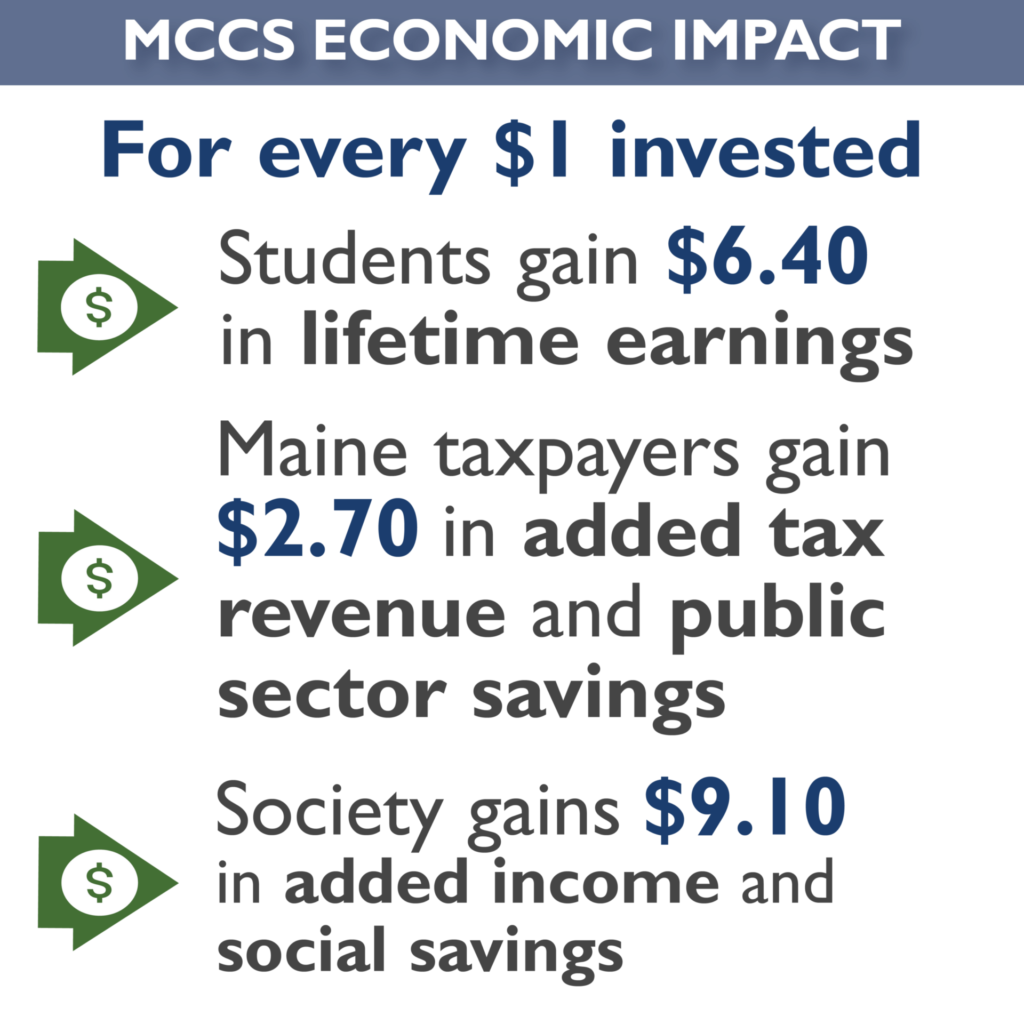
A separate report by Lightcast, a labor market analysis organization, found that the Maine Community College System adds $1 billion to the state’s economy annually. For every public dollar invested in the community colleges, $2.70 is returned back into the state over the course of a student’s working lives, the report said. That’s because those students have a higher earning potential, so they’re paying higher income taxes, in addition to filling in gaps in Maine’s aging workforce, Daigler said.
Changes to the program
The Maine Community College System worked with Mills to propose changes to make the program less expensive and more effective while also prioritizing Maine students. To qualify, high school graduates would now have to prove Maine residence, or have lived in the state for at least 12 consecutive months immediately prior to the date of admission. Previously, students had to be living in Maine while enrolled, which allowed people from out of state to move to Maine and qualify for the scholarship.
Qualifying students would also now have slightly less time — three years instead of four — to complete a two-year associate degree. And under the changes, the free college scholarship would also only cover 100% of tuition, rather than both tuition and fees. Full-time tuition is $2,880 per year, and fees are $1,276 per year.
Mills described the changes as “getting rid of bells and whistles.”
“It’s a growing program in terms of the number of people taking advantage of it, we like that,” she said. “We’re trying not to grow the budget accordingly, but to keep it at a level where it’s sustainable.”
Daigler explained that the changes — particularly the exclusion of fees — would not impact all students, since free college is a last-dollar scholarship, and many community college students are eligible for federal grants or private scholarships to cover their expenses.
“I think the more accessible it can be, the better,” said Zoe Lefluer Keif, a registered nurse who graduated under the pilot program from York County Community College. However, she noted that making the scholarship available for future generations of high school graduates is more important than keeping the pilot version she was able to access.
Maine is one of about 35 states that offer tuition-free community college. And since the fall of 2022, more than 20,000 Maine students have taken advantage of it. More than a third are the first members of their families to ever attend college. But unless lawmakers approve Gov. Janet Mills’ plan to make funding for community college permanent, supporters fear enrollment will decline at a time when Maine needs to train and hire more skilled workers.
Erika Hanks is a second-year student at Eastern Maine Community College studying graphic design. She works three jobs, including at the campus food pantry.
“It’s small, but it’s definitely mighty…it can make a world of difference for somebody who’s struggling,” Hanks said.
Last year, it was Hanks who was struggling.
“When I first came to college, I was, like, broke, like, $3 in my savings broke, and I remember there would be lunch and learns around the campus, and even if I didn’t go to them, they would invite me in to take leftovers,” Hanks said.
Hanks said balancing three jobs and schoolwork is tough, but she’s thrilled to have the chance to attend college.
“The second that I heard that I had the chance to go to college, I could envision myself as like a college girl, like a city girl, and the feeling was a lot like, I can’t even describe how excited I was in the moment,” Hanks said.
Neither of Hanks’ parents has a college degree, and while they encouraged her to pursue higher education, they couldn’t afford to pay for it. She couldn’t finance it on her own. So when she learned about the free community college scholarship, she said it was a game-changer.
“It felt like that my possibilities for jobs opened up because, like, I looked around living in Waldo County is a very rural area. A lot of people are born there. They work at your local, local grocery store until they die,” Hanks said.
Free community college immediately appealed to many students when it started four years ago, said Lillian Barry, a school counselor at RSU 24 in Sullivan.
“It was like, this is the smartest, most financially savvy step that you could make, like the barriers were eliminated,” Barry said.
But without additional funding, the current class of high school seniors will be ineligible for the free community college scholarship. And Barry said she can already see the shift in their thinking and planning.
“It’s less about, you know, their skills and their interests and their passion and more about back to that financial piece,” Barry said.
Martha Johnston with the Finance Authority of Maine helps families figure out how to pay for education. She said community college was always going to be affordable for most students, but the word “free” helped motivate them to take the leap and apply.
“Now that we don’t have that message anymore, we might see a reduction in the pipeline for those high-demand workforce programs, healthcare, and skilled trades that we need. So that if the affordability message starts to get watered down and people think they can’t afford it, you know, we might see a softening in that pipeline,” Johnston said.
Maine Community College System Officials say that since the start of the free tuition program, industrial trades, healthcare, and business programs have all increased enrollments by about 50%. And almost 2,000 free college students have gone on to pursue advanced degrees. And that’s one of the reasons why Maine Community College System President David Daigler is trying to keep the program intact by making changes that he said could save about $2.5 million a year.
“Based on what I’ve heard from the administration, based on what I’ve heard from the legislature, based on what I’ve heard from the public, if you talk to your legislators, I’m optimistic we will get this program back up and made permanent,” Daigler said.
Under the changes, the program would cover tuition but not fees, require students to live in Maine for at least one year before applying, and limit the time students have to finish their degrees. Because students are required to accept all federal and state aid before they can use Maine Free College Scholarship funds, only about half of the students who apply receive those funds. Republican lawmakers have expressed concern that the state is essentially subsidizing wealthier families. Republican Senator James Libby said it also undercuts other institutions that aren’t free.
“If they want to go to the University of Maine, that is probably right for them, and it might have the specific programs that a community college does not have,” Libby said.
Libby said instead of the free community college program, he is in favor of a program that would pay for first-year college students at any Maine higher education institution.
Free community college is widely supported, but some faculty in the community college system have raised concerns about the equity of the program and the strain the extra students put on the system. Tia Zukowski, faculty member at Central Maine Community College, said making the program permanent and providing more resources to the system to support the influx of students would be helpful.
“Our colleges have always been accessible to Maine students, but access is not the same as equity, and we really want to support the faculty and the staff who have been taking on extra work to support all of these students. We’ve really done a wonderful job, but we’re concerned about resources continuing to be stretched thin,” Zukowski said.
Daigler said he is sympathetic to those concerns.
“How can we continue to grow if we don’t have any additional resources. You know, we’re looking forward, and we’re saying, okay, students, there are more students, and those students need more resources,” Daigler said.
Daigler said he hopes to bring forward a new bill to the legislature for more student support in the future. His main focus now is ensuring the program is made permanent.
Back at Eastern Maine Community College, Erica Hanks also hopes the program is extended, not just because of her experience, but the change that she witnessed in her peers when the program was extended back in 2024.
“It was actually kind of inspiring to see the kids who didn’t even care if they turned in their homework or, like, what grade they got, because it didn’t matter anyway, to like asking questions, and like being awake during class, showing up to school. Like, you could really see a change in just the attendance and the attentiveness,” Hanks said.
If the final budget at the end of the session includes funding to make the free community college program permanent, this year’s class of graduating seniors would be eligible. But if the funding is eliminated, Maine would be the first state in the country to first offer students the option of free tuition and then take it away.
AUGUSTA, ME — Maine’s community colleges generate more tax revenue than they receive, returning $2.70 to Maine taxpayers over the course of students’ working lives for every dollar of public money invested in the colleges, according to a recent economic impact study.
For community college students, the payoff on their investment is even greater. For every dollar of the $35.1 million in tuition and $60.5 million they gave up in earnings while they attended a Maine community college, students received $6.40 in increased earnings over the course of their working lives – a whopping 20.2% return on their investment of time and money.
That’s according to a recent economic impact study by Lightcast, a global leader in labor market analytics. The report comes as state lawmakers are considering whether to make the Maine Free College Scholarship permanent – a $10 million a year state investment that would cover 100% of community college tuition for recent high school graduates in Maine.
“Our primary focus every day is on providing students with an excellent education, but our bottom-line fiscal impact on the state can’t be overlooked,” said Maine Community College System (MCCS) President David Daigler. “Our graduates may be the backbone of Maine’s skilled workforce, but the community college system itself is a major player in supporting and lifting up Maine families, employers, and communities. This analysis shows that the state’s investment in MCCS is plowed right back into the state’s economy in multiple ways.”
Lightcast’s report, which analyzed the fiscal year ending June 2025 (FY25), found that overall, the Maine Community College System adds $1 billion to Maine’s economy annually through the combined impact of operations and construction spending, and the spending impact of its students and alumni.
In the analysis year, MCCS provided $115.2 million in payroll and benefits to its 1,760 employees, 95% of whom lived in Maine, with most of the money spent in Maine on housing, groceries, meals out and entertainment, and other household expenses. In addition to direct payroll, MCCS injected another $65.8 million into the economy on expenses related to facilities, supplies, and vendors providing professional services. Construction spending was modest in the analysis year, at $3.3 million.
That’s the equivalent of having one out of every 78 jobs in Maine supported by the activities of Maine’s community colleges and its employees and students. That’s a bigger economic impact than the entire arts, entertainment, and recreation industry in the state, according to the analysis.
“Maine’s public higher education institutions exist to serve the people of Maine. This analysis clearly demonstrates that we are good stewards of the state’s investment, and Maine’s community colleges provide considerable and demonstrable economic benefit for the state’s economy, for Maine businesses, and for Maine families,” Daigler said. “Maine Free College is a modest investment for such a considerable payoff both to the students directly and the communities we serve.”
The Lightcast analysis also measures and quantifies the societal benefit of having MCCS in the state at $2.4 billion, which takes into consideration that additional education statistically correlates to lifestyle changes that result in avoided medical costs associated with smoking, obesity, substance abuse and depression; savings from avoided costs in the judicial system; and income assistance savings from reduced welfare and unemployment claims.
The seven-college system has an annual degree-seeking enrollment of 15,833 students, and serves more than 33,000 individuals annually through a combination of degree programs, customized short-term workforce training, and early college programs. Tuition and fees for a full-time in-state student are $4,156 a year, the lowest in New England.
###
Maine’s seven community colleges are the smart and affordable choice for lifelong learning in Maine, with the lowest tuition and fees in New England. The colleges serve more than 33,000 people a year, through two-year associate degree and one-year certificate programs, short-term workforce training, early college programs, advanced certificates, and other learning opportunities.
Lightcast is a global leader in labor market intelligence, empowering smarter decisions for businesses, education institutions, and governments worldwide. With the world’s most comprehensive database—spanning over 3 billion job postings, 600 million career profiles, and 100+ government sources—Lightcast delivers unparalleled insight into skills, jobs, companies, professional profiles, and workforce trends across 165 countries. Our proprietary taxonomies, advanced AI, and expert guidance transform complex data into clear, actionable intelligence.
AUGUSTA, ME — Maine’s community colleges received $19.4 million in federal funding for critically needed facilities and equipment in a range of programs, as part of the federal budget package signed by President Donald Trump.
“These investments championed by U.S. Senator Susan Collins will have lasting and widespread impact for the students at Maine’s community colleges,” said David Daigler, president of the Maine Community College System (MCCS). “Investments in equipment, program development, and key facilities benefit generations of students who are tomorrow’s skilled workforce in Maine.”
“We deeply appreciate Senator Collins’ persevering effort and the support of U. S. Senator Angus King to ensure Maine’s community colleges have the resources they need to give students a high-quality, affordable education directly tied to our state’s workforce demands,” Daigler said.
The federal funding will go toward the following projects:
York County Community College:
$6.5 million towards a new $15 million student housing project on campus. (Collins and King)
Eastern Maine Community College:
$6.5 million to build a new simulation lab and renovate an existing lab for nursing and health care programs. (Collins)
Southern Maine Community College:
$2.2 million to create a new heat pump training lab and renovate an existing facility to expand the plumbing program. (Collins)
Kennebec Valley Community College:
$1 million for equipment for the short-term workforce training mechanized logging program. (Collins)
$180,000 to purchase equipment for the college’s electrician training program. (Collins)
Central Maine Community College:
$1 million for equipment for a nursing simulation lab. (Collins)
Northern Maine Community College:
$1.3 million for equipment and program development to train industrial electrical and instrumentation technicians. (Collins and King)
$650,000 to purchase labor and delivery simulation equipment for the college’s nursing and health care programs. (Collins and King)
AUGUSTA, ME — Governor Mills has released details on her plan to make the Maine Free Community College Scholarship permanent, with three changes that are estimated to lower the cost of the scholarship program by $2.5 million, to $10 million per year.
The current scholarship and terms remain in place for the graduates of the high school classes of 2023-25, no matter what the legislature decides this session. The proposed changes are not retroactive and would only apply to the governor’s new proposal for the high school graduates in the Class of 2026 and beyond.
“We didn’t seek out these changes, but they are a reasonable and viable way forward to ensure that Maine high school graduates can continue to have this incredible opportunity, and that Maine can remain one of the 30-plus states with a free college program,” said David Daigler, president of the Maine Community College System. “It’s a matter of staying competitive, of supporting hard-working young people looking to get ahead, and investing in the development of our state’s skilled workforce.”
A public hearing on the funding is scheduled for 10:00 AM, Friday, Feb. 20, before the Joint Standing Committee on Appropriations and Financial Affairs.
The proposal for the Class of 2026 and beyond would require that:
Qualifying students must be from Maine, with a primary residence in Maine for at least 12 consecutive months immediately prior to the date of admission. (Previously, students had to be living in Maine while enrolled, which allowed people from out of state to move to Maine and qualify for the scholarship. About 4% of Maine Free College Scholarship students moved to Maine at time of enrollment.)
The scholarship will cover 100% of tuition costs, rather than both tuition and fees. (Full-time tuition is $2,880 per year, and fees are $1,276 per year). The program continues to require that students accept all federal and other state grant aid prior to accessing Maine Free College funds and many, but not all, students’ other financial aid will still cover their fees.
Qualifying students would have 150% of time, rather than the current 200% of time, to access the scholarship. (Previously, a student pursing an associate degree part time had up to four years of scholarship support. For the Class of 2026 and beyond, that student would only have up to three years of scholarship support.) (Source: https://www.maine.gov/budget/home. See QQQ language)
Other requirements from the initial Free Community College Scholarship are continued in the new proposal, including the “last-dollar scholarship” structure that requires students to accept all federal and state aid before Maine Free College Scholarship funds are applied; that students pursue an associate degree or certificate; and that students enroll no later than two years after high school completion.
“Between these proposed changes and the overwhelming support we’ve seen across the state, we’re hopeful this will pass in the legislature and be signed by Governor Mills in time to benefit this year’s graduating seniors,” Daigler said.
The legislature is scheduled to complete its work by April 15.
AUGUSTA, ME — Governor Mills has released details on her plan to make the Maine Free Community College Scholarship permanent, with three changes that are estimated to lower the cost of the scholarship program by $2.5 million, to $10 million per year.
The current scholarship and terms remain in place for the graduates of the high school classes of 2023-25, no matter what the legislature decides this session. The proposed changes are not retroactive and would only apply to the governor’s new proposal for the high school graduates in the Class of 2026 and beyond.
“We didn’t seek out these changes, but they are a reasonable and viable way forward to ensure that Maine high school graduates can continue to have this incredible opportunity, and that Maine can remain one of the 30-plus states with a free college program,” said David Daigler, president of the Maine Community College System. “It’s a matter of staying competitive, of supporting hard-working young people looking to get ahead, and investing in the development of our state’s skilled workforce.”
A public hearing on the funding is scheduled for 10:00 AM, Friday, Feb. 20, before the Joint Standing Committee on Appropriations and Financial Affairs.
The proposal for the Class of 2026 and beyond would require that:
Qualifying students must be from Maine, with a primary residence in Maine for at least 12 consecutive months immediately prior to the date of admission. (Previously, students had to be living in Maine while enrolled, which allowed people from out of state to move to Maine and qualify for the scholarship. About 4% of Maine Free College Scholarship students moved to Maine at time of enrollment.)
The scholarship will cover 100% of tuition costs, rather than both tuition and fees. (Full-time tuition is $2,880 per year, and fees are $1,276 per year). The program continues to require that students accept all federal and other state grant aid prior to accessing Maine Free College funds and many, but not all, students’ other financial aid will still cover their fees.
Qualifying students would have 150% of time, rather than the current 200% of time, to access the scholarship. (Previously, a student pursing an associate degree part time had up to four years of scholarship support. For the Class of 2026 and beyond, that student would only have up to three years of scholarship support.) (Source: https://www.maine.gov/budget/home. See QQQ language)
Other requirements from the initial Free Community College Scholarship are continued in the new proposal, including the “last-dollar scholarship” structure that requires students to accept all federal and state aid before Maine Free College Scholarship funds are applied; that students pursue an associate degree or certificate; and that students enroll no later than two years after high school completion.
“Between these proposed changes and the overwhelming support we’ve seen across the state, we’re hopeful this will pass in the legislature and be signed by Governor Mills in time to benefit this year’s graduating seniors,” Daigler said.
The legislature is scheduled to complete its work by April 15.
AUGUSTA, ME —Governor Janet Mills’ supplemental budget released Wednesday includes a plan to make the Maine Free College Scholarship permanent, starting with this year’s graduating seniors.
“It’s critical this scholarship remains available for the thousands of grateful students and families who benefit from continuing their education at a Maine community college,” said David Daigler, president of the Maine Community College System (MCCS). “We thank the governor for making this life-changing program a priority.”
The previously funded Maine Free College Scholarship, in place since 2022, was a last-dollar scholarship that paid 100% of tuition and fees for recent high school graduates headed to a community college in qualifying years. Currently, graduates (or equivalent) from the high school classes of 2023, 2024, and 2025 qualify for the scholarship. Qualifying students must pursue a degree or certificate and accept any state or federal aid before Maine Free College Scholarship funds are applied.
“This scholarship is wildly popular not just with students and families who save money on tuition, but with employers and industry leaders,” Daigler said. “They recognize that it’s attracting more hard-working people to get the education and technical skills they need for high-demand jobs. It’s a powerful tool that is growing Maine’s skilled workforce faster, with people carrying less or no college debt into their working lives.
Since fall 2022, when the scholarship began, 22,327 Free College Scholarship-eligible students have enrolled. After state and federal aid is applied, the average annual Maine Free College Scholarship amount is $1,600 per student.
AUGUSTA, ME — Maine’s community colleges received $19.4 million in federal funding for critically needed facilities and equipment in a range of programs, as part of the federal budget package signed by President Donald Trump.
“These investments championed by U.S. Senator Susan Collins will have lasting and widespread impact for the students at Maine’s community colleges,” said David Daigler, president of the Maine Community College System (MCCS). “Investments in equipment, program development, and key facilities benefit generations of students who are tomorrow’s skilled workforce in Maine.”
“We deeply appreciate Senator Collins’ persevering effort and the support of U. S. Senator Angus King to ensure Maine’s community colleges have the resources they need to give students a high-quality, affordable education directly tied to our state’s workforce demands,” Daigler said.
The federal funding will go toward the following projects:
York County Community College:
$6.5 million towards a new $15 million student housing project on campus. (Collins and King)
Eastern Maine Community College:
$6.5 million to build a new simulation lab and renovate an existing lab for nursing and health care programs. (Collins)
Southern Maine Community College:
$2.2 million to create a new heat pump training lab and renovate an existing facility to expand the plumbing program. (Collins)
Kennebec Valley Community College:
$1 million for equipment for the short-term workforce training mechanized logging program. (Collins)
$180,000 to purchase equipment for the college’s electrician training program. (Collins)
Central Maine Community College:
$1 million for equipment for a nursing simulation lab. (Collins)
Northern Maine Community College:
$1.3 million for equipment and program development to train industrial electrical and instrumentation technicians. (Collins and King)
$650,000 to purchase labor and delivery simulation equipment for the college’s nursing and health care programs. (Collins and King)
AUGUSTA, ME — Maine Community College System President David Daigler said he was “thrilled” that Governor Janet Mills is proposing ongoing support for the Maine Free College Scholarship.
“I’m thrilled Governor Mills is fighting to keep the Maine Free College Scholarship going for the Class of 2026 and beyond,” Daigler said after the governor’s State of the State address Tuesday night.
“The scholarship is an incredible investment in Maine’s economy because today’s community college students are tomorrow’s skilled workers that we all rely on for a productive and growing state economy. Maine’s young high school graduates deserve the opportunity to put in the work, study hard, and get a strong start without struggling to pay tuition as they get the technical skills they need for good-paying jobs right here in Maine or to transfer to a four-year college,” Daigler said. “We thank the governor for leading this effort to offer the scholarship to this year’s graduating high school seniors and beyond. It will make a huge difference and bring more skilled workers into Maine’s workforce faster.”
The scholarship allowed Tori Wile of Gray, who attended the Governor’s address, to pursue her dreams of learning a trade. “I didn’t want a sit-down job, and I knew the community colleges had all the trades,” said Wile, who earned an associate degree in building construction technology from Central Maine Community College (CMCC) last year and now works in the facilities department. “I don’t think I could have afforded college at all, or at least as easily.”
Wile, a lifelong Scout who earned the Bronze Star and is an Eagle Scout, is assistant scout master for a Lewiston troop and is currently pursuing a second CMCC degree in facilities management.
The Maine Free College Scholarship is a last-dollar scholarship that pays 100% of tuition and fees for recent high school graduates in qualifying years. Currently, graduates (or equivalent) from the high school classes of 2023, 2024, and 2025 qualify for the scholarship. Qualifying students must pursue a degree or certificate, fill out the FAFSA, and accept any state or federal aid before Maine Free College Scholarship funds are applied.
Since the scholarship began in fall 2022, 22,327 Free College Scholarship-eligible students have enrolled. Of those, more than a third are still enrolled, more than 3,600 have graduated, and almost 1,800 have transferred to a University of Maine System (UMS) university of another four-year college to continue their education.
A recent UMS transfer report said “MCCS transfers show the strongest outcomes: in Fall 2024 they passed 88.5% of attempted credits, the highest among transfer groups and higher than first-time students …. MCCS transfers also post the highest return rate (75.8%) than other transfer groups and first-time students.”
Full-time tuition and fees for a Maine resident at the community colleges is $4,156 a year, the lowest of any New England college. After FAFSA-related state and federal aid is applied, the average annual Maine Free College Scholarship amount is $1,600 per student.