AUGUSTA, ME — The Board of Trustees of the Maine Community College System (MCCS) has confirmed the recommendation of MCCS President David Daigler and appointed Dr. Julius Edwards, a vice president at Ivy Tech Community College in Indianapolis, as the next president of Eastern Maine Community College in Bangor. He will begin April 1.
Edwards has served in a series of leadership roles at Ivy Tech over the last 15 years, including vice chancellor of academic affairs, dean of the Ivy Tech School of Business & Supply Chain Management, director of the transfer center, and assistant director of the financial aid office. Ivy Tech is one of the nation’s largest community colleges, serving more than 168,000 students a year and has 19 campuses.
“Dr. Edwards has outstanding experience leading initiatives that are directly tied to our priorities at Maine’s community colleges,” Daigler said, noting Edwards’ work in aligning academic programs with industry trends, developing short-term workforce training in high-demand industries, and finding innovative ways to improve student experience and outcomes.
Edwards also managed diverse academic programs that included agriculture, advanced automation and robotics, supply chain management, culinary, and commercial driving. He also worked as an adjunct professor teaching business courses.
“I have spent my career working in a multi-campus community college, keeping access, student success, and workforce relevance at the center of every decision. Along the way, I have worked to strengthen academic quality, build meaningful employer and transfer partnerships, and secure resources that expand students’ opportunities,” Edwards said. “Those experiences have shaped how I approach leadership and will guide my work alongside the Eastern Maine Community College community as we support students, employers, and the region together.”
“We warmly welcome Julius Edwards to our community and look forward to working with him,” MCCS Board Chairman Peter DelGreco said. “His deep and broad experience with community colleges, commitment to the student experience, and focus on innovation is just what the board was looking for in a leader.”
Edwards has a doctorate in higher education leadership from Indiana State University, a master’s in business administration from Indiana Wesleyan University, and a bachelor’s degree in accounting and finance from Indiana University and Pursue University at Indianapolis.
Edwards succeeds Elizabeth Russell, who passed away last fall shortly after retiring. MCCS Chief Academic Affairs Officer Janet Sortor has served as interim president.
Eastern Maine Community College, located in Bangor with an off-campus center in East Millinocket, enrolls more than 2,700 students. It is one of seven colleges in the Maine Community College System.
AUGUSTA, ME — In 2025, Maine’s community colleges continued their mission of providing an affordable, relevant, high-quality education – delivered by outstanding instructors and with the support and community that students need to thrive. Among the year’s highlights were new student housing and athletics options, expanded academic programming in key economic sectors, new leadership, spectacular athletic and academic achievements, and record high enrollments for both degree-seeking students and Early College students who are still in high school.
The year’s highlights include:
RECORD OVERALL ENROLLMENT: A third straight year of record fall enrollment, with 15,833 students enrolled in fall 2025. Key factors include the colleges’ robust high-quality programming, high demand for skilled workers, new guaranteed transfer agreements with the University of Maine System and six private colleges in Maine, and the Maine Free College Scholarship.
RECORD HEALTH CARE ENROLLMENT: Responsive to Maine’s ongoing shortage of health care workers, Maine’s community colleges continued to focus on expanding nursing and health care training programs, enrolling a record high 3,570 health care students in Fall 2025 (up from about 2,000 students pre-pandemic) in more than 60 health care-related degree and certificate programs across the state. In addition, the colleges offered scores of health care-related short-term workforce training programs that take less than a year to complete and offer both immediate job skills and prepare graduates to pursue certificates and degrees.
CONSTRUCTION TRADES TAKE CENTER STAGE: As the state of Maine takes multiple steps to alleviate Maine’s housing crunch, the need for skilled construction workers of all stripes has never been greater. Maine’s community colleges focused on meeting that need in 2025, developing new industry based collaborations through the system’s Harold Alfond Center for the Advancement of Maine’s Workforce and with expanded degree, certificate, and short-term training opportunities.
INNOVATION RECOGNIZED: Three of Maine’s community colleges (Kennebec Valley Community College (KVCC), Southern Maine Community College (SMCC), and York County Community College YCCC) were recognized for high quality non-credit offerings, a noteworthy development as colleges nationwide adopt new non-credit short-term workforce training programs alongside accredited degree and certificate programs. The colleges are in the first cohort recognized by the New England Commission of Higher Education (NECHE).
STRATEGIC PLAN UNVEILED: In March, the system Strategic Plan was released, outlining the short- and long-term goals and strategies for serving our students, supporting our employees, and building lasting partnerships with business and industry groups.
GROUNDBREAKING PRISON EDUCATION: Washington County Community College (WCCC) received funding to expand the college’s innovative prison education program, allowing the college to launch an innovative suite of online, stackable certification courses in computer technology. WCCC, which has offered a range of classes at multiple corrections facilities in Maine since 2018, was one of five New England colleges to receive the funding.
LEADERSHIP: Among the leadership changes in 2025 was the hire of Doug Binsfeld as president of Northern Maine Community College (NMCC), and Betsy Libby, formerly the president of CMCC, as the new MCCS vice president and chief academic affairs and enrollment management officer. MCCS also welcomed construction executive Stacey Harris and KVCC nursing student Jasmine Sanders as new trustees for the system’s Board of Trustees. Sadly, MCCS mourned the passing of Eastern Maine Community College (EMCC) President Liz Russell and honored her with the naming of the campus Learning Commons. MCCS President David Daigler joined the College Presidents for Civic Preparedness, working with higher education leaders in Maine and across the country and the Institute for Citizens & Scholars to promote students becoming engaged citizens.
EMPLOYEE HONORS: SMCC Don Sheets was named the 2025 recipient of the Maine EMS Governor’s Award, the highest individual honor in the state’s emergency medical services system. NMCC faculty member Patrick Wiley was recognized by the U.S. Environmental Protection Agency’s New England office as the 2024 EPA Regional Wastewater Trainer of the Year.
NEW FACILITIES, ASSOCIATIONS: Among the new and updated facilities around the system in 2025: KVCC added a new student housing option, which means all seven colleges now offer housing options. KVCC also opened a new early childhood education classroom on the Fairfield campus, providing full-day care for children ages six weeks to three years, with priority for students and employees. SMCC opened a new Advanced Manufacturing lab at the Brunswick campus. YCCC added a new student shower facility. CMCC opened a new Construction Electricity Lab. NMCC finalized preparations of its new child care center.
2025 Sports highlights include:
SMCC’s golf program won two national championships when the men’s team won the USCAA National Championship team title, and first-year standout Grace Thompson won Individual National Champion honors in the women’s field.
Augusta, Maine – The Maine Community College System (MCCS) and The Associated General Contractors of Maine (AGC Maine) are partnering to launch a four-week, hands-on construction training program across the state to prepare Maine adults for meaningful careers in the construction trades.
The Maine Construction Academy Immersion Programs, managed by AGC Maine and funded by MCCS’s Harold Alfond Center for the Advancement of Maine’s Workforce, will launch next year at five community colleges. A certified pre-apprenticeship program, students receive hands-on training, industry-recognized credentials, and direct connections to employers. Graduates will be qualified to enter high-value registered apprenticeships or pursue certificate or degree programs to advance along career pathways within Maine’s growing construction industry.
The Maine Construction Academy Immersion Programs will launch at:
Central Maine Community College (CMCC) in Auburn, on March 3, 2026
Northern Maine Community College (NMCC) in Presque Isle, on March 16, 2026
Kennebec Valley Community College (KVCC) in Fairfield, on May 11, 2026
Eastern Maine Community College (EMCC) in Bangor, on May 13, 2026
Washington County Community College (WCCC) in Calais, on May 18, 2026
Funding from the Alfond Center comes from private philanthropic support and Maine Jobs and Recovery Plan funding. The program will be offered at no cost to trainees.
“We are proud to partner with AGC Maine to offer such a streamlined, low-barrier program that not only fast-tracks the number of skilled workers into Maine’s construction industry, it creates a way for graduates to move seamlessly into apprenticeships or ongoing training to launch their construction careers. Partnerships like this between employers and the Harold Alfond Center for the Advancement of Maine’s Workforce are critical to scaling opportunities and strengthening Maine’s talent pipeline,” said MCCS Chief Workforce Development Officer Dan Belyea.
This strategic partnership is a result of a statewide Construction Industry Workforce Partnership launched in March 2025 by the Alfond Center that includes over 50 stakeholders from the construction industry, trade associations, union, education, and workforce development systems. The group collaborates to develop workforce training strategies to effectively and efficiently strengthen the skilled construction and trades workforce. The launch of the Maine Construction Academy Immersion Program across five community colleges is just one of the strategies developed to address workforce shortages in Maine’s construction industry. Other programs under development include new short-term training programs in carpentry, heavy equipment operation, and HVAC skills. For more information on construction and trades programs at the community colleges, visit this page: Construction Career Training in Maine
“This partnership represents an exciting step forward for Maine’s construction industry and workforce development efforts,” said Kelly Flagg, Executive Director of AGC Maine. “The Maine Construction Academy Immersion Program gives participants a real-world introduction to the trades while connecting them directly to employers ready to hire. Together with the Maine Community College System and The Harold Alfond Center for the Advancement of Maine’s Workforce, we’re opening doors to rewarding, high-demand careers and helping to build the skilled workforce our state needs.”
Joan Dolan, director of apprenticeship & strategic partnerships at the Maine Department of Labor, shared her support for the initiative:
“The Maine Department of Labor is proud to support the Maine Construction Academy as a certified pre-apprenticeship program that opens doors to meaningful careers in the skilled trades. Through this partnership with the Associated General Contractors of Maine, the Harold Alfond Center for the Advancement of Maine’s Workforce, and the Maine Community College System, we are building stronger pathways into registered apprenticeship—and a stronger future for Maine’s workforce.”
The Maine Construction Academy Immersion Program reflects a shared commitment among AGC Maine, MCCS, and the Alfond Center to strengthen Maine’s workforce pipeline, expand access to quality training, and support the next generation of construction professionals.
If you are interested in applying for the program, click here.
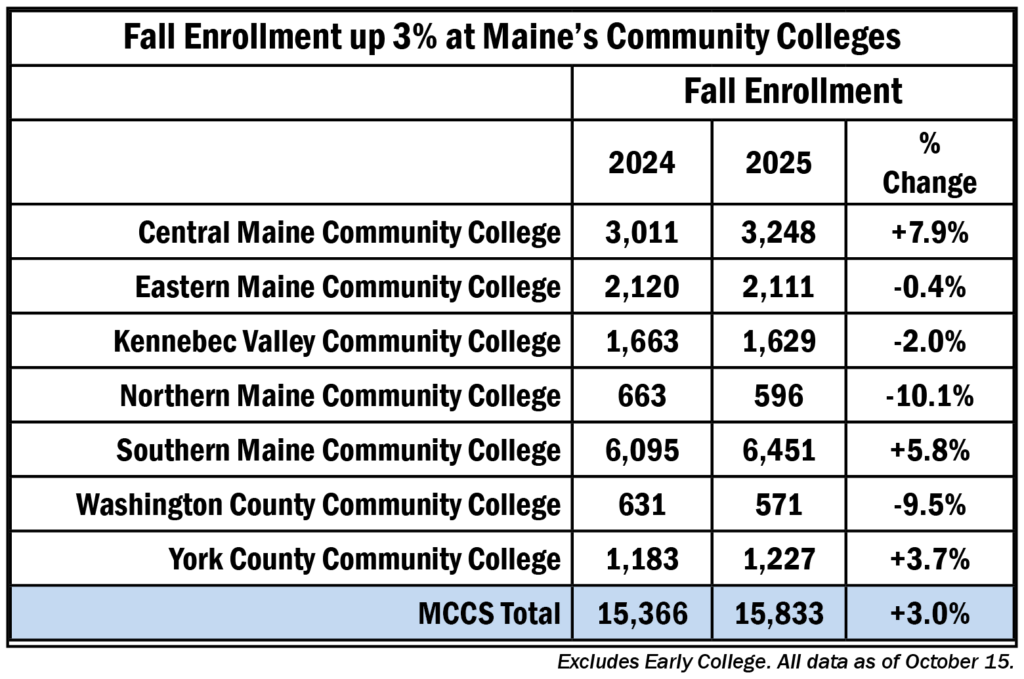
AUGUSTA, ME — Fall enrollment is up 3% at Maine’s community colleges, marking another historic high enrollment for the seven colleges.
“This sustained enrollment growth is critical at a time when Maine’s economy needs more skilled employees in a range of industries that we specifically target for high-quality, low-cost instruction – from construction to computer science. This ongoing demand is a sign that we are executing on our mission of providing an education that works for Mainers looking to find meaningful work and a better life,” said David Daigler, president of the Maine Community College System (MCCS).
Significant initiatives at Maine’s community colleges in recent years have played a large role in continuing the system’s role as the state’s premiere workforce training partner.
Recent changes include new transfer agreements with the University of Maine System and six independent Maine colleges aimed at making the four-year college pathway more affordable and seamless; Free Community College scholarships that cover 100% of tuition for the high school graduating classes of 2020-2025; expanded instruction hours and new remote learning options; new certificate and degree programs to meet market demands; and academic initiatives that increase student success and improve the student experience. At the same time, the colleges serve as vibrant community centers with new housing options, new sports teams, and additional student events and activities.
As of October 15, fall enrollment was 15,833 students, up 3% from 15,366 students on the same date last year. Tuition and fees for a full-time in-state student are $4,156 a year, the lowest in New England.
Starting this year, MCCS has changed the way it reports fall enrollment to exclude Early College students, who are high school students taking community college courses at their high school or at a college campus. The new reporting method aligns MCCS with the University of Maine System, which began excluding Early College students from its enrollment reports several years ago. The change also ensures transparency in the makeup of Maine’s community college student body.
Using the new model, fall enrollment at Maine’s community colleges has increased 20% since fall 2019 (the last pre-COVID fall class) and increased 13% since 2017.
Although official fall enrollment figures only capture degree-seeking students, MCCS has also significantly expanded short-term workforce training programs that take less than a year to complete and are generally free for students. These short-term programs are coordinated by the system’s Harold Alfond Center for the Advancement of Maine’s Workforce. Since 2022, 45,000 people have enrolled in those programs, which focus on quickly and efficiently acquiring a particular skill – such as basic construction skills in 10 weeks, a three-week welding course with a weekly $500 stipend, or a compact nine-month option for a medical assisting program.
MCCS is on track to train more than 100,000 students in short-term workforce training programs by 2030, the result of a historic five-year grant from the Harold Alfond Foundation. Graduates of the short-term program are eligible for scholarships toward a degree or certificate program.
AUGUSTA, ME — An innovative partnership bringing together more than 50 leaders from Maine’s construction industry, education and workforce organizations, and the Maine Community College System (MCCS) is expanding the state’s short-term construction training opportunities and increasing the number of skilled workers available to fill critical labor shortage gaps across the state.
“Now’s the time for an all hands-on-deck approach. Demand for housing and construction projects is through the roof. Projects are hampered by worker shortages, and the existing workforce is aging. We need to come together for solutions that work,” said Dan Belyea, MCCS chief workforce development officer and director of MCCS’ Harold Alfond Center for the Advancement of Maine’s Workforce.
The Center, which coordinates all short-term workforce training programs for MCCS, is prioritizing sector-based partnerships as part of a bold five-year plan to train more than 70,000 Maine workers between 2025 – 2030. Since 2022, the Center has already trained 45,000 students.
The Construction Industry Workforce Partnership is the first of several sector partnerships launched by the Center that design and deliver targeted training pipelines in Maine’s highest-demand fields. Healthcare and manufacturing sector partnerships are next, each with steering committees and action teams that co-create short-term, skills-focused training aligned to real hiring needs.
“We’re listening to industry and co-designing workforce training solutions,” said Liz Love, director of sector partnerships for the Center. “The construction partnership’s initial focus is on training carpenters, HVAC technicians, and heavy equipment operators.”
The partnership brings together stakeholders including residential, commercial, industrial, and specialty trade construction companies; trade associations; union representatives; Maine’s seven community colleges; and statewide education and workforce partners. A full list of partners is here.
“We need the voices of those with their boots on the ground, which is why this partnership is industry-led,” said partnership member Stacey Harris, a general superintendent at Consigli Construction Co., Inc.’s Portland office and a member of the MCCS Board of Trustees.
Construction is one of Maine’s largest industries and employs more than 48,000 people.
“I believe Maine’s future depends on the strength of its people. Through this collaboration, we can shape training programs that prepare Mainers for rewarding careers and give our industry the skilled workforce it needs to thrive,” Harris said.
Short-term workforce training programs take just weeks or months to complete and are offered in addition to the Maine community colleges’ robust trade and construction degree and certificate programs, which take one- to two-years to complete. Short-term training programs, usually offered at no cost to students and some with stipends or housing available, are ideal for people training for entry-level positions or for incumbent workers adding to their skills.
The construction sector partnership has already led to programing changes. Southern Maine Community College is offering a new flexible “a la carte” enrollment model for its short-term construction and carpentry training this fall. Courses address targeted foundation skills such as blueprint reading and tool safety, as well as advanced skills like millwork and advanced roofing. Students can enroll in a single course or complete SMCC’s full Construction Institute or Advanced Construction Institute. In early 2026, multiple Maine community colleges will expand short-term training for construction laborers, carpenters, heavy equipment operators, and HVAC technicians.
The new construction sector partnership is “vital for tackling the increased demand for skilled workers in our industry,” said Heather Raisanen, executive officer of the Home Builders and Remodelers Association of Maine. “It has been a tremendous opportunity to collaborate with experts from various sectors to ensure we are getting precisely what we need. Investing in workforce development and training is not only essential for our member companies but also for ensuring a strong and sustainable future for the entire construction sector in Maine,” Raisanen said.
Sanders works full time, is a single parent, and maintains top academic honors while remaining deeply involved in campus and community programs. She is board president of KVCC Rotaract, an extension of Waterville Rotary that develops a network of college-affiliated students and professionals. She is vice president of honor society Phi Theta Kappa, and is a member of the KVCC Student Senate, Future Nurses of America, and the KVCC Multicultural Club. She is also a student advocate for TRIO, a student services program.
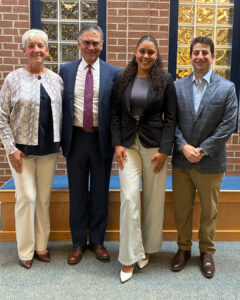
Photo: (l to r) KVCC President Karen Normandin, MCCS President David Daigler, MCCS Student Trustee Jasmine Sanders, MCCS BOT Chair Peter DelGreco.
“Advocacy and service are integral to who I am, and I feel deeply honored to have the opportunity to make an impact on a broader level,” Sanders said. “I bring the perspective of a working mother who has faced many obstacles throughout her educational journey and has discovered what works to support student success.”
Sanders said support from people at KVCC, TRIO, and other organizations play a “huge role” in her success.
“It warms my heart to know that I am showing my children, other young people, and fellow college students that what we feel and need during our educational journey matters. I hope to empower and encourage other students to use their voices to create inclusivity and change, because all our perspectives are important,” she said.Sanders is also an accomplished dancer and singer who continues to participate regularly at dance performances. In 2014, as a senior at Cony High School in Augusta, she sang at Carnegie Hall in New York City as a member of an honors choir.
“Jasmine’s talents and experiences make her an outstanding addition to the board. Her perspective as a parent, student, and actively involved community member will be extremely valuable,” said MCCS President David Daigler. “I’m looking forward to having her on the board.”
Sanders was nominated by Governor Janet Mills and confirmed by the Maine Senate. She serves a two-year term. Her first board meeting was Wednesday, at the board meeting held at Northern Maine Community College in Presque Isle.
The Maine Community College System’s Board of Trustees is the policy making authority for the system and consists of 13 appointed voting members, one ex-officio voting member, and one ex-officio non-voting member.
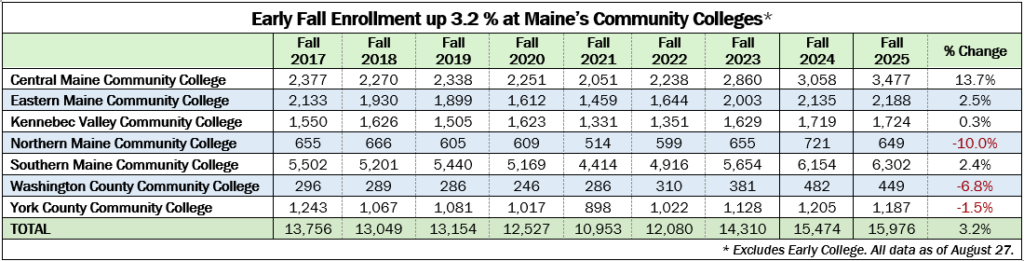
AUGUSTA, ME — Early fall enrollment is up 3.2% at Maine’s community colleges for a third straight year of record-breaking enrollment at the seven colleges.
“We’re proud to be reporting another year of record enrollment. Maine’s community colleges are great places to get an excellent education at an unbeatable price. It’s no surprise more people are taking advantage of this incredible opportunity,” said David Daigler, president of the Maine Community College System. (MCCS) “Students leave here prepared for good-paying jobs in high-demand fields right here in Maine, or ready to transfer to a four-year college.”
Maine’s community colleges have undergone a transformative shift in the last five years, vastly expanding short-term workforce training of less than a year; adding new certificates and degree programs to respond to market demands, streamlining academic planning, and adding remote learning options to serve students who can’t attend on campus. Outside the classroom, campus life is more robust, with new sports teams, expanded student housing options, and enhanced student life activities.
At the same time, and with the strong support of Governor Janet Mills and Maine’s legislature, the colleges have been able to offer tuition-free college for recent high-school graduates through the Free College Scholarship. MCCS also has new guaranteed transfer agreements with the University of Maine System and six independent colleges in the state. Enrollment is also strengthened by the steady retention rate of students who started in recent years.
“We are very connected to our students, and we want to make it as easy as possible for someone to come here to build their future, learn what they need to get a new or better job, gain confidence in their skills, and make meaningful connections with the people around them,” Daigler said. “That’s what success looks like.”
As of Wednesday, 15,976 students had enrolled this fall, up 3.25% from 15,474 students on the same day last year. Tuition and fees for a full-time in-state student are $4,156 a year, the lowest in New England.
Starting this year, MCCS has changed the way it reports fall enrollment to exclude Early College students, who are high school students taking community college courses at their high school or at a college campus. Updating the reporting method aligns MCCS with the University of Maine System, which began excluding Early College students from its enrollment reports several years ago. The change also ensures transparency in the makeup of Maine’s community college student body.
Using the new model, early fall enrollment at Maine’s community colleges has increased 21% since fall 2019 (the last pre-COVID fall class) and increased 16% since 2017.
Early fall enrollment figures do not include short-term workforce training students at Maine’s community colleges. More than 39,000 students have taken short-term workforce training classes through MCCS since January 2022, when the system received the first in a series of significant grants from the Harold Alfond Foundation earmarked for no- or low-cost short-term training that takes just weeks or months to complete.
Official fall enrollment figures are calculated on October 15.
AUGUSTA, ME — Over the next year, 6,700 Mainers will attend free short-term workforce training programs at Maine’s community colleges, thanks to $8.3 million distributed by The Harold Alfond Center for the Advancement of Maine’s Workforce.
The Alfond Center, a unit of the Maine Community College System (MCCS) that manages short-term workforce programming, provided the funding for campus-delivered classes as part of its five-year $75 million grant from the Harold Alfond Foundation.
“This is the largest investment in on-campus short-term workforce programming in the system’s history,” MCCS Chief Workforce Development Officer Dan Belyea said. “This is workforce training at the scale and speed Maine needs.”
The 220 programs being offered over the next year will result in industry-recognized certifications and skill development, for both new and incumbent workers, in such fields as construction, healthcare, IT, manufacturing, electrical, plumbing, welding, hospitality, and more. Students can earn Google Career Certificates, and be trained to be medical or dental assistants, truck drivers, welders, early childhood education workers, fiber optic technicians, and more. The programs typically run from three to eight weeks, with some extending up to a year. Some programs include temporary housing, weekly stipends, and guaranteed interviews with industry hiring managers.
“I was tired of entry-level jobs and ready to build a more secure future,” said Wilmarys Martinez, who is currently enrolled in a fiber optics training program at Central Maine Community College. “This program gave me hands-on experience, real skills, and the confidence that I can turn this into a career. I see myself making a whole life out of what I’m learning.
“We’re opening doors for thousands of Mainers to earn the skills and credentials that lead directly to employment — without the financial barrier of tuition,” Belyea said. People completing the short-term programs also earn scholarships towards one-year and two-year programs at the colleges.
Short-term workforce programs offered through the Alfond Center both on- and off-campus have vastly expanded since 2018, when the Harold Alfond Foundation began a series of significant grants – now totaling almost $100 million – to MCCS earmarked for short-term workforce training. Alfond Center projects are also funded by the Maine Jobs and Recovery Plan, Maine Quality Centers, Put ME to Work, and private foundations. By 2030, the Alfond Center will have provided low- or no-cost training to almost 100,000 Mainers – out of a statewide labor force currently at about 700,000.
In the past three years, the Alfond Center has already provided training to 31,000 Mainers. Programs are developed in close partnership with employers, industry associations, and state partners to create training aligned with real-time hiring needs – moving job seekers into meaningful careers and helping Maine businesses find skilled, qualified workers.
In addition to short-term workforce training programs, Maine’s community colleges enroll more than 20,000 people a year in degree-seeking programs, which include one-year certificates and two-year associate degree programs. About 5,000 high school students enroll through the colleges’ Early College programs.
AUGUSTA, ME — Maine’s Free College Scholarship ends with the Class of 2025 graduates after state lawmakers declined to fund future graduating classes in the budget signed by the governor on Monday.
The Free College Scholarship, which started in fall 2022, is a last-dollar scholarship that covers 100% of tuition and mandatory fees at Maine’s community colleges for recent high school graduates. The state previously approved the Classes of 2023-25 for the scholarship, which will continue to be available to those students. Qualifying high school graduates have up to two years post-graduation to enroll, and up to four years to complete an associate degree, so Free College Scholarship students will continue to be enrolled at the colleges for several more years.
It would take a separate act of the legislature to continue the scholarship beyond the Class of 2025.
“It’s dispiriting to have such a successful program benefiting so many people – students, their families, Maine employers – come to an end,” said David Daigler, president of the Maine Community College System (MCCS). “We’ll continue our mission to provide affordable, relevant education and training that prepares people for good jobs in Maine – but it will be harder to reach all the deserving, motivated, and hard-working students who came to the colleges because of the Free College Scholarship.”
“I want each one of the potential students who are disappointed they won’t get the scholarship to know that Maine’s community colleges are still very, very affordable, and we’ll help them any way we can to make ends meet,” Daigler said. Tuition and fees are $4,156 a year for a full-time student and more than 50% of MCCS students qualify for federal Pell grants that often cover those costs.
The state budget signed Monday includes one-time funding of $20 million for MCCS to pay for the Free College Scholarship for current students and the Class of 2025; a 4% increase to base funding; and one-time funding to cover new paid family medical leave (PFML) costs.
Since fall 2022, 17,826 Free College-eligible students have enrolled at Maine’s community colleges. In fall 2024, there were 8,989 Free College-eligible students enrolled, out of a total enrollment of 21,385 students. Enrollment has increased 23% since the pre-pandemic fall 2019 enrollment of 17,327.
More information on the Free College Scholarship is available here.
(l to r) Zoe LaFleur-Kief (YCCC), Jordyn Balicki (EMCC), Kolaiah Spooner (WCCC), Victoria Wile (CMCC), Karen Winfree (KVCC), Islakeno Mahabir (NMCC), and Katelyn McKay (SMCC)
AUGUSTA , ME — Seven Maine community college students were honored Wednesday for their academic success and campus and community involvement at a luncheon ceremony at Maple Hill Farm in Hallowell. The event was hosted by the Maine Community College System (MCCS) Board of Trustees.
The 2025 MCCS Student of the Year are:
Victoria Wile, Gray, Central Maine Community College
Jordyn Balicki, Jonesport, Eastern Maine Community College
Karen Winfree, Fairfield, Kennebec Valley Community College
Islakeno Mahabir, Trinidad and Tobago, Northern Maine Community College
Katelyn McKay, Gorham, Southern Maine Community College
Kolaiah Spooner, Andersonville, New Brunswick, Canada, Washington County Community College
Zoe LaFleur-Kief, York, York County Community College
The seven students being honored were selected by faculty and staff at the colleges.
In addition to being recognized as Students of the Year, they each received a John and Jana Lapoint Leadership Award in the amount of $1,000.
Mr. Lapoint was president of UF Strainrite in Lewiston and a trustee of the Maine Community College System. After his death in 1995, his widow, Jana Lapoint, served on the Board from 1995 to 2006 and helped establish the fund for the annual awards.